
양천구 목동 기능성 소화불량 한의원
기능성 소화불량
내시경도, 혈액검사도 정상이라는데 밥만 먹으면 명치가 꽉 막힙니다. "신경성이니 마음 편히 가지세요"라는 말을 듣고 돌아오는 길이 더 답답합니다. 검사에 나오지 않을 뿐, 기능성 소화불량은 분명히 있는 병입니다.
기능성 소화불량 한눈에 보기
- 기능성 소화불량은 내시경에서 원인이 없는데도 식후 더부룩함, 조기 포만감, 명치 통증이나 쓰림이 이어지는 질환입니다.
- 식사 때문에 힘든 식후불편증후군이 약 60%로 가장 많고, 명치 통증이 주가 되는 명치통증증후군과 둘이 겹친 경우가 있습니다.
- 유형에 따라 치료의 초점이 달라, 위의 움직임과 감각, 자율신경의 상태를 함께 살펴야 합니다.
- 치료후기 54건
- 의료진 칼럼 1편
- 건강정보 7편
이런 증상이 있나요?

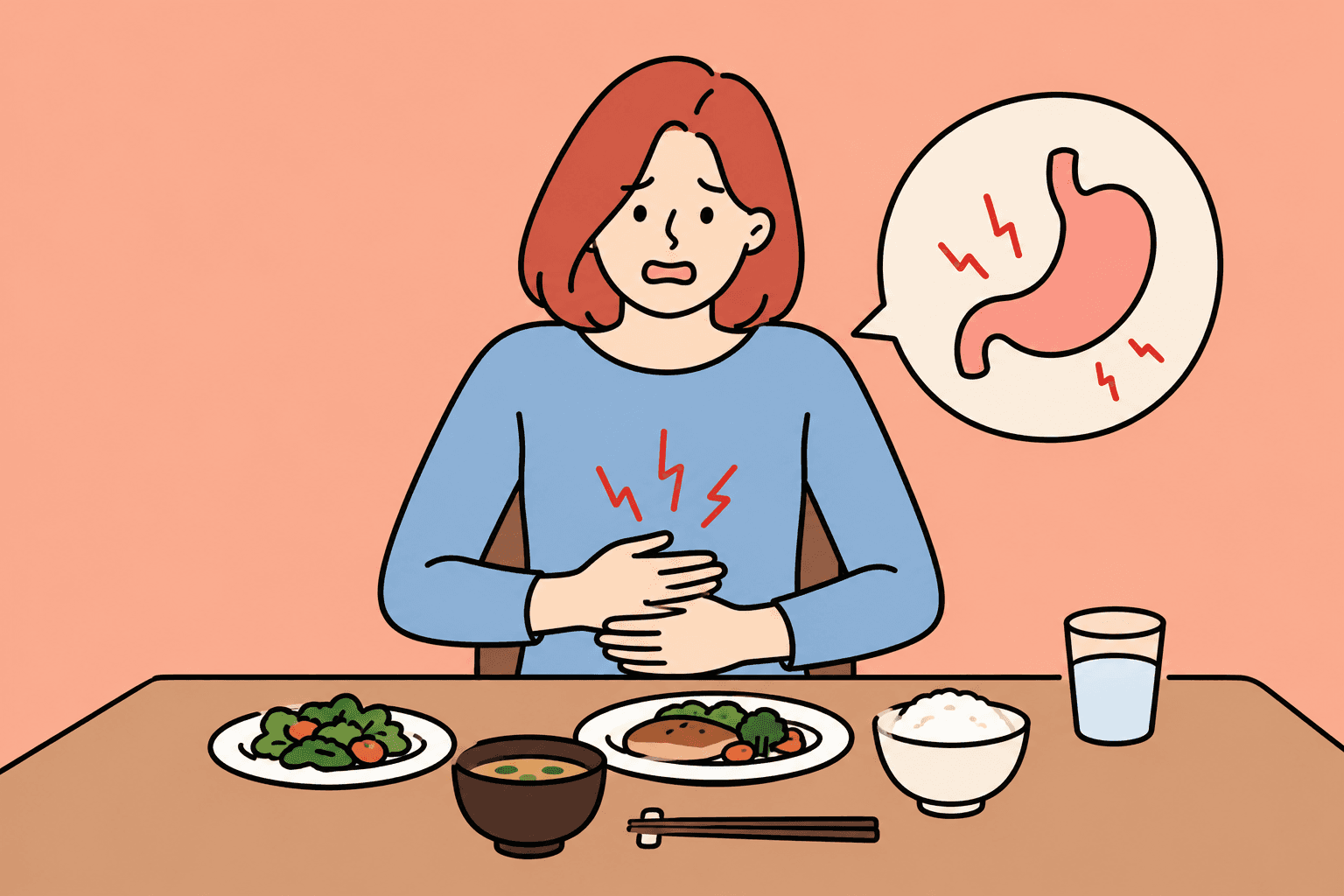
증상이 석 달 넘게 이어지고, 위 내시경에서 원인이 없을 때 진단합니다. 세계적인 진단 기준인 로마 기준은 두 유형으로 나눕니다. 어떤 유형인지 먼저 확인해 보세요.
- 식사 뒤 음식이 그대로 얹혀 있는 느낌이다
- 평소 양의 절반만 먹어도 배가 찬다
- 명치가 아프거나 타는 듯 쓰리다
- 내시경은 정상인데 증상이 석 달 넘었다
- 위장약을 먹을 때만 조금 나아진다
- 배변 문제나 속쓰림도 함께 있다
기능성 소화불량은 왜 생기나요?
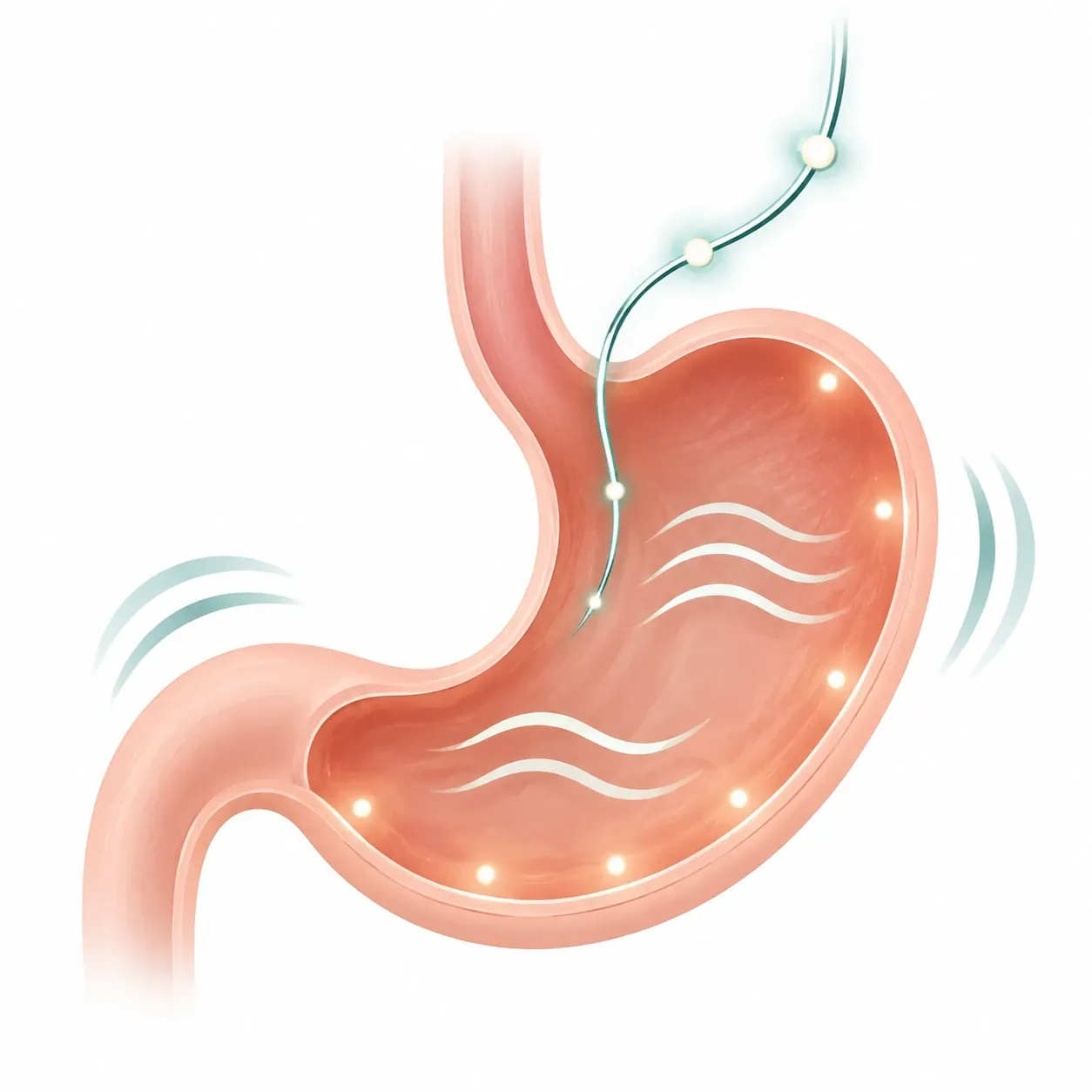
검사가 정상인 이유는 내시경이 위의 "모양"만 보기 때문입니다. 이 병은 움직임과 감각의 문제라 사진에 잘 나오지 않습니다.
- 음식이 들어와도 위가 잘 늘어나지 않는 경우
- 위가 음식을 늦게 내려보내는 경우
- 위가 작은 자극에도 예민하게 느끼는 경우
- 장염을 앓은 뒤 시작된 경우
- 스트레스와 불안, 수면 부족
유형마다 함께 오는 문제도 다릅니다. 두 유형이 겹친 분은 삶의 질이 더 낮고, 기능성 속쓰림과 과민성대장증후군을 함께 겪는 경우가 많았습니다[1]. 그래서 위 하나만 보지 않고 뇌와 위를 잇는 자율신경까지 살펴야 합니다.
기능성 소화불량의 표준 치료
표준 치료는 유형에 맞춰 약을 고르는 것입니다. 식후불편증후군에는 위장운동촉진제를, 명치통증증후군에는 위산억제제를 주로 쓰고, 헬리코박터균이 있으면 제균 치료를 합니다. 효과가 부족하면 저용량 항우울제를 더하기도 합니다.
약을 끊으면 다시 불편해지는 분이 많습니다. 위의 기능과 자율신경의 균형이 그대로이기 때문입니다. 한의학 치료는 이 바탕을 다스립니다.
연구도 쌓여 있습니다. 식후불편증후군에서 침 치료의 4주 반응률은 83.0%로 가짜 침(51.6%)보다 높았습니다[3]. 육군자탕은 위약보다 식후 포만감과 복부 팽만을 줄였고[4], 한약은 위장운동촉진제보다 4주 뒤 전체 증상의 호전 비율이 14% 포인트 높았습니다[5].
해움한의원은 이렇게 치료합니다

해움한의원은 "검사가 정상"이라는 말에서 멈추지 않고, 어떤 유형인지와 무엇이 위를 흔드는지를 함께 찾습니다.
1단계. 유형과 위험 신호를 가립니다
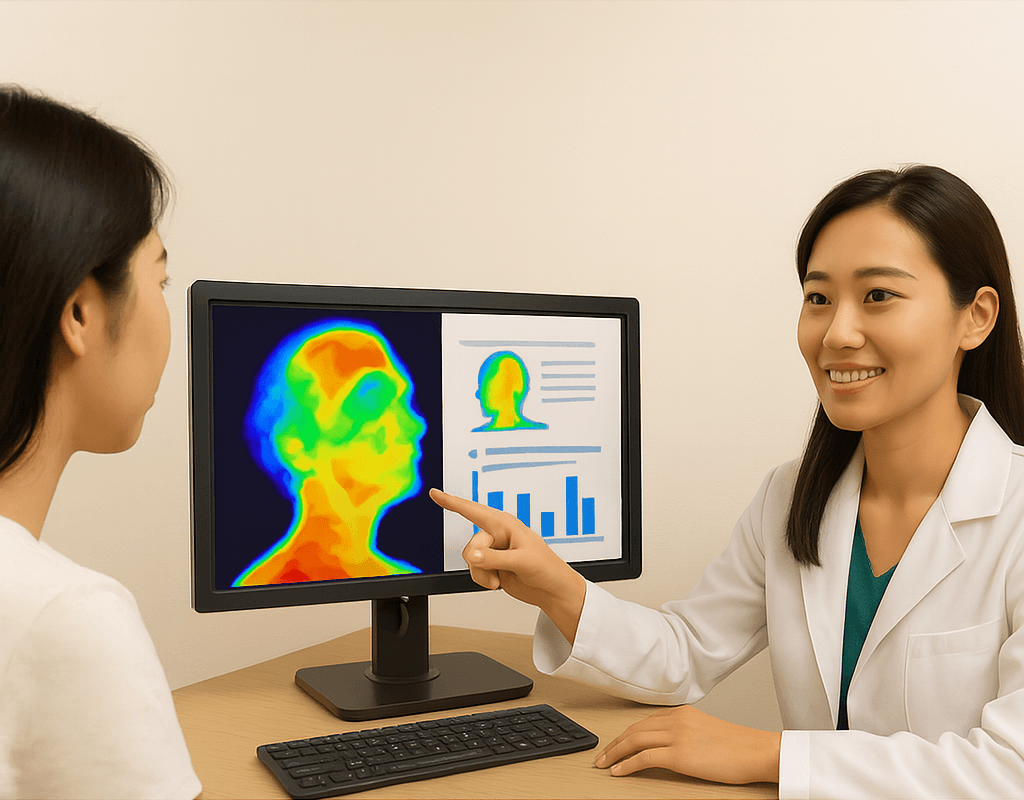
내시경 결과와 식사 때의 증상, 수면과 스트레스를 자세히 살펴봅니다. 내시경이 필요한 경우에는 검사를 먼저 안내해 드립니다. 심박변이도와 적외선 체열검사로 자율신경의 균형과 배의 냉열 상태를 확인합니다.
2단계. 굳은 명치와 배를 풉니다
침과 약침, 추나로 명치와 등, 목의 긴장을 풀어 위가 편하게 움직이도록 돕습니다.
3단계. 유형에 맞춰 바탕을 다스립니다
식사량과 속도, 수면을 함께 살피고, 걱정이 증상을 키운다면 상담을 함께 진행합니다. 체질과 상태에 맞춰 한약을 짓습니다.
4만 건의 처방 사례가 말해주는, 한방 맞춤 치료의 힘

소화불량 치료후기 총 54건
환자분들이 남긴 치료후기입니다. 본문은 로그인 후 보실 수 있습니다.
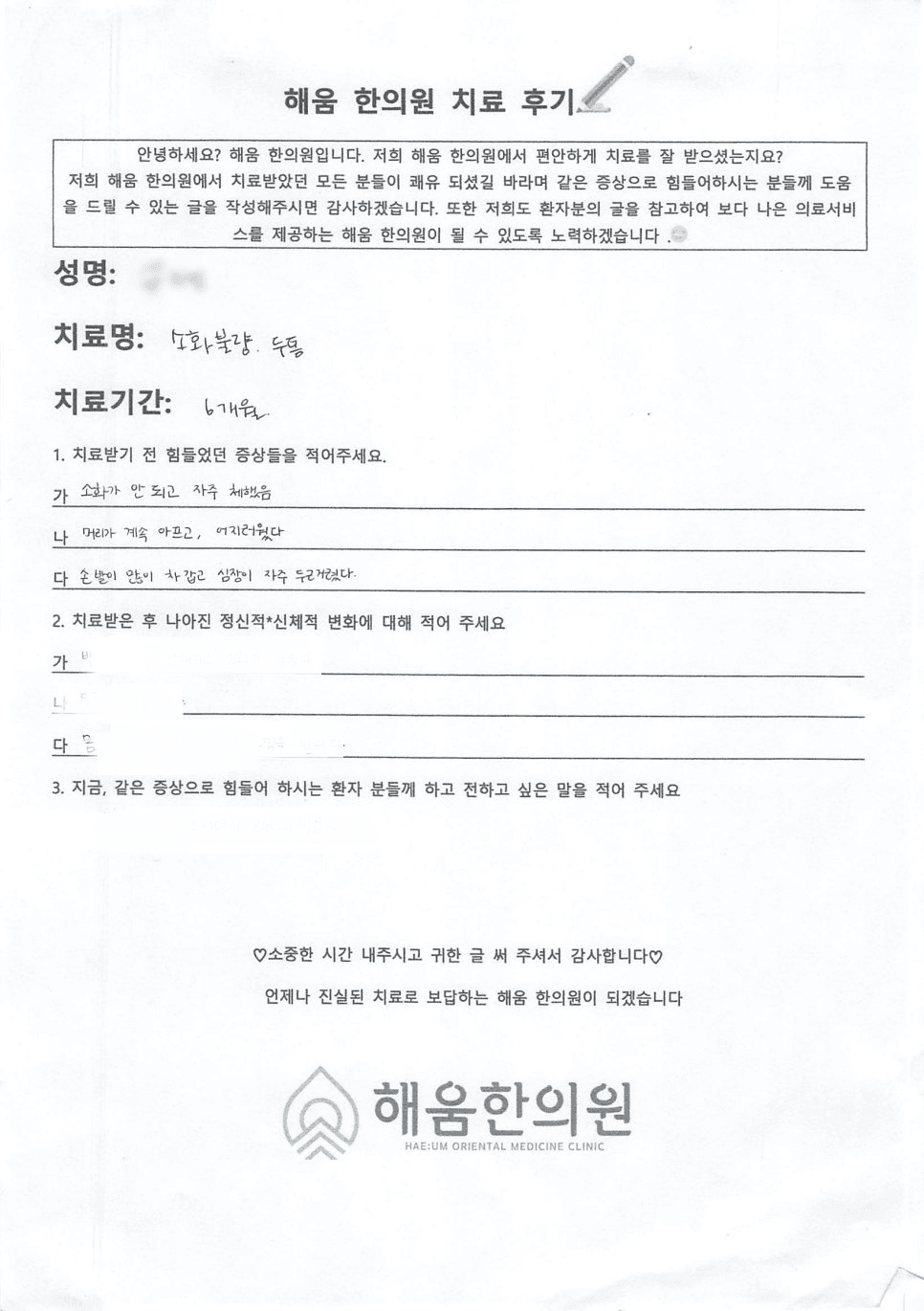
두통 속울렁거림 식은땀, 단순 소화불량이 아니라고요?
2026. 04. 09.
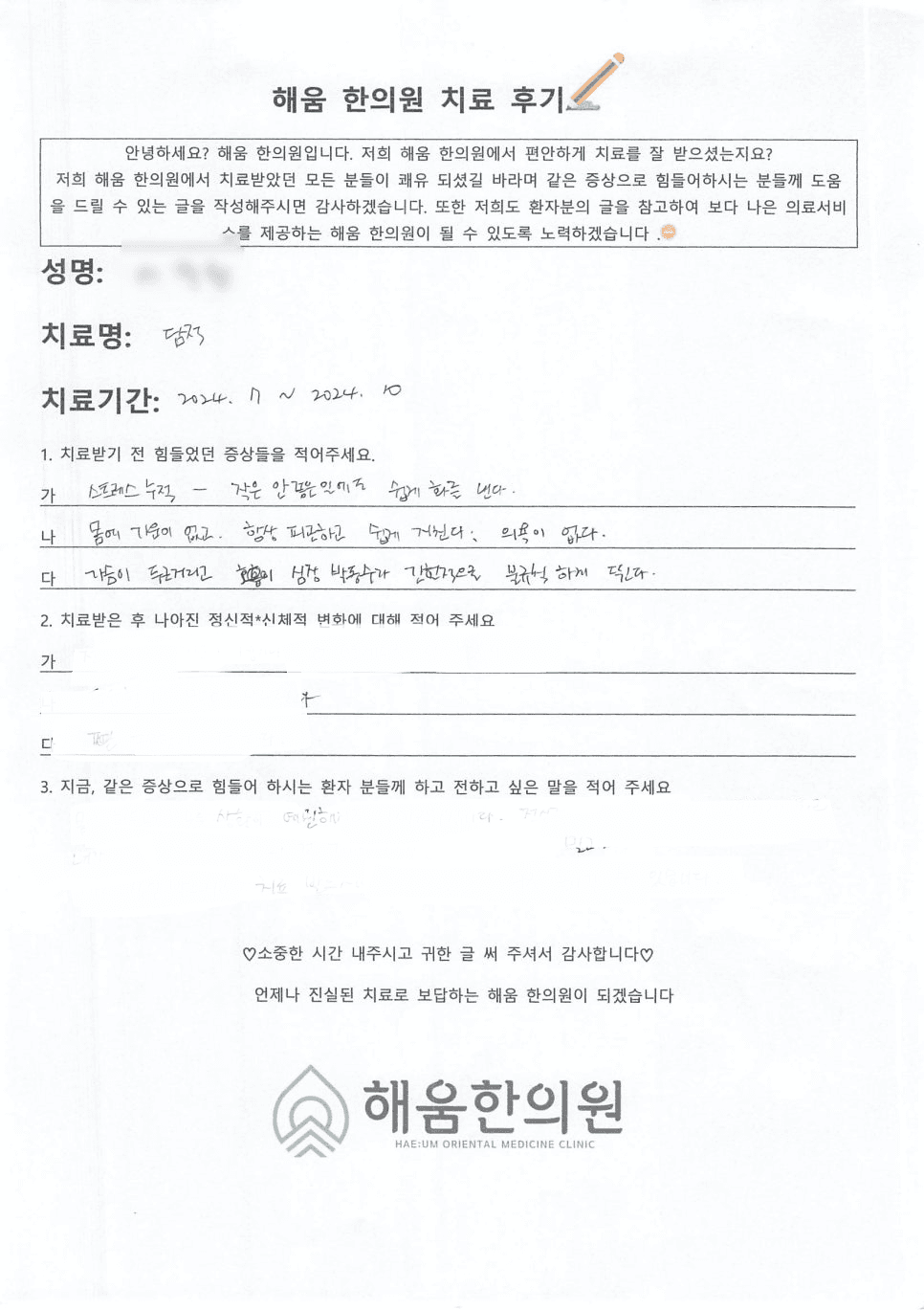
명치답답 소화불량, 담적 증상 같은데 원인이 없대요. 정신과 문제인 걸까요?
2026. 01. 31.
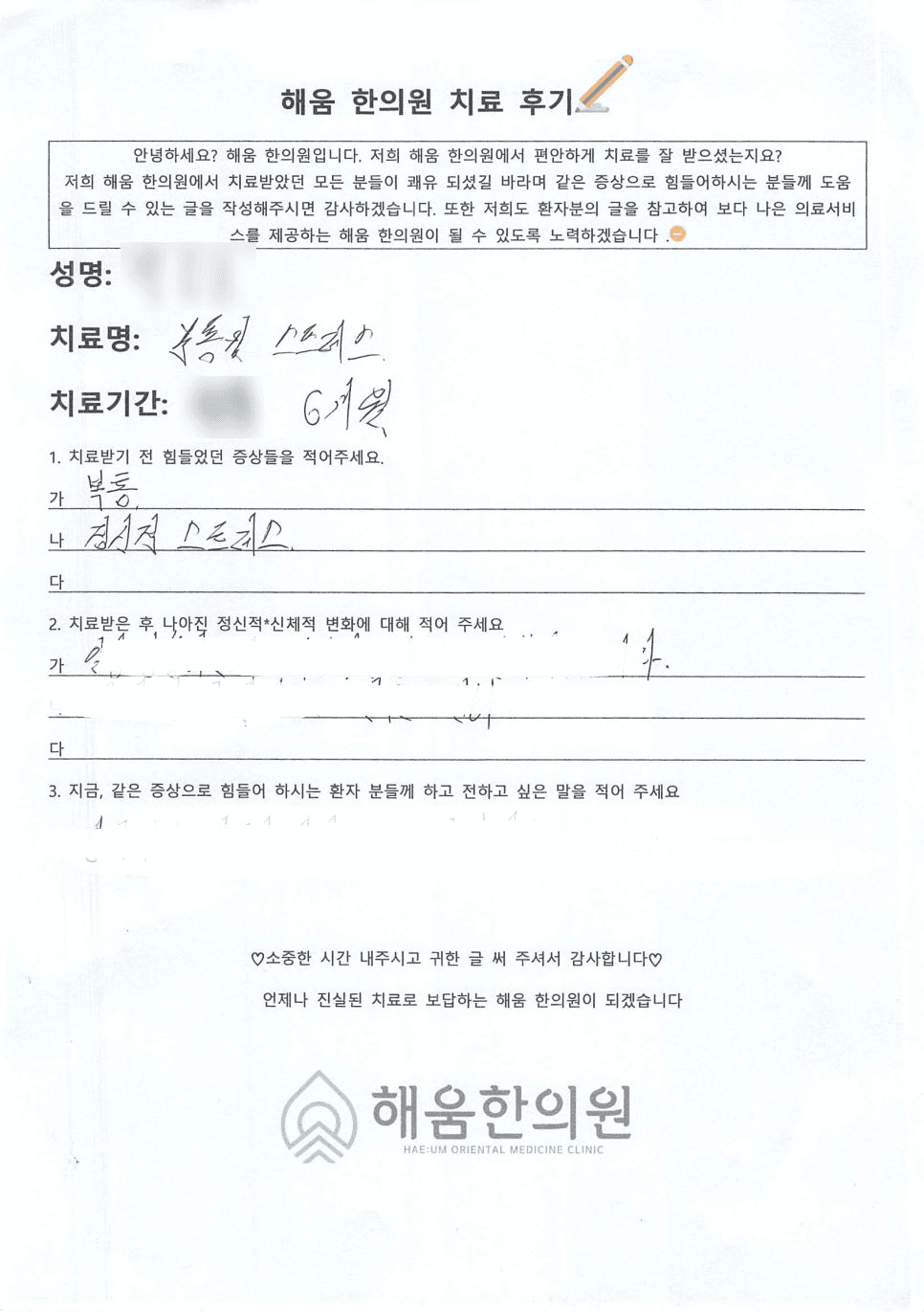
검사는 이상 없는데 복통이 심해요..제가 예민한 걸까요?
2026. 01. 09.
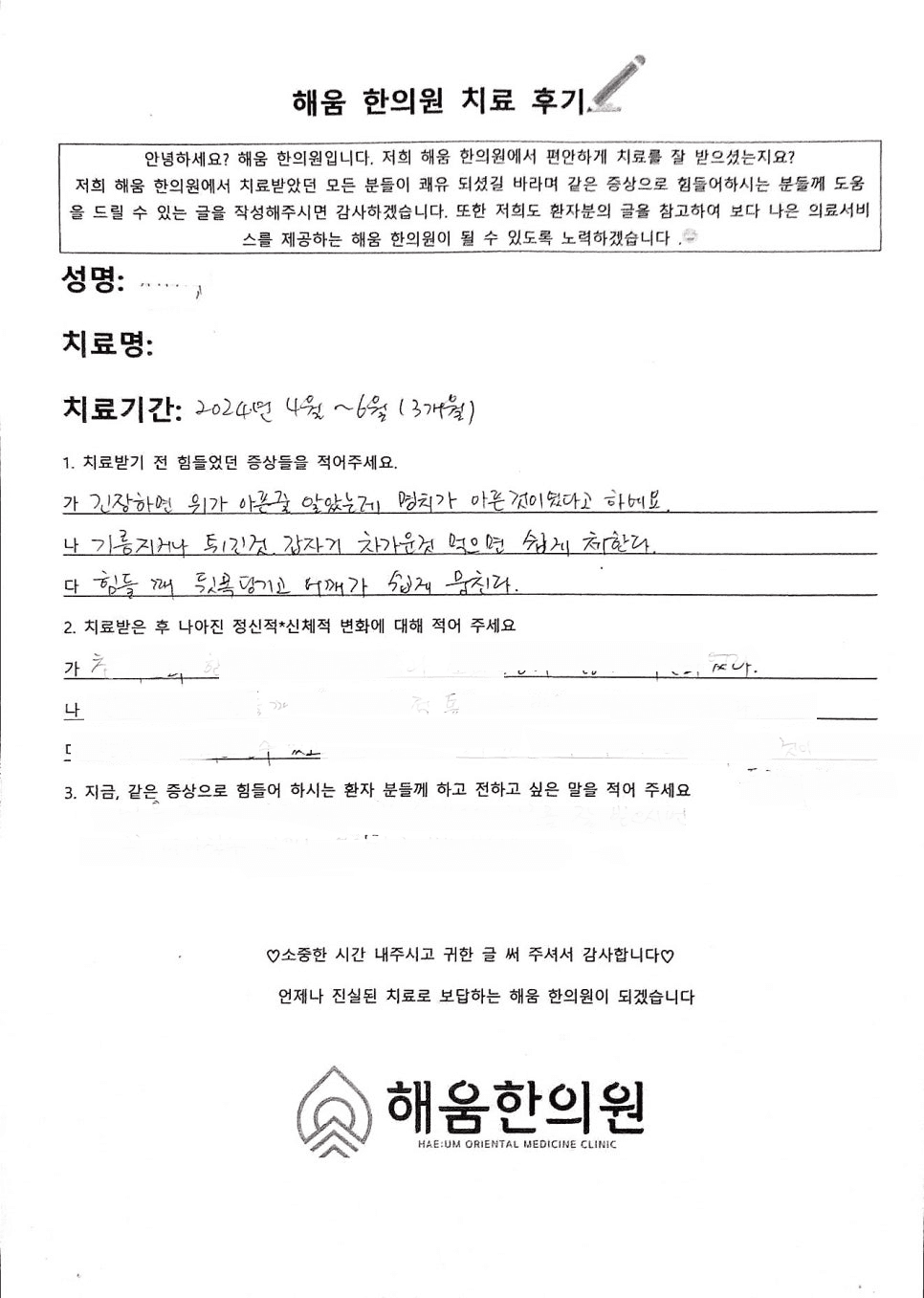
소화불량두통, 체할까 봐 항상 조심스러웠던 마음이 이제는 편해졌어요
2026. 01. 05.
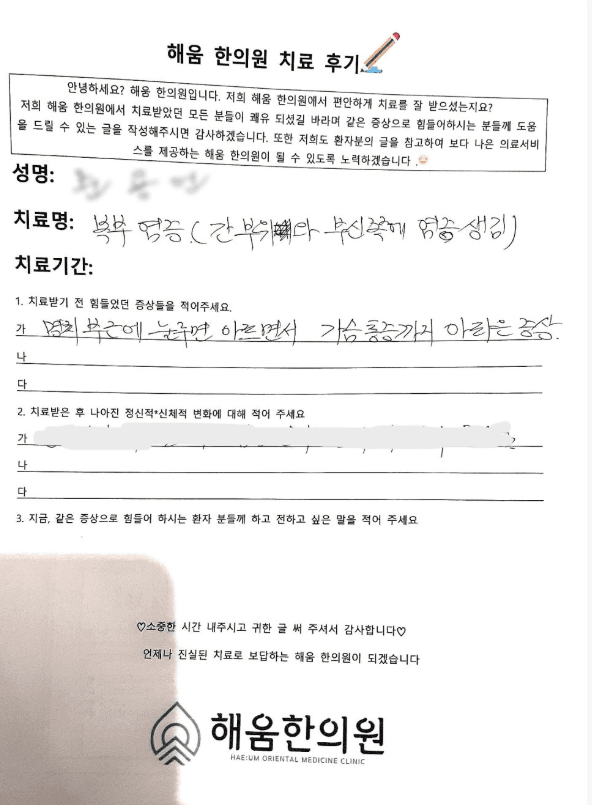
검사에선 이상 없다는데, 명치가 왜 계속 아플까요? 소화불량 명치통증 내시경 원인 치료
2025. 12. 16.
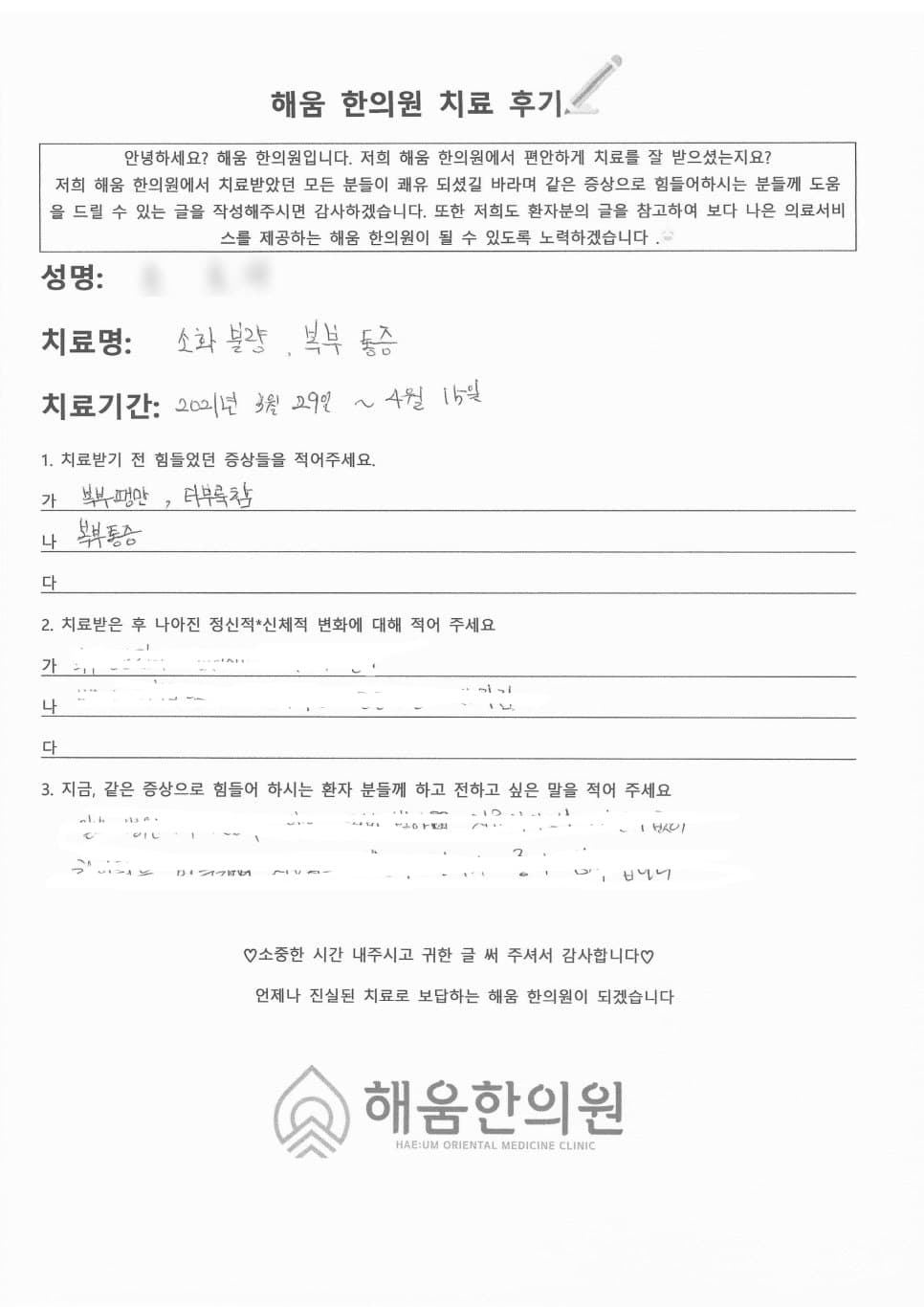
간이 너무 뚱뚱해도 소화불량이 올 수 있어요 갑작스러운 복부 팽만감, 체함, 소화불량 추나 침치료로 좋아진 사례
2025. 07. 17.
치료후기 25건 더 보기접기
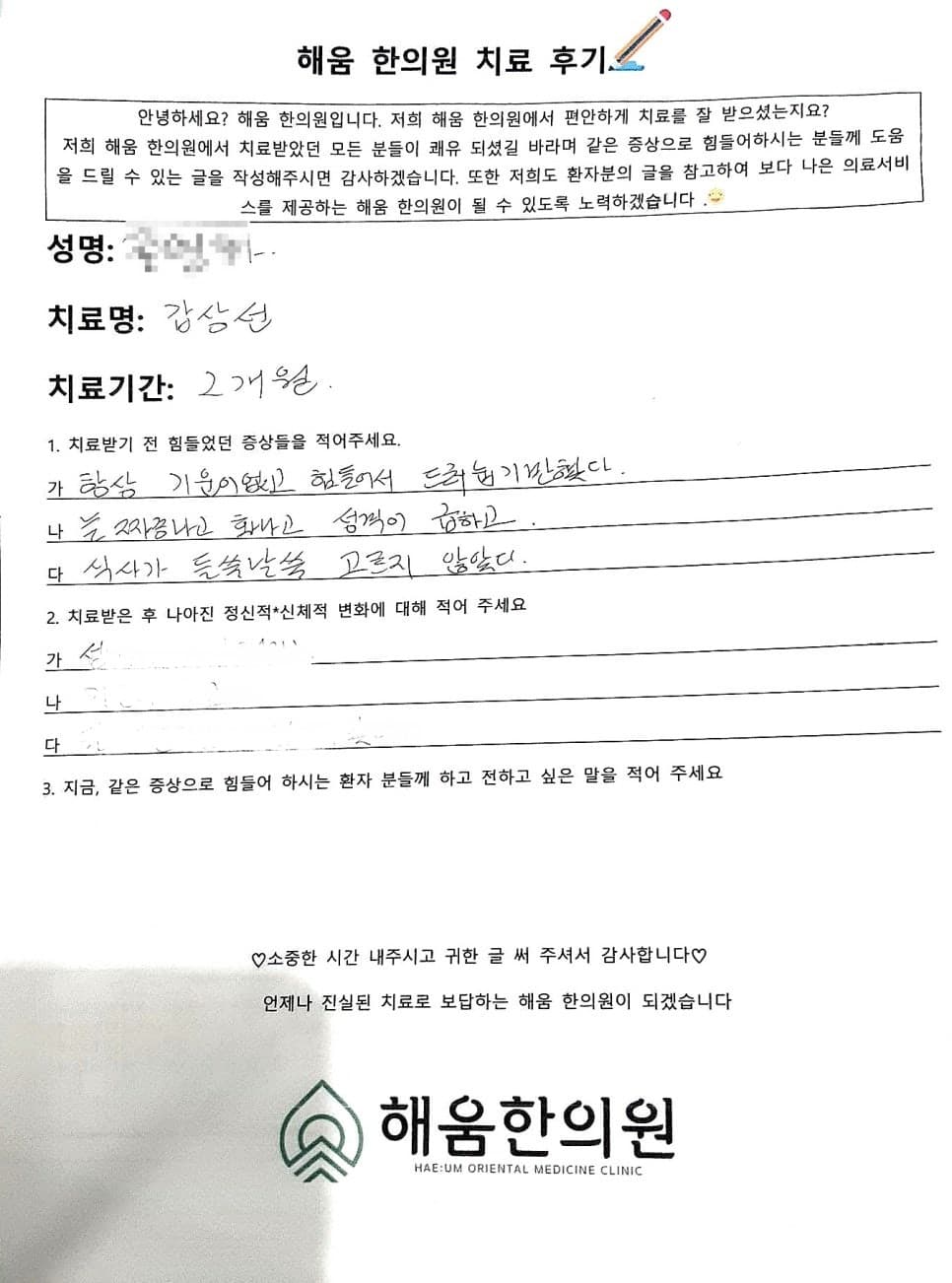
갑상샘항진증 아급성갑상선염 치료 환자, 피로감 소화불량 고지혈증 완화 한약 2달간
2025. 01. 25.
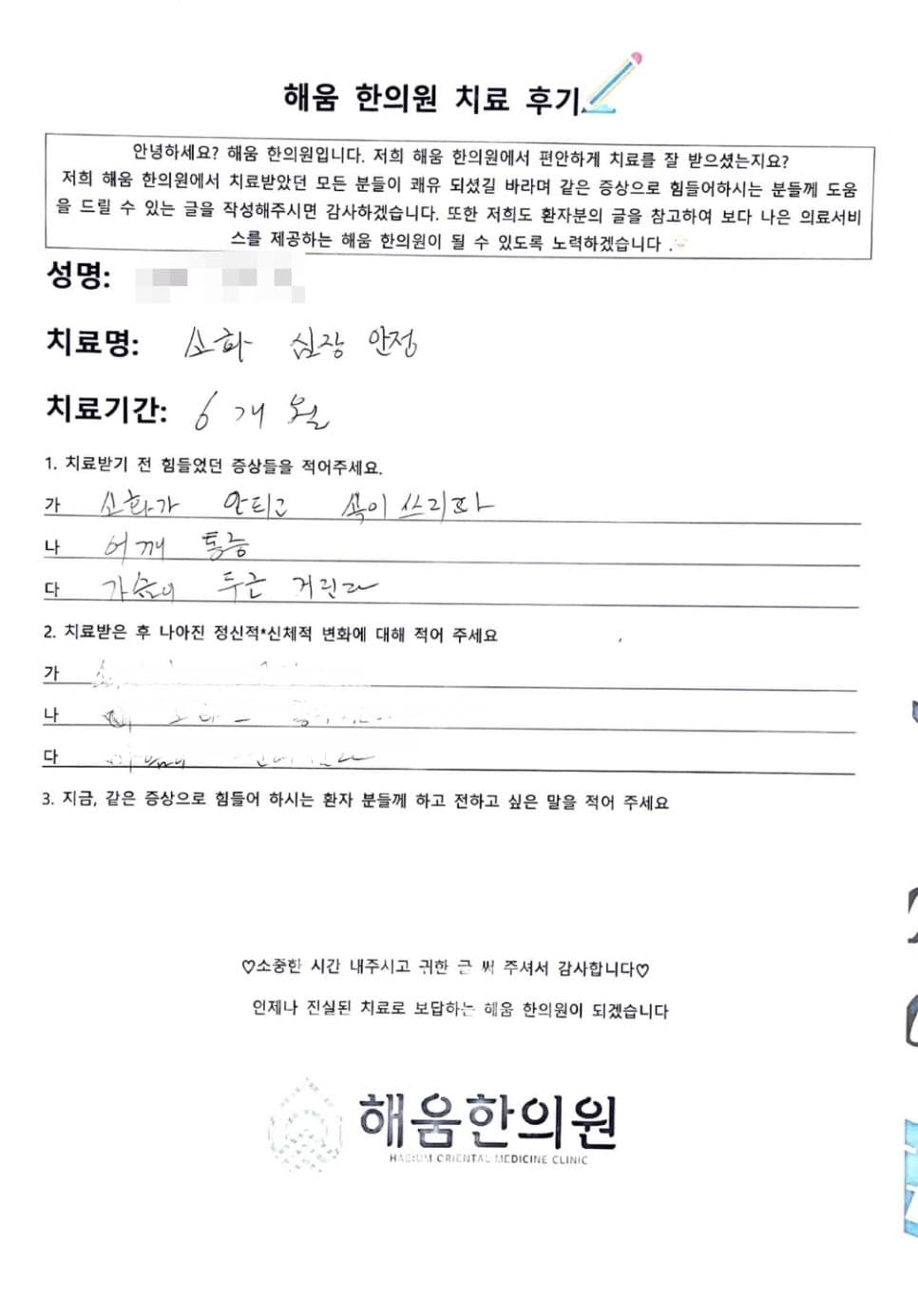
만성 위염, 장상피화생, 소화불량
2024. 06. 27.
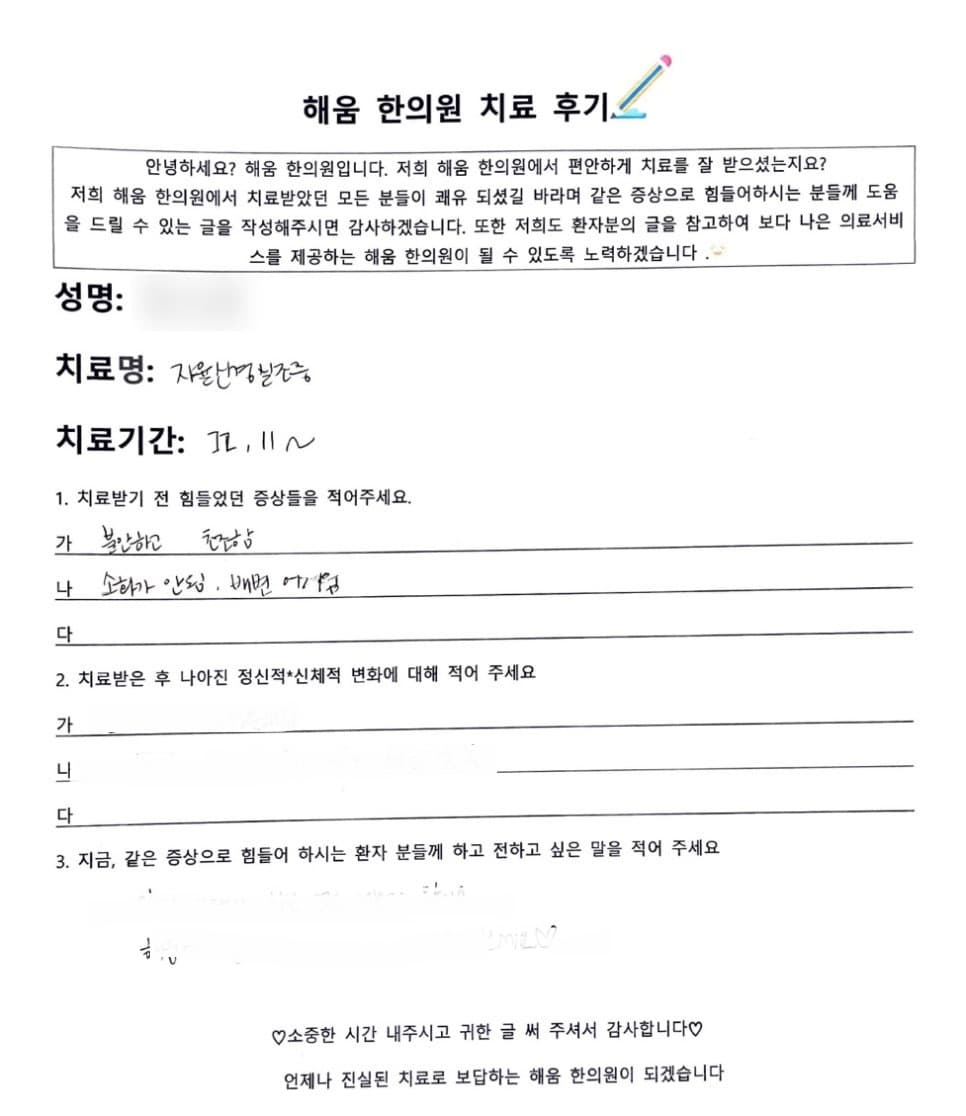
심한 변비 배아픔에 직빵, 소화불량 불안 불면 3개월
2024. 05. 02.
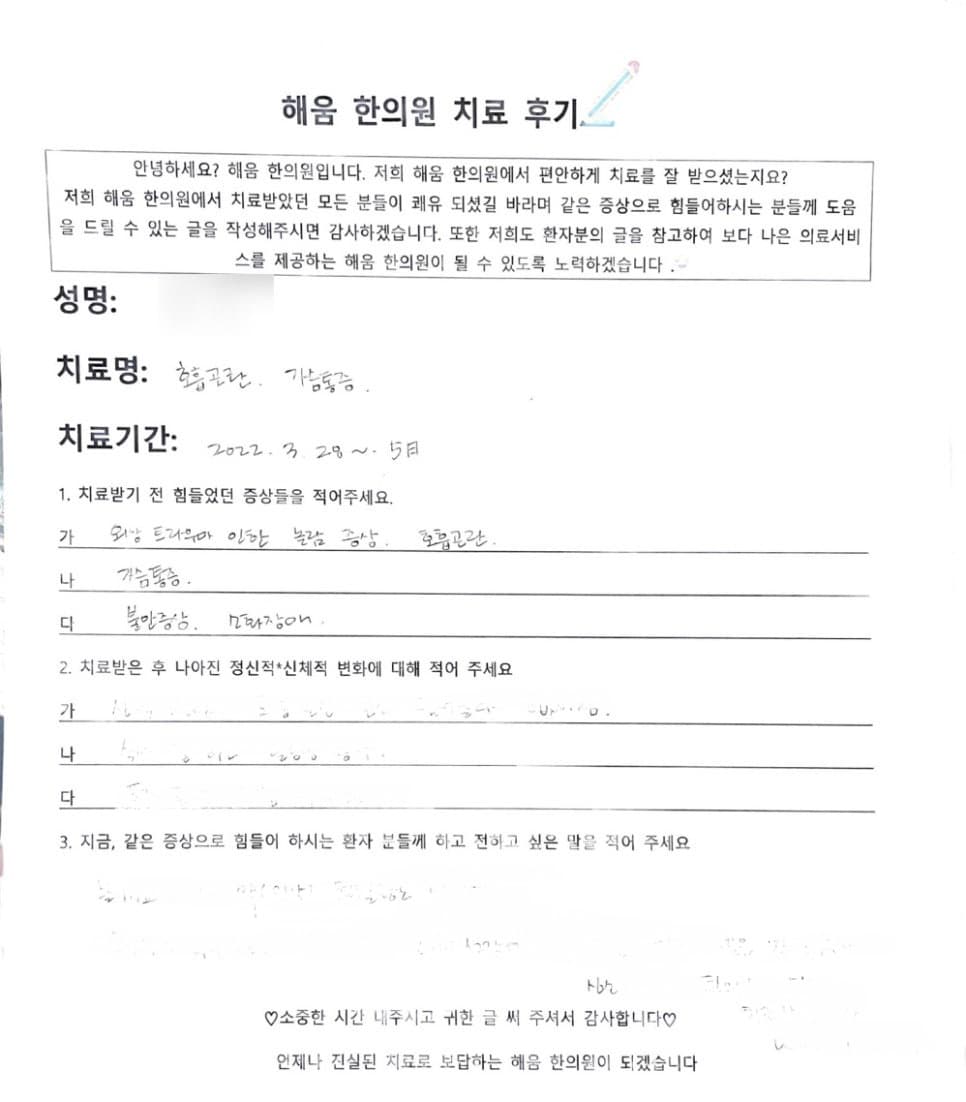
PTSD 외상후스트레스장애 증상으로 찾아온 초등학생, 한약 치료로 두근거림,호흡곤란,불안장애,소화불량이 좋아졌어요
2024. 05. 01.
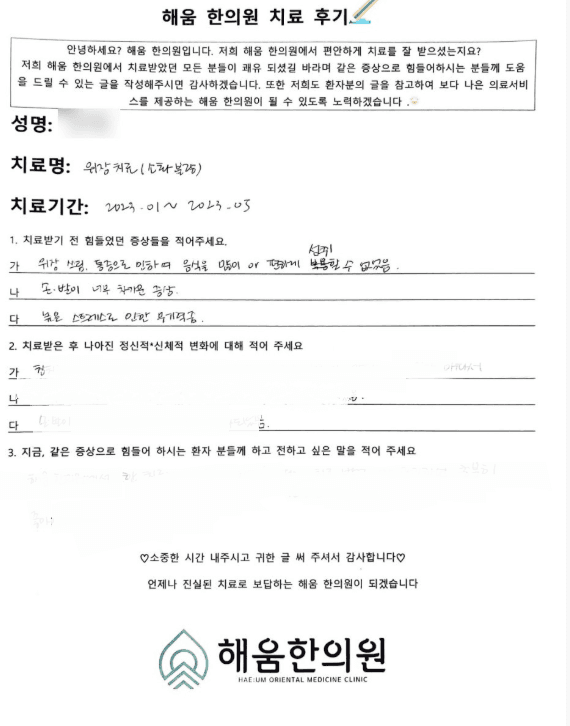
내시경 검사상 아무 문제 없는 속쓰림, 위경련 통증, 소화불량
2024. 04. 20.
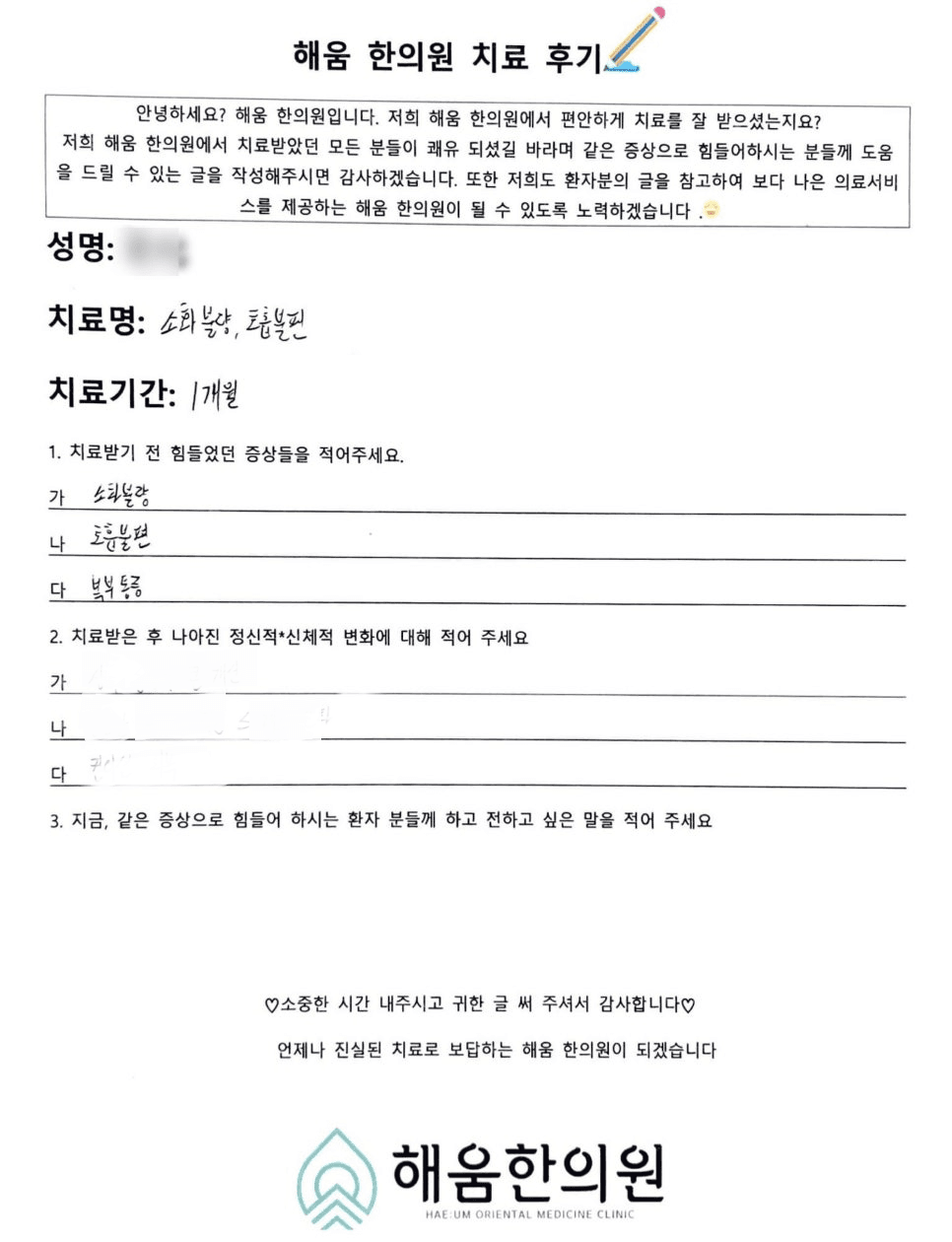
3개월간 고생한 옆구리통증 명치통증 호흡곤란 소화불량 1달만에
2022. 12. 29.
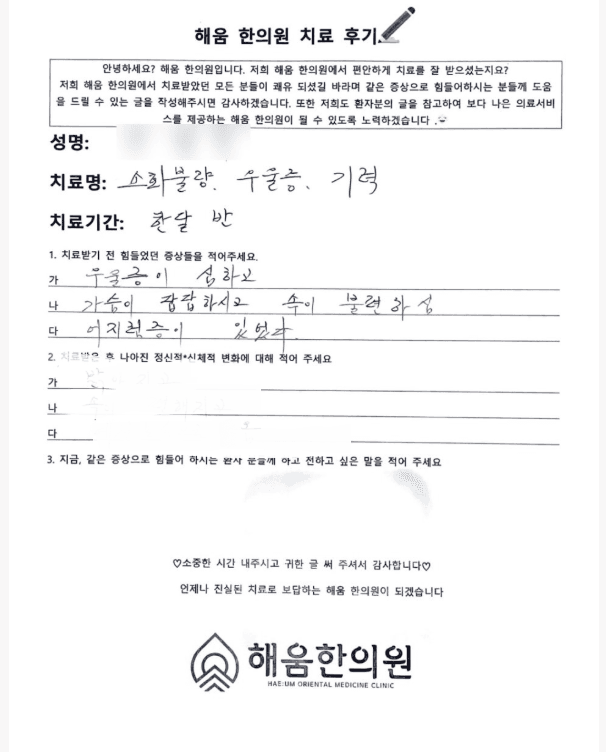
평생을 달고 살아온 소화불량, 노인 우울증 한약 1달반 먹고 좋아진 사례
2022. 08. 02.
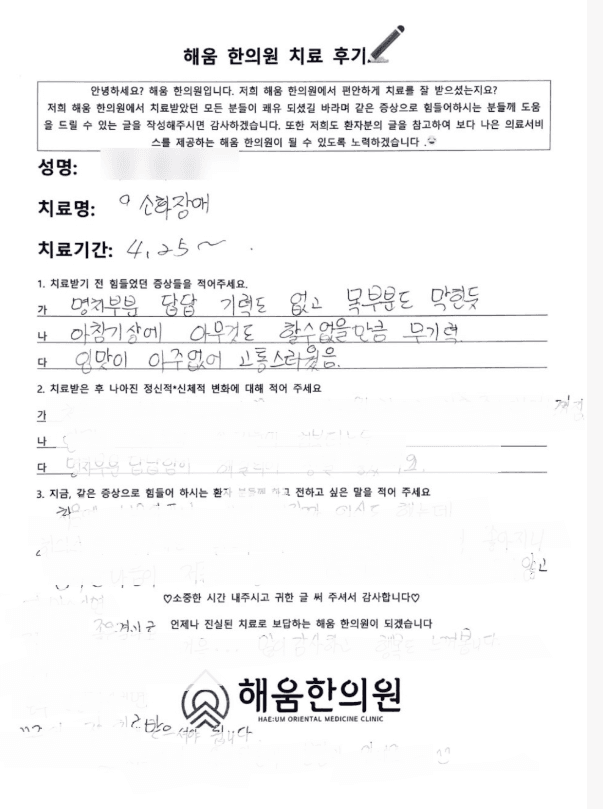
신경성소화불량? 담적병? 기능성위장장애? 원인을 못 찾던 위장병, 한약 1달
2022. 06. 03.
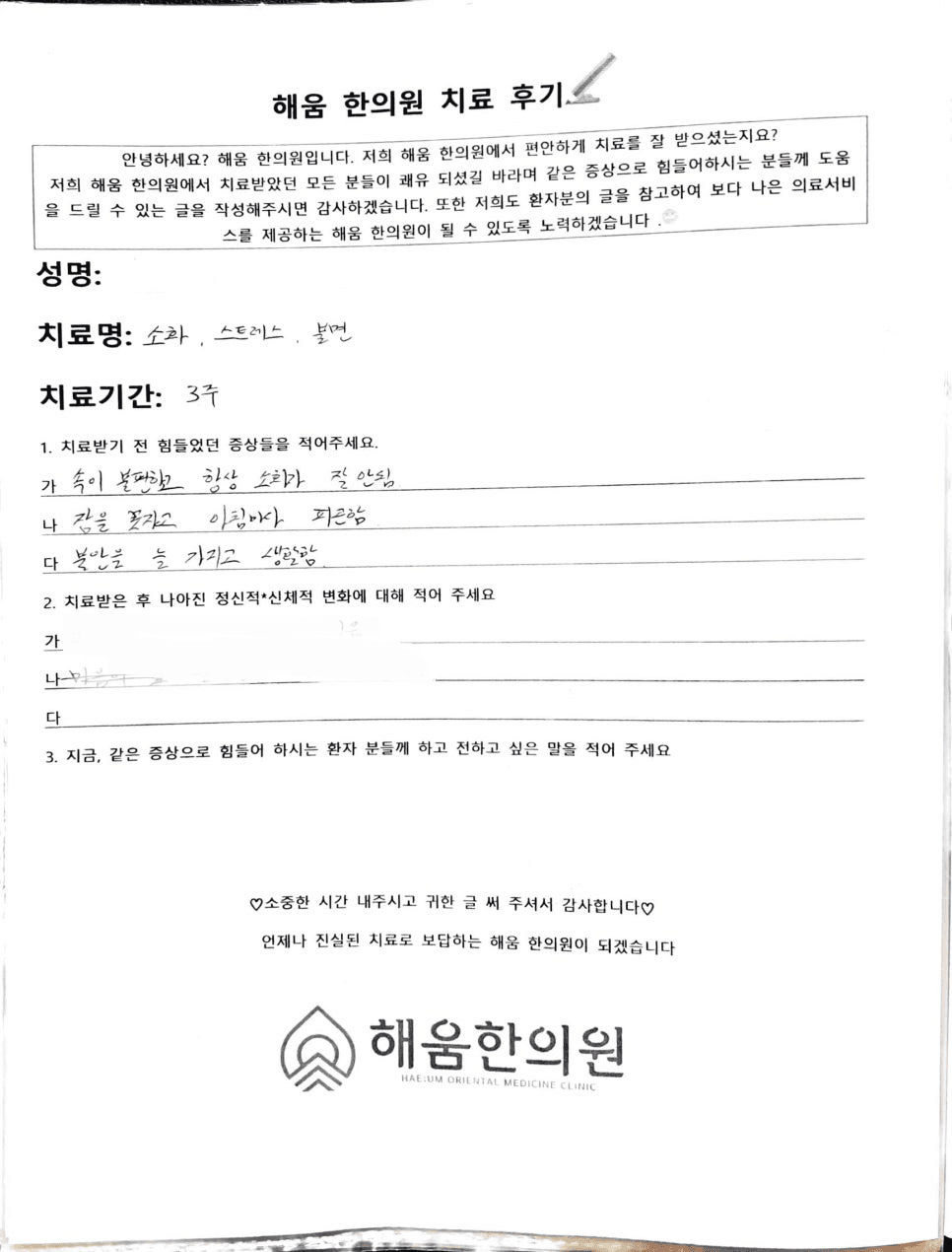
3주만에 좋아졌어요 스트레스로 인한 소화불량, 불면증
2022. 05. 19.
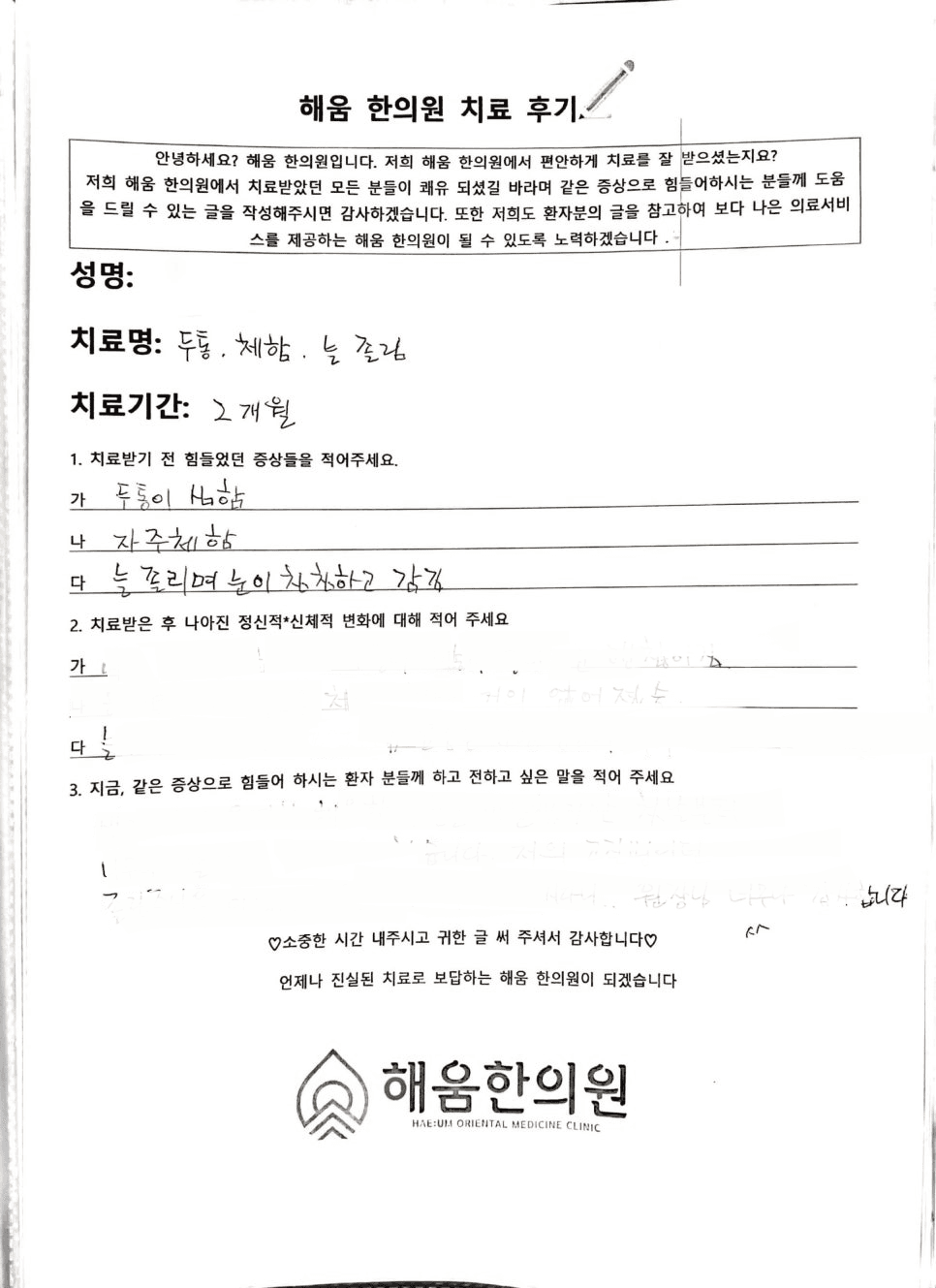
소화불량이 두통과 눈침침함을 유발하는 이유? 몇년 된 증상 2개월만에
2022. 05. 17.
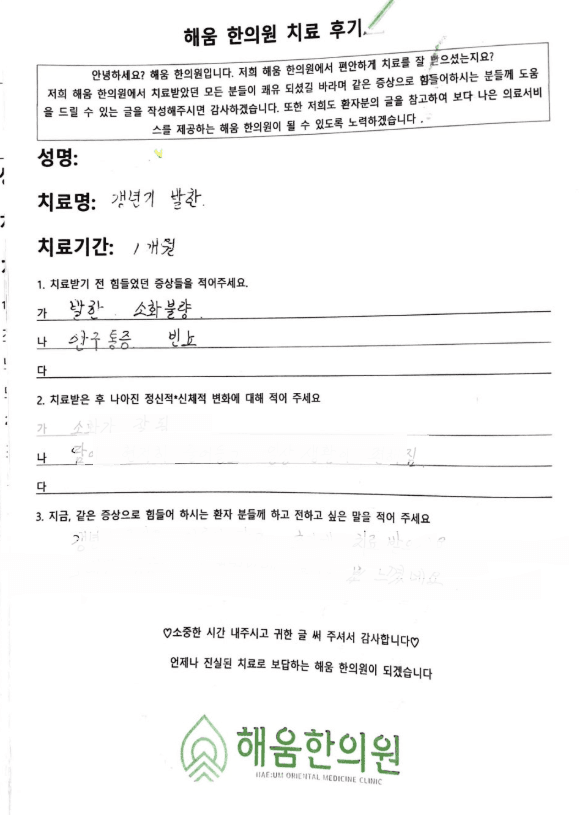
오래된 발한 식은땀 소화불량 한약 먹고 10일만에..?!
2022. 05. 12.
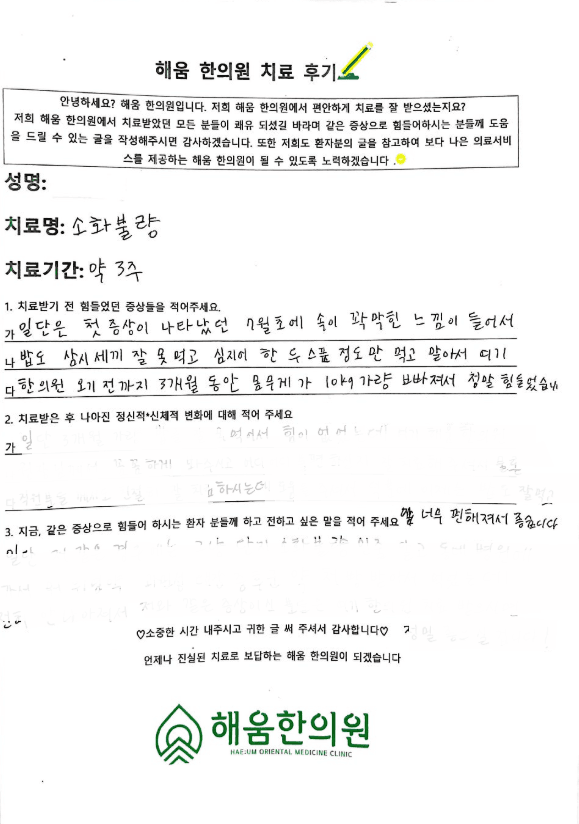
소화불량으로 3개월동안 10kg 빠져서 고생하신 환자분 한약 치료기
2022. 05. 12.
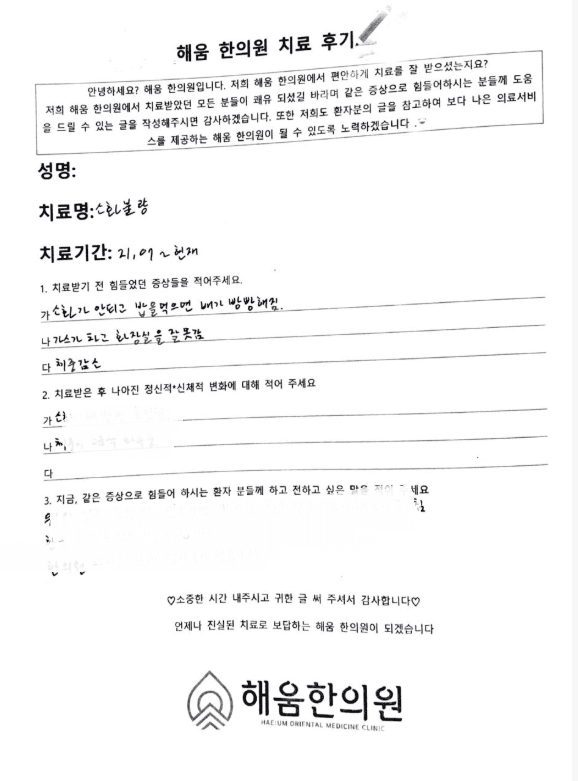
만성소화불량 체중감소
2022. 05. 10.
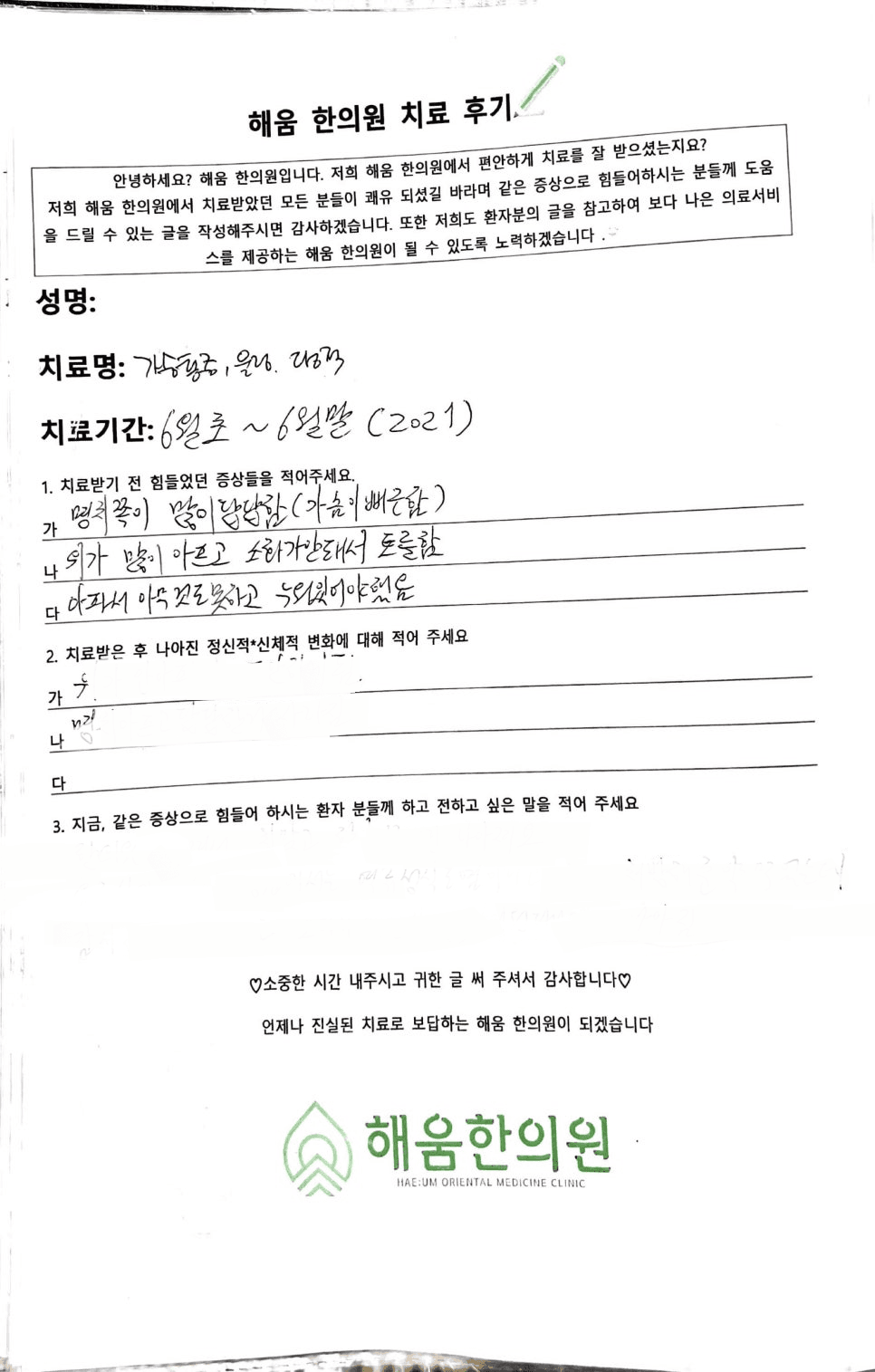
명치가 답답하고 뻐근한데 이거 가슴담적인가요?? 가슴통증,구토,소화불량 신정동한의원 치료후기
2022. 04. 15.
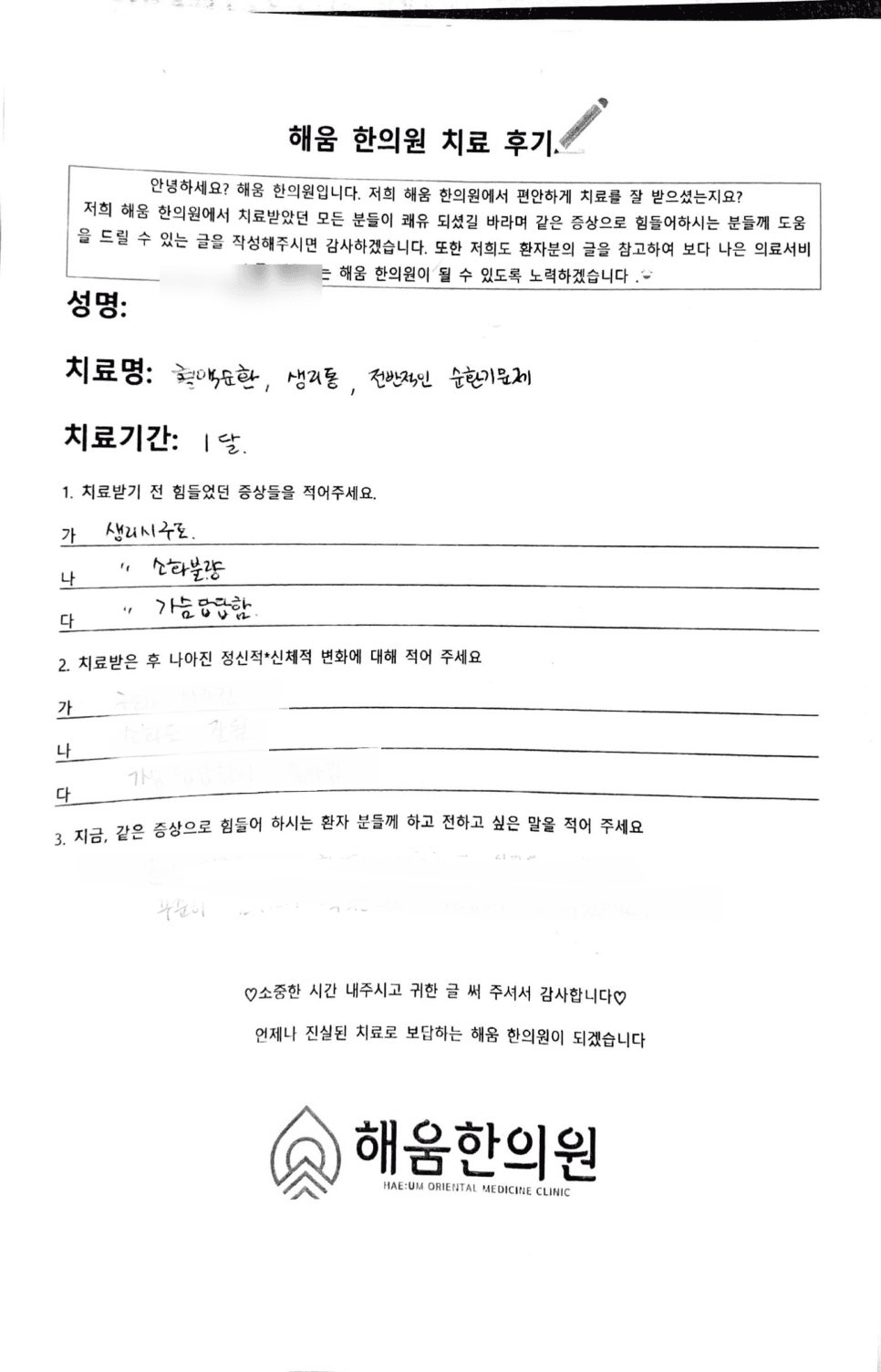
생리할때 구토, 소화불량, 가슴답답함으로 고생하셨던 환자분 1달만에 치료된 사례
2022. 03. 16.
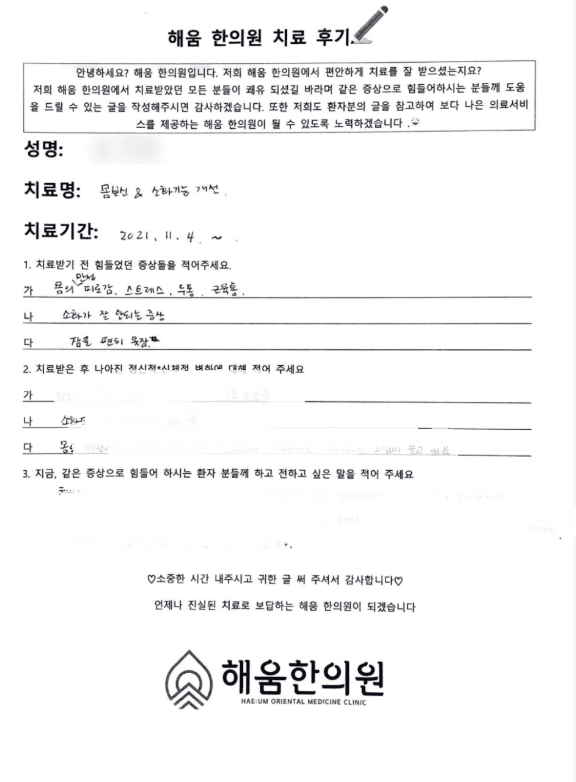
만성피로,소화불량,불면.. 사는게 피곤하셨던 환자분 보약 먹고 기운 차리신 얘기
2022. 03. 09.
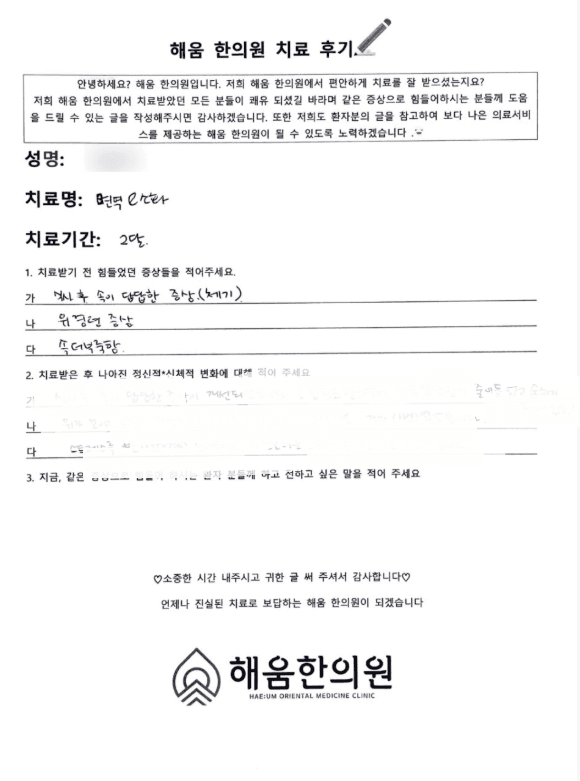
잔병치레를 달고 살던 환자분, 한약으로 소화불량 위경련 예민함 치료를 통해 좋아진 사례
2022. 03. 07.
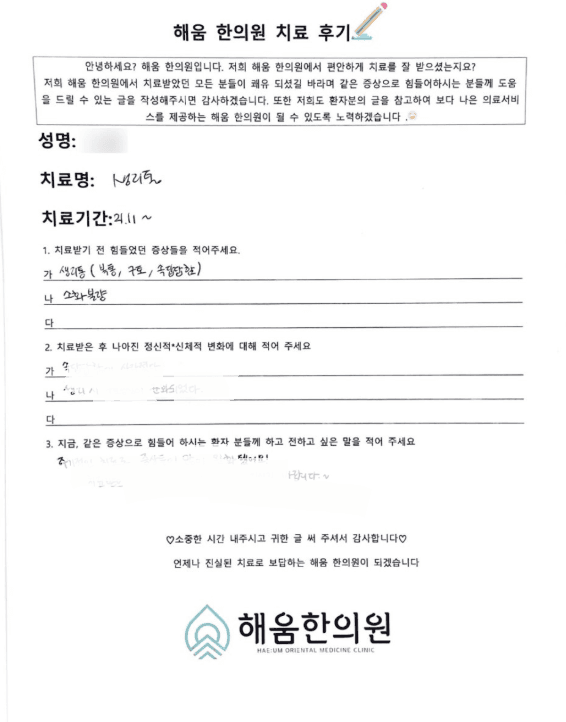
생리시 구토, 헛구역질, 소화불량 으로 고생하는 여학생 한약 한달만에 좋아진 사례
2022. 03. 04.
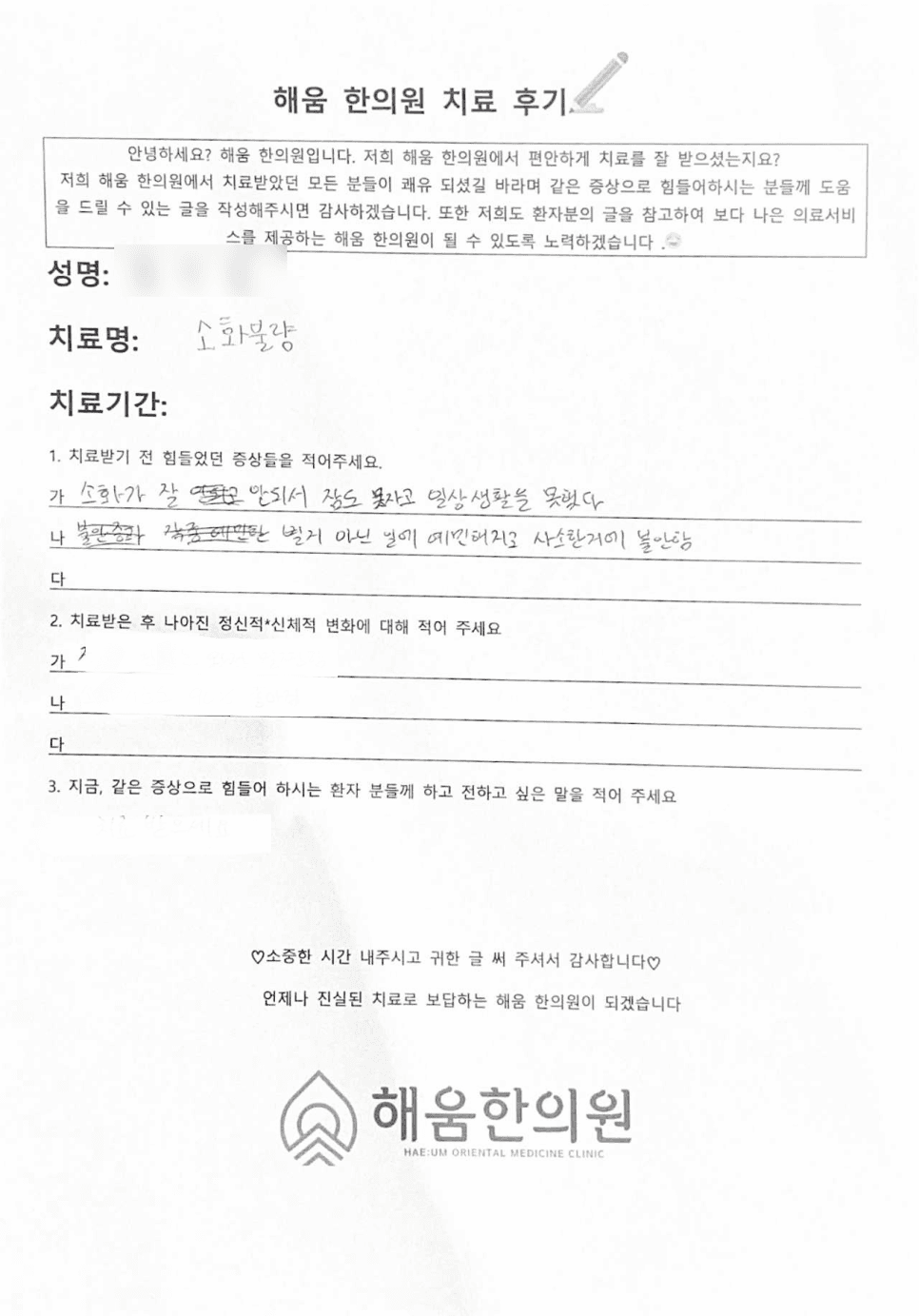
응급실 다녀온 후 생긴 식사불가,호흡곤란,불면 으로 직장을 그만둘뻔했던 분 완치 사례
2021. 10. 29.
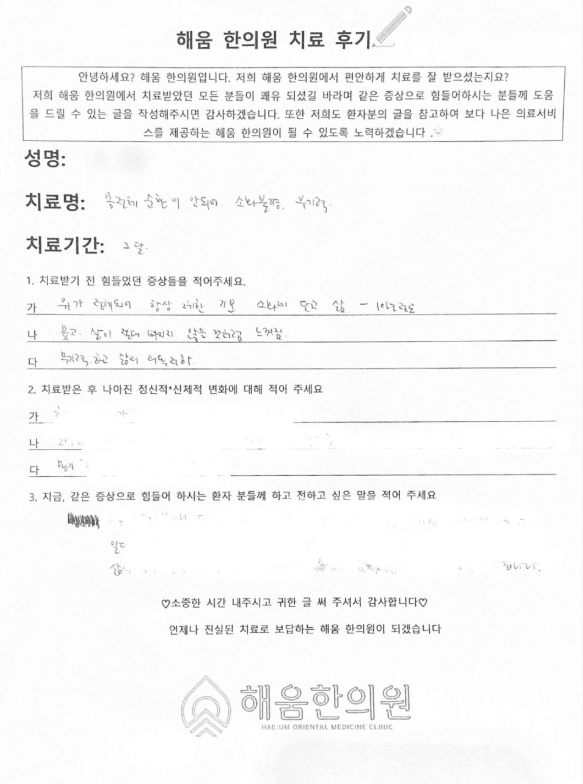
소화가 안되서 많이 먹지도 못하는데 비만이.. 붓기 빠지는 것만으로도 체중감량된 사례
2021. 10. 15.
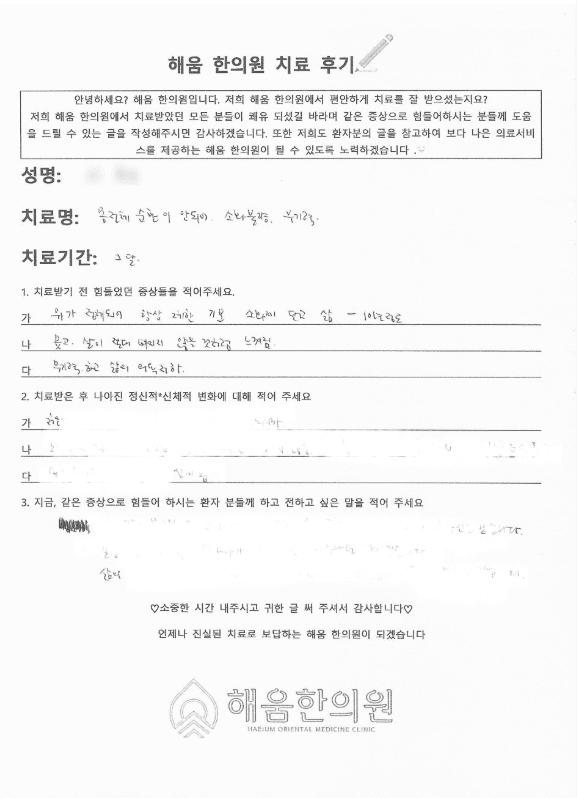
10년 이상 된 소화불량, 무기력하고 우울하던 인생이 바뀌었다는 환자분의 한약 치료 후기
2021. 07. 30.
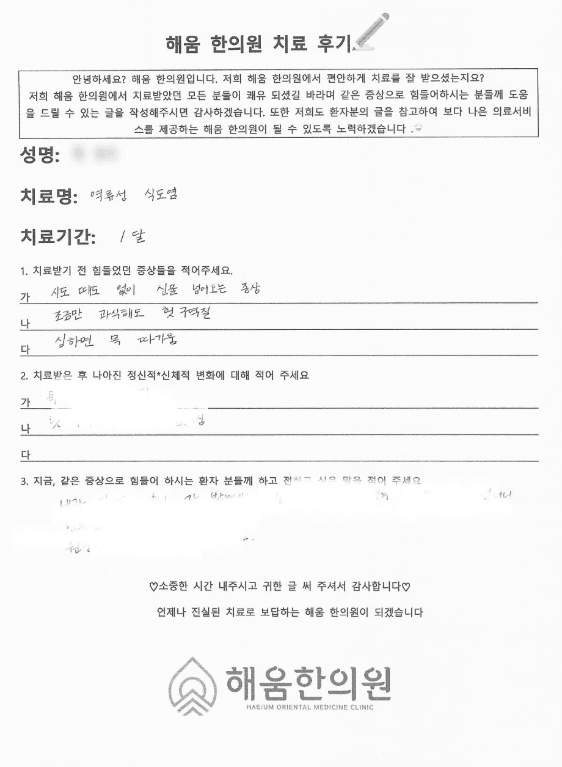
내과약이 효과없던 소화불량으로 헛구역질과 신물로 고생하시던 환자 한약치료후기
2021. 07. 29.
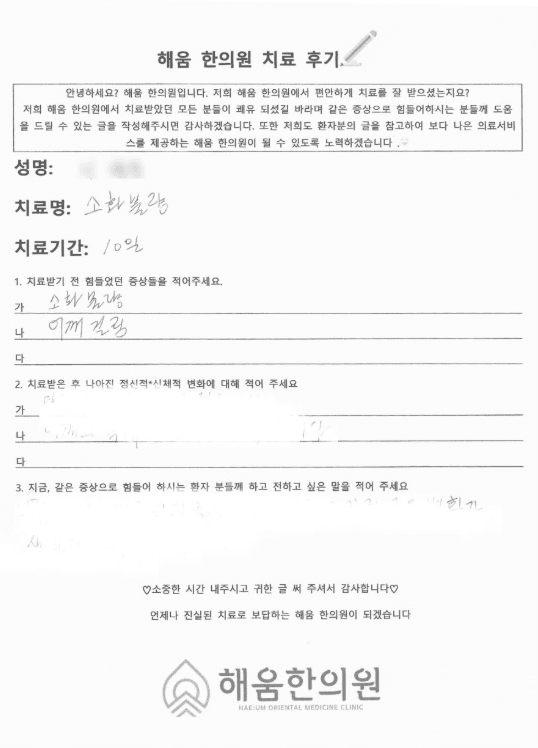
내시경상 원인을 모르는 소화불량 약침 추나치료 3번만에 완쾌한 후기
2021. 07. 16.
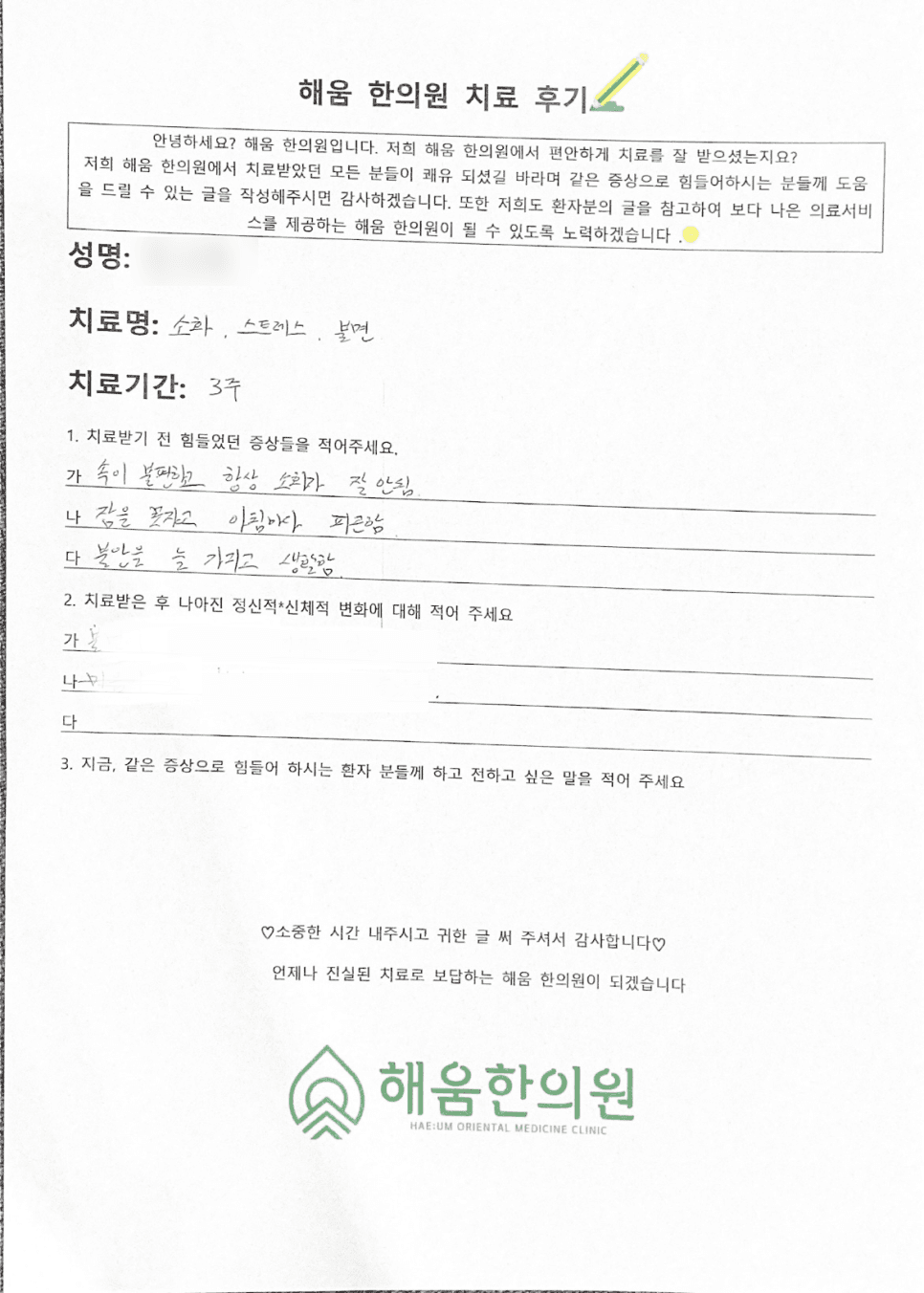
코로나 백신 후유증으로 생긴 불면, 불안, 소화불량, 이명
2021. 01. 14.

속이 메스꺼울때 약 먹어도 효과없었던 환자분 해움한의원 치료 후기
2020. 11. 20.
다른 증상으로 내원하신 분들의 후기 중 ‘소화불량’이 증상으로 함께 언급된 기록
- 입대 전 갑자기 발생한 과민성대장증후군, 한의원에서 치료가 될까요?2026. 06. 01.
- 코로나 백신 맞고 기억이 안날 때는? 머리가 멍해요. 코로나 브레인포그 후유증 브레인포그 극복 혈관성 치매 한의원 후기2026. 05. 04.
- 시험만 보려고 하면 배가 아프고 설사하고 심장이 두근거려요2026. 01. 19.
- 직장 스트레스와 과로로 악화된 편두통·삼차신경통 환자2026. 01. 06.
- 스트레스로 인한 자율신경 문제가 불러온 화병, 불면증2024. 06. 28.
- 치료 안 돼서 고생하던 과민대장증후군2024. 06. 06.
- 저혈압과 함께 어지러움이 심한 학생2024. 05. 22.
- 속이 메스꺼울때 약 먹어도 효과없었던 환자분 해움한의원 치료 후기2024. 04. 25.
- 아내와 사별후 찾아온 갑자기 가슴두근거림 손발저림 어지러움증2023. 12. 22.
- 생리전증후군인가요? 진통제를 하루 8알씩.. 심각한 생리통 편두통 변비 한약 먹고 좋아진 사례2023. 12. 13.
나머지 13건 더 보기접기
- 스트레스인지 코로나후유증인지.. 왼쪽가슴통증손저림 만성피로 염증 한 방에!2023. 01. 18.
- 코로나 후유증으로 구토 미식거림 두통 어지러움 연하장애로 고생하신 노인 환자분2023. 01. 03.
- 스트레스성 공황장애 초기증상 한약 치료사례: 공황발작과 공황장애의 차이2022. 12. 27.
- 이유 모르게 토하고 배가 부글거리고 구토 증상2022. 07. 30.
- 심박수가 120까지.. 코로나 확진 후 두근거림 숨이차고 소화가 안 되었는데 한약치료로 좋아졌어요2022. 06. 02.
- 선생님 덕분에 수능 너무 잘봤어요!! 수험생 피로보약,과민대장증후군2022. 05. 13.
- 한약 치료 왈칵왈칵 역류하는 위산으로 목구멍이 아프고 따갑던 환자 이야기2022. 03. 30.
- 소화도 안되고 손발도 차고 생리통도 심하고.. 마르고 허약한 여자분 체질개선 치료기2022. 03. 25.
- 이게 담적인가요? 위내시경 후유증으로 명치 가슴이 답답하고 딱딱하게 만져지는 환자분 한약 1달 치료기2021. 11. 24.
- 코로나백신 맞고 가슴쪽으로 열감이 돌아다니고 소화가 안되기 시작한 환자, 침 및 추나로 호전된 사례2021. 11. 18.
- 애기때부터 시작한 만성변비와 여드름 치료사례, 장건강이 피부건강에 얼마나 중요하냐면요2021. 10. 28.
- 화이자 백신 맞고 호흡곤란, 가슴통증으로 고생하신 분 3주만에 완쾌 사례2021. 10. 28.
- 어떤 검사로도 원인을 알 수 없던 호흡곤란과 역류성식도염 한방 치료후기2021. 07. 19.
기능성 소화불량, 누가 진료하나요?
담당 의료진
대표원장 박재은

“병이 아니라 그 뒤의 사람을 봅니다”
경희대학교 한의학박사이자 여한의사입니다. 심리상담사 1급 자격, 20만명 차트분석과 4만건 이상의 한약 처방 경험을 바탕으로 진료합니다.
의료진 소개 더보기기능성 소화불량, 자주 묻는 질문
소화불량과 기능성 소화불량은 다른가요?
신경성이라는데 정말 마음의 문제인가요?
완치가 되나요?
내시경을 다시 받아야 하나요?
위장약과 한약을 같이 먹어도 되나요?
해움한의원에서 기능성 소화불량을 진료하나요?
기능성 소화불량으로 내원하려면 어떻게 하나요?
기능성 소화불량에 관해 알아두면 좋은 정보
7건기능성 소화불량과 관련해 정리한 건강정보입니다.
위가 쓰릴때와 위가 더부룩할때, 검사 이상 없는데 왜 계속될까요?
식사만 하면 속이 답답하고 더부룩하다면 단순한 소화불량이 아닐 수도 있습니다"조금만 먹어도 배가 금방 부른 것 같아요.""식사 후에는 항상 위가 꽉 막힌 느낌이 듭니다.""내시경은 정상이라는데 속은 계속 쓰리고 답답
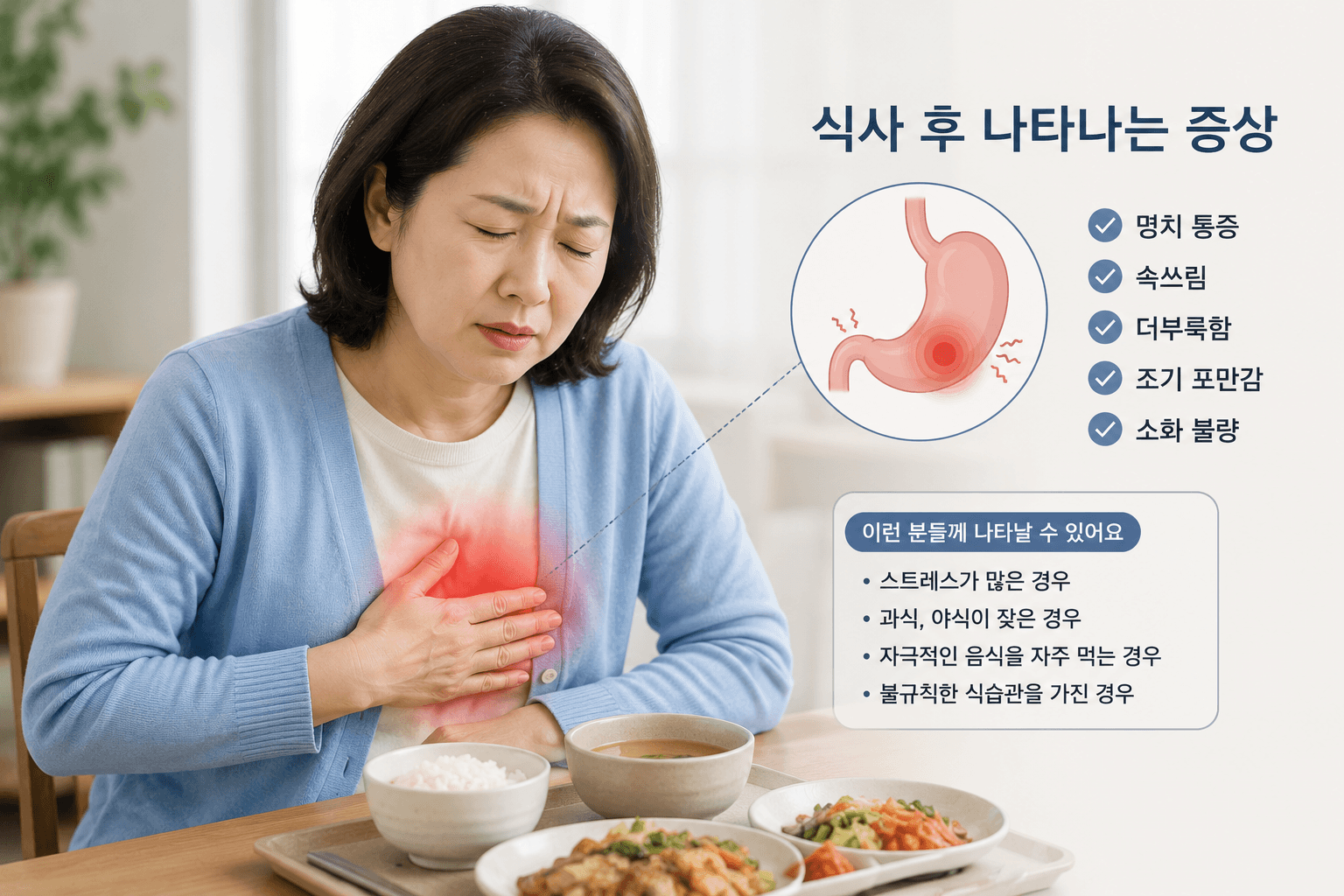
먹기만 하면 소화가 안 돼요, 검사까지 정상이라면 무엇을 살펴봐야 할까요?
밥을 먹는 일이 어느 순간 부담이 되기 시작했다면“조금밖에 안 먹었는데 벌써 배가 꽉 찬 것 같아요.”“점심에 먹은 음식이 저녁까지 그대로 남아 있는 느낌이에요.”“먹기만 하면 소화가 안 돼요. 그런데 검사에서는 별
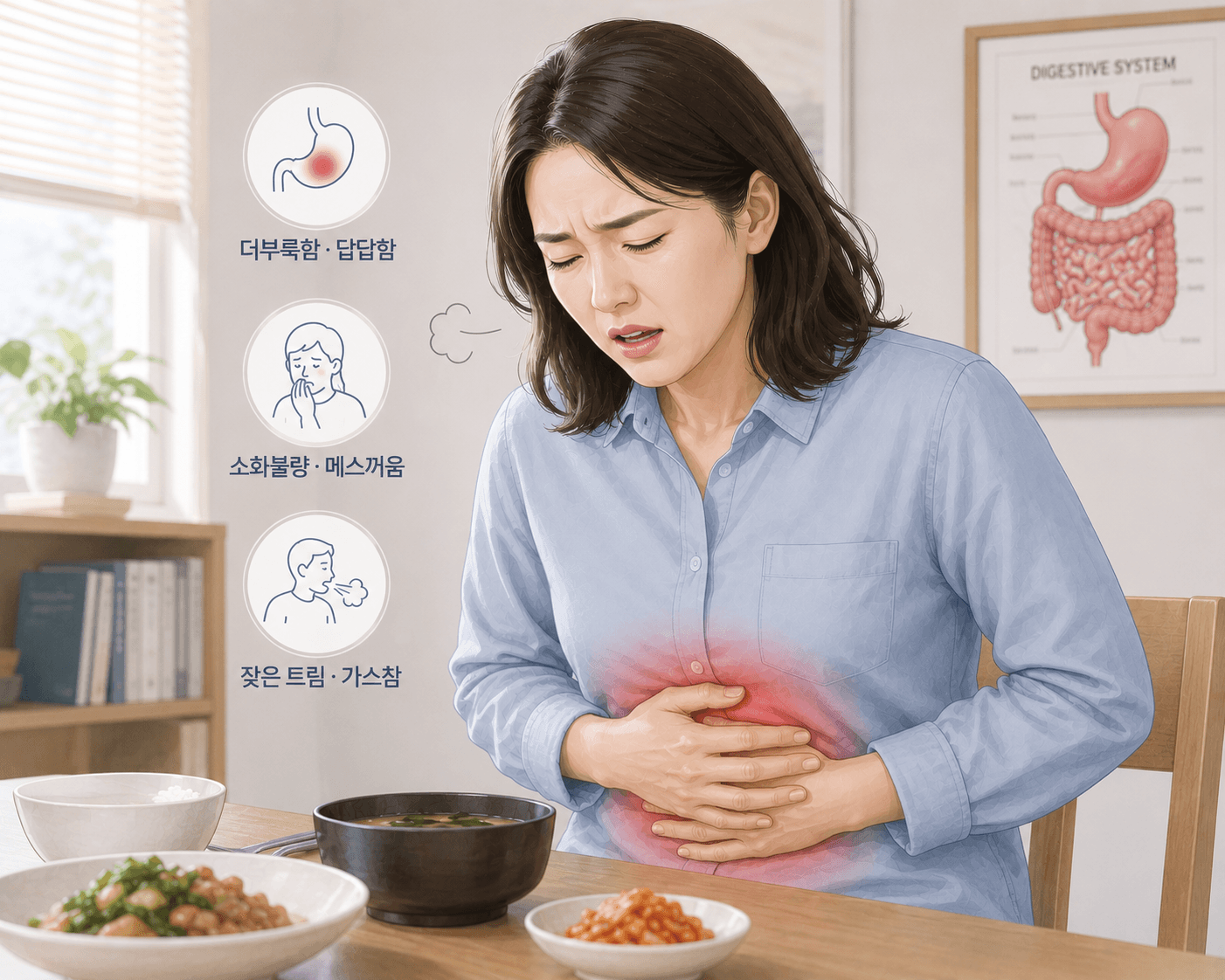
기능성소화불량 완치 가능할까? 반복되는 더부룩함의 원인부터 살펴보세요
조금만 먹어도 배가 꽉 찬 것처럼 답답하다면분명 많이 먹은 것도 아닌데 식사를 조금만 하면 금세 배가 꽉 찬 것처럼 느껴지고, 한참이 지나도 음식이 내려가지 않는 듯 답답할 때가 있습니다.트림이 계속 나오거나 가스가
명치가 너무 아파요..소화제만 먹기 전에 꼭 확인해야 할 원인들
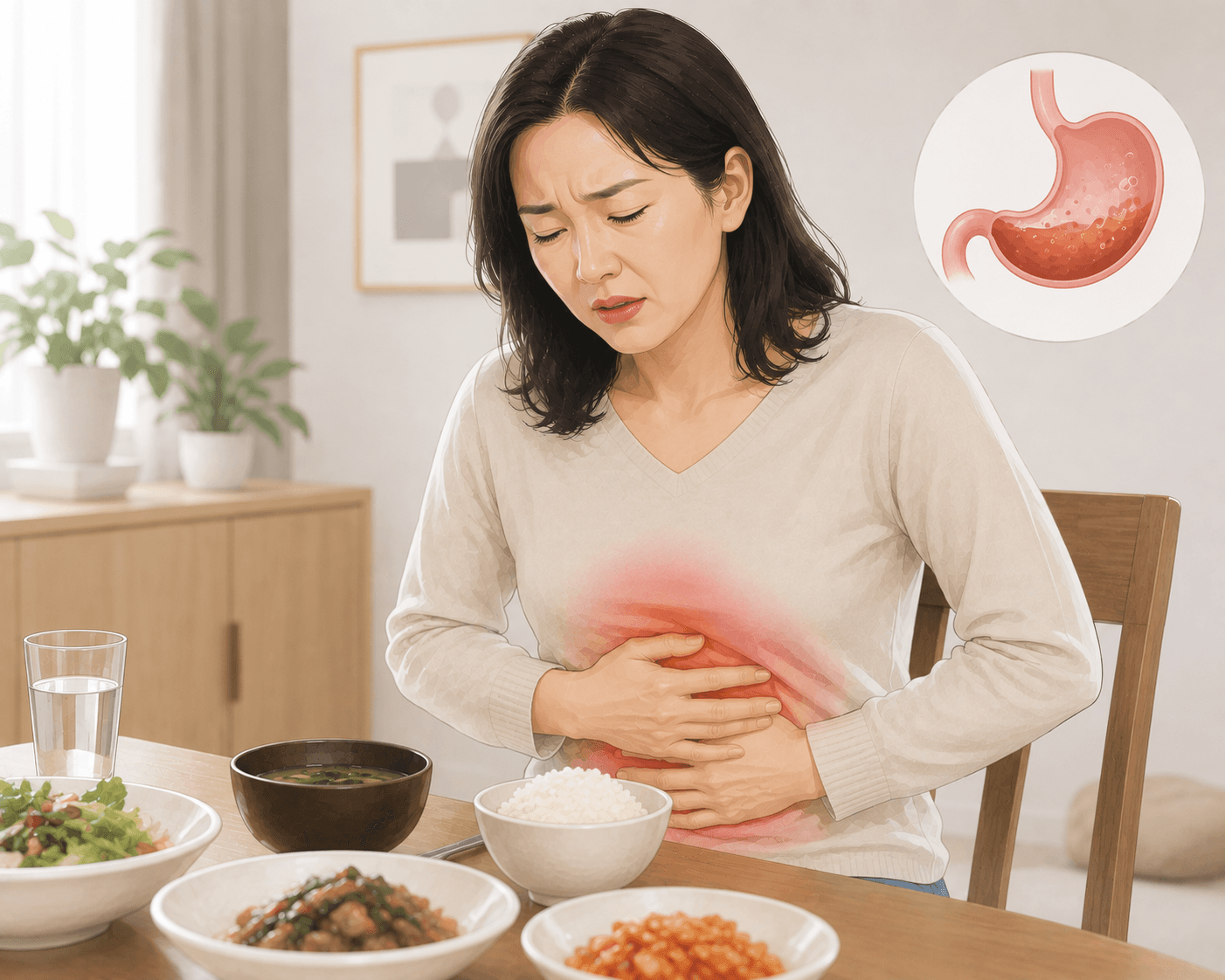
“명치가 너무 아파요” 갑자기 이런 통증이 시작됐다면가슴과 배가 만나는 한가운데가 꽉 막힌 것처럼 답답하고, 안쪽에서 조이는 듯한 통증이 반복되는 분들이 있습니다.처음에는 “체했나?”라고 생각하기 쉽습니다.실제로 명
생리전소화불량 치료방법, 소화제를 먹어도 답답하다면?
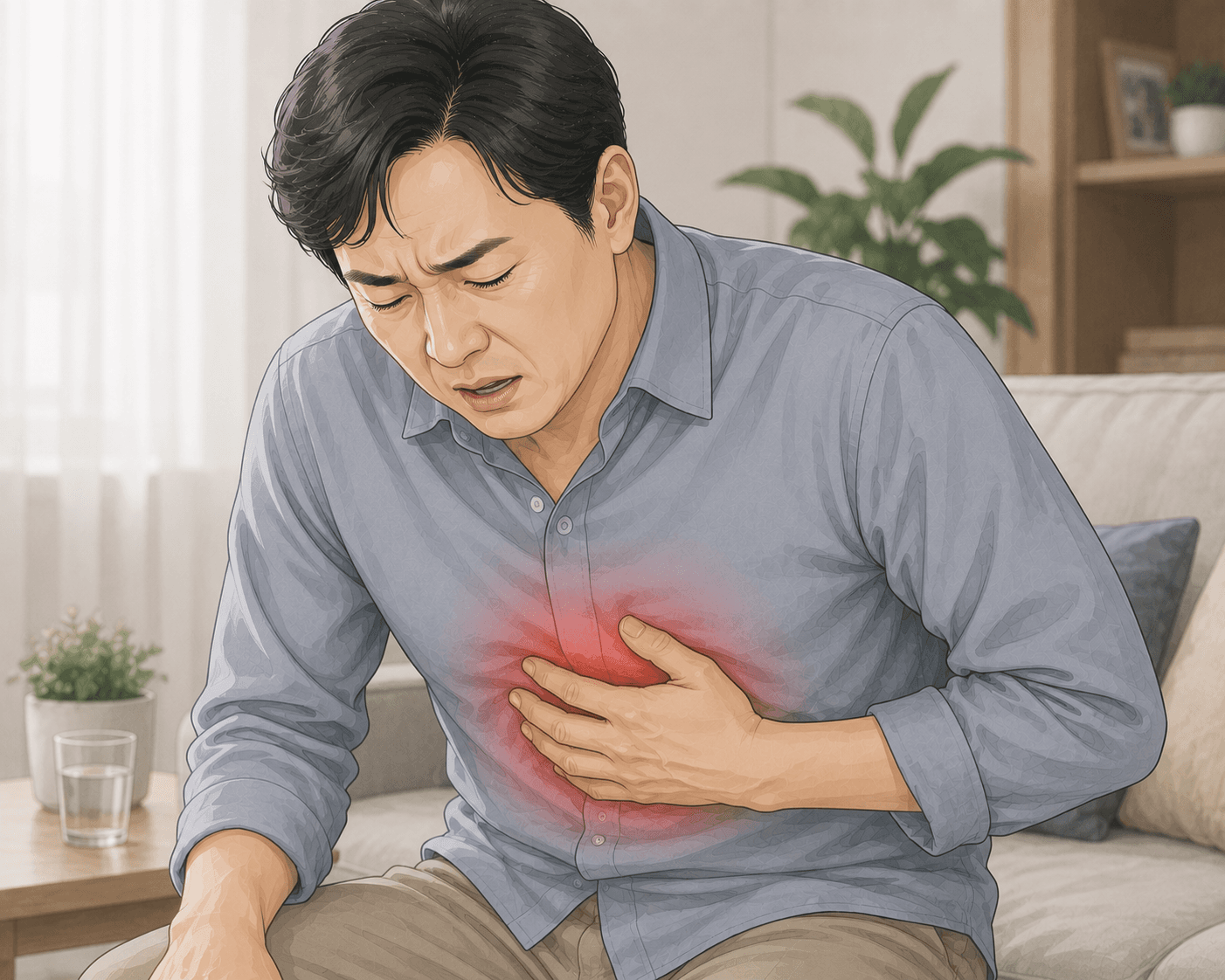
생리전소화불량, 생리만 다가오면 속이 더부룩해지는 이유평소에는 식사를 잘하다가도 생리 날짜가 가까워지면 유독 속이 더부룩하고 소화가 잘되지 않는 분들이 있습니다.음식을 조금만 먹어도 배가 빵빵해지는 느낌이 들고, 평

기능성소화불량정신과, 스트레스와 소화불량의 연결고리를 찾아야 합니다
소화가 안 되는 것도 힘든데, 마음까지 지쳐가고 있지는 않으신가요?식사를 해도 속이 편하지 않습니다.조금만 먹어도 금세 배가 부르고, 하루 종일 더부룩함이 이어집니다.병원 검사를 받아도 특별한 이상은 없다는 이야기를
소화불량 침 맞아도 다시 불편하다면, 위만 보고 있지 않았나요?
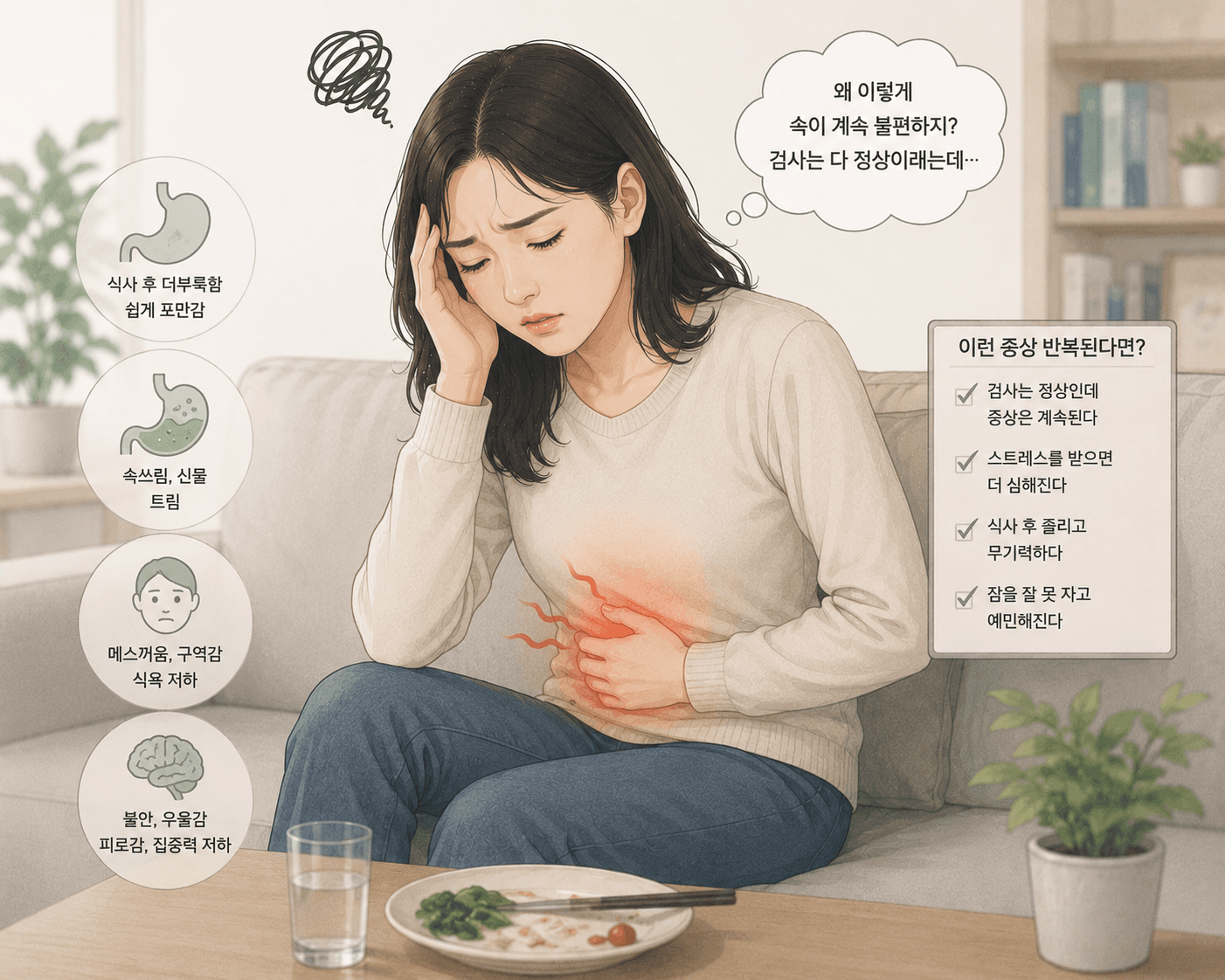
“조금만 먹어도 배가 꽉 찬 것 같아요.”“몇 시간이 지나도 음식이 그대로 남아 있는 느낌이에요.”“내시경에서는 괜찮다는데 저는 계속 불편해요.”소화가 안 되면 처음에는 음식 탓을 합니다.기름진 걸 먹었나, 너무 빨
이런 경우에는 바로 응급실로 가세요
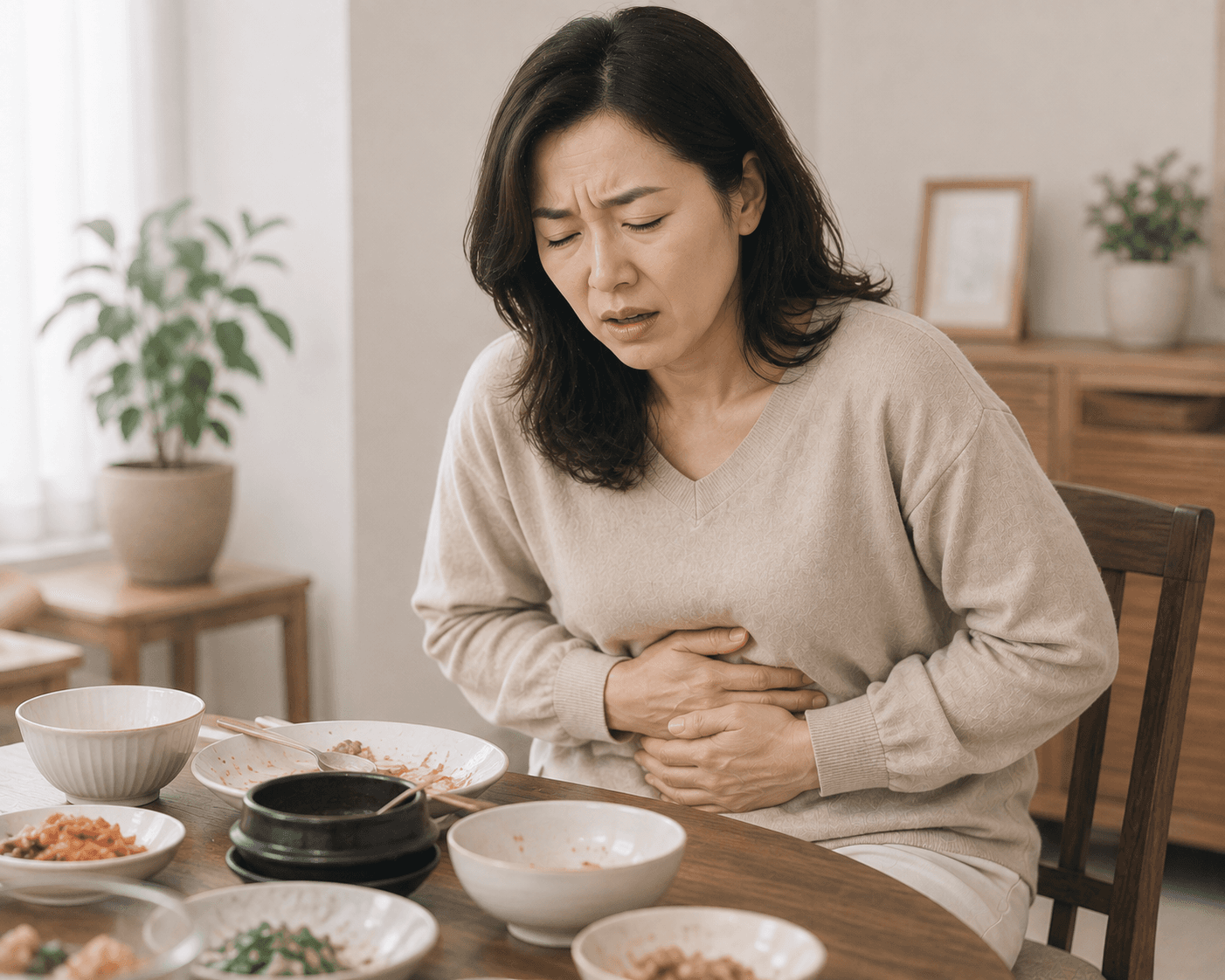
아래 증상은 궤양 출혈이나 위암, 심장 질환 같은 다른 병일 수 있습니다. 한의원보다 응급실(119)이나 내과를 먼저 찾으세요.
- 피를 토하거나 짜장면 같은 검은 변을 본다
- 갑자기 배가 찢어지듯 아프다
- 가슴이 조이듯 아프고 식은땀이 난다
- 이유 없이 체중이 빠지고 빈혈이 있다
- 음식을 삼키기 어렵거나 계속 토한다
참고문헌 5편
[1]Aziz I, Palsson OS, Törnblom H, Sperber AD, Whitehead WE, Simrén M. Epidemiology, clinical characteristics, and associations for symptom-based Rome IV functional dyspepsia in adults in the USA, Canada, and the UK: a cross-sectional population-based study. Lancet Gastroenterol Hepatol. 2018;3(4):252-262. doi:10.1016/s2468-1253(18)30003-7. PMID: 29396034.
요약 미국·캐나다·영국 성인 5,931명의 조사입니다. 약 10%가 로마 IV 증상 기준에 해당했습니다. 유형은 식후불편증후군 61%, 명치통증증후군 18%, 둘이 겹친 경우 21%였습니다.원문은 출판사 저작권 자료로, 위 링크에서 확인하실 수 있습니다.
[2]Sperber AD, Bangdiwala SI, Drossman DA, Ghoshal UC, Simren M, Tack J, et al. Worldwide Prevalence and Burden of Functional Gastrointestinal Disorders, Results of Rome Foundation Global Study. Gastroenterology. 2021;160(1):99-114.e3. doi:10.1053/j.gastro.2020.04.014. PMID: 32294476.
요약 33개국 성인 7만 3천여 명의 조사입니다. 인터넷 조사에서 40.3%가 기능성 위장 질환을 하나 이상 가졌고, 삶의 질이 낮고 진료를 더 자주 받았습니다.원문은 출판사 저작권 자료로, 위 링크에서 확인하실 수 있습니다.
[3]Yang JW, Wang LQ, Zou X, Yan SY, Wang Y, Zhao JJ, et al. Effect of Acupuncture for Postprandial Distress Syndrome: A Randomized Clinical Trial. Ann Intern Med. 2020;172(12):777-785. doi:10.7326/m19-2880. PMID: 32422066.
요약 식후불편증후군 278명을 침과 가짜 침으로 나누어 4주간 12회 치료한 중국의 다기관 연구입니다. 4주 뒤 반응률은 침 83.0%, 가짜 침 51.6%였고, 세 가지 주요 증상이 모두 사라진 비율은 27.8%와 17.3%였습니다. 효과는 치료 후 12주까지 유지되었고 심각한 이상반응은 없었습니다.원문은 출판사 저작권 자료로, 위 링크에서 확인하실 수 있습니다.
[4]Tominaga K, Sakata Y, Kusunoki H, Odaka T, Sakurai K, Kawamura O, et al. Rikkunshito simultaneously improves dyspepsia correlated with anxiety in patients with functional dyspepsia: A randomized clinical trial (the DREAM study). Neurogastroenterol Motil. 2018;30(7):e13319. doi:10.1111/nmo.13319. PMID: 29498457.
요약 일본 56개 병원의 위약 대조 연구입니다. 8주간 육군자탕을 먹은 군은 위약군보다 전반적 효과 평가가 좋았고, 식후 포만감과 복부 팽만이 줄었으며, 불안 개선은 소화 증상의 개선과 함께 움직였습니다.원문은 출판사 저작권 자료로, 위 링크에서 확인하실 수 있습니다.
[5]Ho L, Zhong CCW, Wong CHL, Wu JCY, Chan KKH, Wu IXY, et al. Chinese herbal medicine for functional dyspepsia: a network meta-analysis of prokinetic-controlled randomised trials. Chin Med. 2021;16(1):140. doi:10.1186/s13020-021-00556-6. PMID: 34930390.
초록 (Abstract)
Background: Prokinetic is the first-line conventional treatment for functional dyspepsia (FD) in Asia despite potential adverse events. Chinese herbal medicine (CHM) may be an effective and safe substitution. This network meta-analysis (NMA) aimed to evaluate the comparative effectiveness of different CHM formulae for FD against prokinetics.
Methods: Seven international and Chinese databases were searched from their inception to July 2020 for randomised controlled trials (RCTs) on CHM versus prokinetics. Data from each RCT were first pooled using random-effect pairwise meta-analyses and illustrated as risk difference (RD) or standardised mean difference (SMD) with 95% confidence interval (CI). Random-effect NMAs were then performed to evaluate the comparative effectiveness of CHM formulae and displayed as RD with 95% CI or SMD with 95% credible interval (CrI). The GRADE partially contextualised framework was applied for NMA result interpretation.
Results: Twenty-six unique CHM formulae were identified from twenty-eight RCTs of mediocre quality. Pairwise meta-analyses indicated that CHM was superior to prokinetics in alleviating global symptoms at 4-week follow-up (pooled RD: 0.14; 95% CI: 0.10–0.19), even after trim and fill adjustment for publication bias. NMAs demonstrated that Modified Zhi Zhu Decoction may have a moderate beneficial effect on alleviating global symptoms at 4-week follow-up (RD: 0.28; 95% CI: − 0.03 to 0.75). Xiao Pi Kuan Wei Decoction may have a large beneficial effect on alleviating postprandial fullness (SMD: − 2.14; 95% CI: − 2.76 to 0.70), early satiety (SMD: − 3.90; 95% CI: − 0.68 to − 0.42), and epigastric pain (SMD: − 1.23; 95% CI: − 1.66 to − 0.29). No serious adverse events were reported.
Conclusion: Modified Zhi Zhu Decoction and Xiao Pi Kuan Wei Decoction may be considered as an alternative for patients unresponsive to prokinetics. Confirmatory head-to-head trials should be conducted to investigate their comparative effectiveness against prokinetics.
Supplementary Information: The online version contains supplementary material available at 10.1186/s13020-021-00556-6.
결과 (Results)
Study selection and characteristics: A total of 1,927 citations were yielded from the literature search. 1,572 titles and abstracts were screened after deduplication. 110 potential full-texts then proceeded to further eligibility assessment. Finally, twenty-eight RCTs were included in this study. Selection process is illustrated in Fig. 1.
All RCTs were conducted in China, with only one of them published in English, and spanned 2004 to 2019 (Table 1). A total of 2,736 participants took part in the twenty-eight trials, with an average sample size of 98 (range, 56–202). Average age of the participants ranged from 24.0 to 54.6 years. Duration of their FD symptoms ranged from less than one year to over twenty-four years. Participants in twenty-three trials were diagnosed by the Rome III criteria, while those in the other five trials were diagnosed by the Rome II criteria. Fifteen out of twenty-eight RCTs adopted TCM diagnostic pattern as part of their inclusion criteria (Table 1). Nine unique TCM diagnostic patterns were included: food stagnation, liver qi invading the stomach, liver depression and spleen deficiency, cold-heat complex, liver qi depression, spleen deficiency and qi stagnation, spleen-stomach weakness, spleen qi deficiency, and spleen deficiency and dampness-heat.
Twenty-six unique CHM formulae were studied in the twenty-eight RCTs (Table 2). TCM function(s) of the CHM formulae corresponded to the diagnostic pattern(s) adopted in the fifteen RCTs according to TCM theories. Twenty-one formulae were compared against domperidone in twenty-three RCTs, with Liu Wei An Xiao Capsule and He Wei Decoction studied in two RCTs respectively. Five formulae were compared against mosapride in five RCTs. Treatment duration ranged from two to six weeks. Twenty trials had a length of follow-up of four weeks, while seven and one trials had a 2-week follow-up and 6-week follow-up, respectively.
Risk of bias assessment: The overall risk of bias among the included studies was mediocre, with none of them being at low risk, twenty-four having some concerns, and four being at high risk [Additional file 1: Appendix 2]. Those having some concerns did not implement blinding for trial participants, carers, and people delivering interventions. Moreover, they did not report details on allocation sequence generation or provide information on whether the data were analysed following a pre-specified analysis plan. For those at high risk of bias, despite limitations described, they did not report details on baseline differences groups.
Pairwise meta-analysis: Six pairwise meta-analyses were conducted to compare CHM with prokinetics in alleviating global symptoms, postprandial fullness, early satiety, and epigastric pain (Figs. 2, 3).
Alleviation of global symptoms: Compared to prokinetics, CHM had a stronger effect in alleviating global symptoms at 4-week follow-up (20 RCTs; pooled RD: 0.14; 95% CI: 0.10–0.19; p < 0.00001; I2 = 56%; low-quality of evidence) (Table 3). CHM was also superior to domperidone alone (17 RCTs; pooled RD: 0.16; 95% CI: 0.10–0.21; p < 0.00001; I2 = 57%; low-quality of evidence). Substantial heterogeneity was observed in both results. No significant difference was found between CHM and mosapride (3 RCTs; pooled RD: 0.07; 95% CI: − 0.03 to 0.17; p = 0.19; I2 = 34%; low-quality of evidence). At 2-week follow-up, CHM was more effective than prokinetics (7 RCTs; pooled RD: 0.14; 95% CI: 0.04–0.23; p = 0.005; I2 = 73%; moderate-quality of evidence) and domperidone alone (6 RCTs; pooled RD: 0.11; 95% CI: 0.02–0.20; p = 0.01; I2 = 61%; moderate-quality of evidence). High-level heterogeneity existed in both pooling results. The MCID of 0.20 RD was not met by any comparisons above.
Alleviation of postprandial fullness: When compared with prokinetics, CHM showed a stronger effect in alleviating postprandial fullness at 4-week follow-up (8 RCTs; pooled SMD: − 1.08; 95% CI: − 1.64 to − 0.51; p = 0.0002; I2 = 90%; moderate-quality of evidence) (Table 4), with the effect size exceeded the MCID of − 0.50 SMD. CHM was also superior to domperidone (6 RCTs; pooled SMD: − 0.81; 95% CI: − 1.37, − 0.24; p = 0.005; I2 = 88%; low-quality of evidence) and mosapride alone (6 RCTs; pooled SMD: − 1.97; 95% CI: − 3.79, − 0.16; p = 0.03; I2 = 93%; very low-quality of evidence). Substantial heterogeneity was detected in all results.
Alleviation of early satiety: There was no significant difference between CHM and domperidone in alleviating early satiety at 4-week follow-up (4 RCTs; pooled SMD: − 1.19; 95% CI: − 2.40 to 0.10; p = 0.05; I2 = 96%; very low-quality of evidence) (Table 4). High-level heterogeneity was observed in this comparison.
Alleviation of epigastric burning: No significant difference was found between CHM and domperidone in alleviating epigastric burning at 4-week follow-up (4 RCTs; pooled SMD: − 1.93; 95% CI: − 4.29 to 0.43; p = 0.11; I2 = 97%; very low-quality of evidence) (Table 4). High-level heterogeneity existed for this meta-analysis.
Alleviation of epigastric pain: CHM was more effective than domperidone in alleviating epigastric pain at 4-week follow-up (4 RCTs; pooled SMD: − 0.84; 95% CI: − 1.10 to − 0.58; p < 0.00001; I2 = 23%; low-quality of evidence), with moderate-level heterogeneity (Table 4). The effect size was higher than the MCID of − 0.50 SMD.
Sensitivity analysis: Sensitivity analysis comparing pooled results from “studies with some concerns over risk of bias” and “studies at high risk of bias” is illustrated in Fig. 4. There was no significant subgroup difference (p = 0.18) between the two groups, implying that the difference in risk of bias level did not influence the pooled results on global symptom alleviation at 4-week.
Publication bias assessment: Judging from visual inspection of contour-enhanced funnel plots [Additional file 1: Appendix 3a–3b], evidence of funnel plot asymmetry was observed, indicating the potential presence of publication bias favouring CHM in alleviating global symptoms at 4-week follow-up, as compared to all prokinetics and domperidone alone. After applying the trim and fill adjustment, CHM remained to be superior to prokinetics (adjusted RD: 0.10; 95% CI: 0.05–0.15) and domperidone alone (adjusted RD: 0.12; 95% CI: 0.06–0.17) (Table 3).
Network meta-analysis: Five star-shaped networks were devised to illustrate comparison networks of CHM formulae in alleviating global symptoms, postprandial fullness, early satiety, and epigastric pain against domperidone (Figs. 5, 6, 7). Another star-shaped network was used to illustrate the comparison network of CHM formulae in alleviating global symptoms against mosapride [Fig. 10]. The quality of evidence supporting each network is illustrated in Additional file 1: Appendix 4–9.
Alleviation of global symptoms: In the NMA of seventeen RCTs, no specific CHM formula was significantly better than domperidone or other CHM formulae in the network in alleviating global symptoms at 4-week follow-up (Table 5). Nevertheless, according to the partially contextualised framework, Modified Zhi Zhu Decoction (RD: 0.28; 95% CI: − 0.03 to 0.75) may have a moderate beneficial effect in alleviating global symptoms at 4-week, comparing to domperidone. It was the best-ranked intervention in the network (SUCRA: 0.85), as supported by low certainty of evidence (Table 6).
Similarly, in the NMA of six RCTs, no specific CHM formula was significantly superior to domperidone or other CHM formulae in the network in alleviating global symptoms at 2-week. Under the partially contextualised framework, both Cai Hu Shu Gan Powder (RD: 0.16; 95% CI: − 0.06 to 0.50) and Wei Kang Ping Decoction (RD: 0.16; 95% CI: − 0.07 to 0.49) may have a small beneficial effect in alleviating global symptoms at 2-week, as compared to domperidone. They were the best-ranked intervention in the network (SUCRA: 0.79), as supported by low certainty of evidence (Table 7).
In the NMA of three RCTs, no specific CHM formula was significantly more effective than mosapride or other CHM formulae in the network in alleviating global symptoms at 2-week (Table 8). According to the partially contextualised framework, Da Li Tong Granules (RD: 0.12; 95% CI: − 0.05 to 0.35) may have a small beneficial effect in alleviating global symptoms at 2-week, when compared to mosapride. It was the best-ranked intervention in the network (SUCRA: 0.85), as supported by low certainty of evidence (Table 9).
Alleviation of postprandial fullness: In the NMA of six RCTs, no specific CHM formulae were significantly superior to domperidone or other CHM formulae in alleviating postprandial fullness at 4-week (Table 5). However, based on the partially contextualised framework, Xiao Pi Kuan Wei Decoction (SMD: − 2.14; 95% CrI: − 2.76 to 0.70) may have a large beneficial effect on postprandial fullness alleviation at 4-week follow-up. It was the best-ranked intervention in the network (SUCRA: 0.85), and this finding was supported by low certainty of evidence (Table 10).
Alleviation of early satiety: In the NMA of four RCTs, Xiao Pi Kuan Wei Decoction was significantly more effective than domperidone in alleviating early satiety at 4-week follow-up (SMD: − 3.90; 95% CrI: − 0.68 to − 0.42) (Table 5). Under the partially contextualised framework, Xiao Pi Kuan Wei Decoction may have a large beneficial effect on early satiety alleviation at 4-week follow-up. It was the best-ranked intervention in the network (SUCRA: 0.92), as supported by low certainty of evidence (Table 10).
원문 발췌 · Ho L, Zhong CCW, Wong CHL, Wu JCY, Chan KKH, Wu IXY, Leung TH, Chung VCH, Chin Med 2021 · CC BY 4.0 라이선스에 따라 수정 없이 인용했습니다(본문 속 인용 번호는 생략).