

생리 첫날이면 아랫배를 쥐어짜는 통증에 아무것도 할 수 없습니다. 진통제를 먹어도 그때뿐이고, 달마다 그날이 오는 것이 무섭습니다. 생리통, 원래 다 그런 거라며 참는 게 맞을까요?
생리통 한눈에 보기
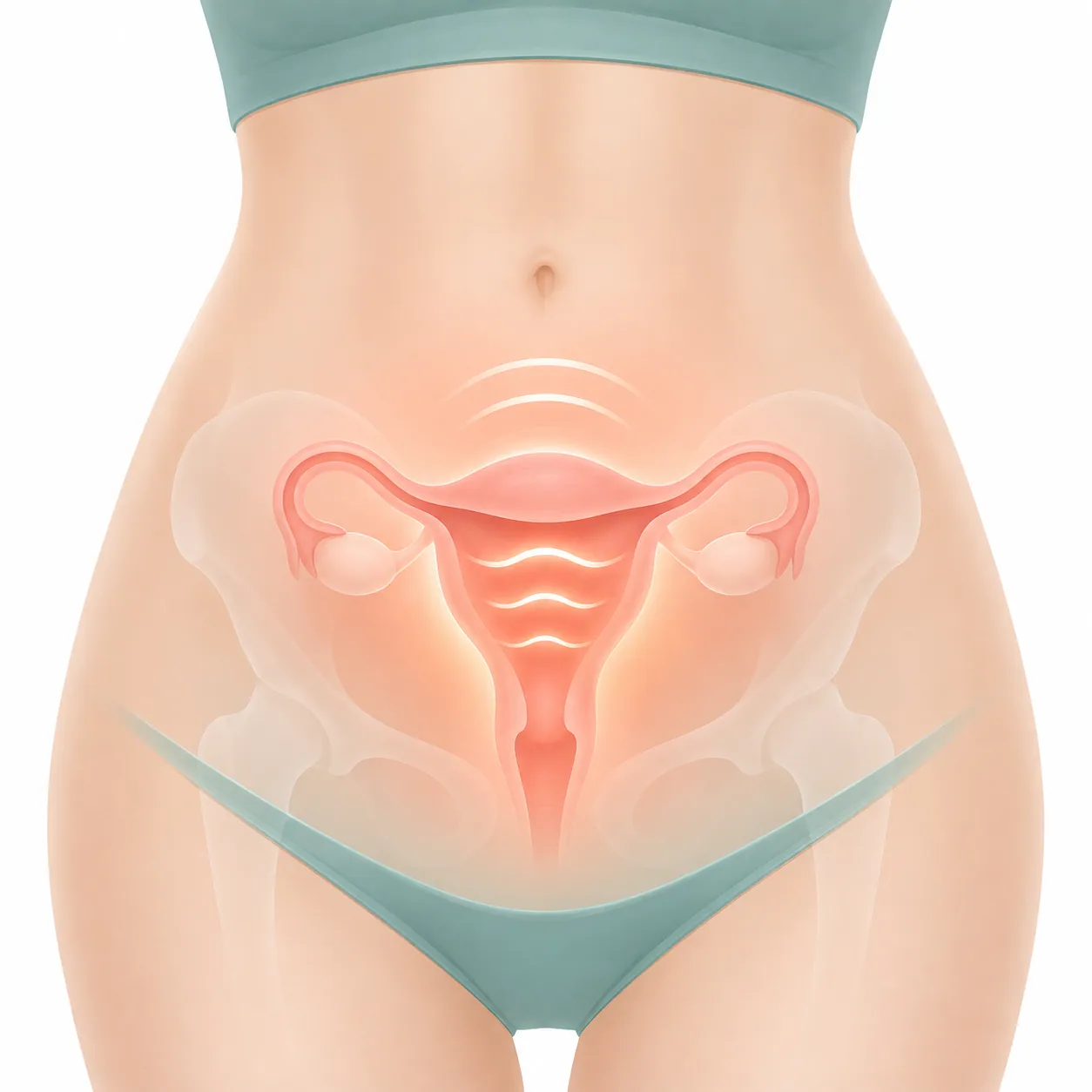
- 생리통은 생리 전후로 아랫배가 쥐어짜듯 아프고 허리, 골반, 두통, 메스꺼움까지 번지는 통증으로, 의학 용어로는 월경통이라고 합니다.
- 젊은 여성 10명 중 7명이 겪고, 소염진통제가 듣지 않는 분도 약 18%입니다. 없던 통증이 새로 생겼다면 자궁 질환 확인이 먼저이나, 자궁에 이상이 없는 생리통도 많습니다.
- 스트레스, 냉증, 소화·배변 문제가 자율신경과 얽혀 골반을 굳게 만들기 때문에, 체질에 따라 원인을 찾아 다스려야 합니다.
- 치료후기 10건
- 의료진 칼럼 4편
- 건강정보 15편
- 온라인 상담 5건
이런 증상이 있나요?
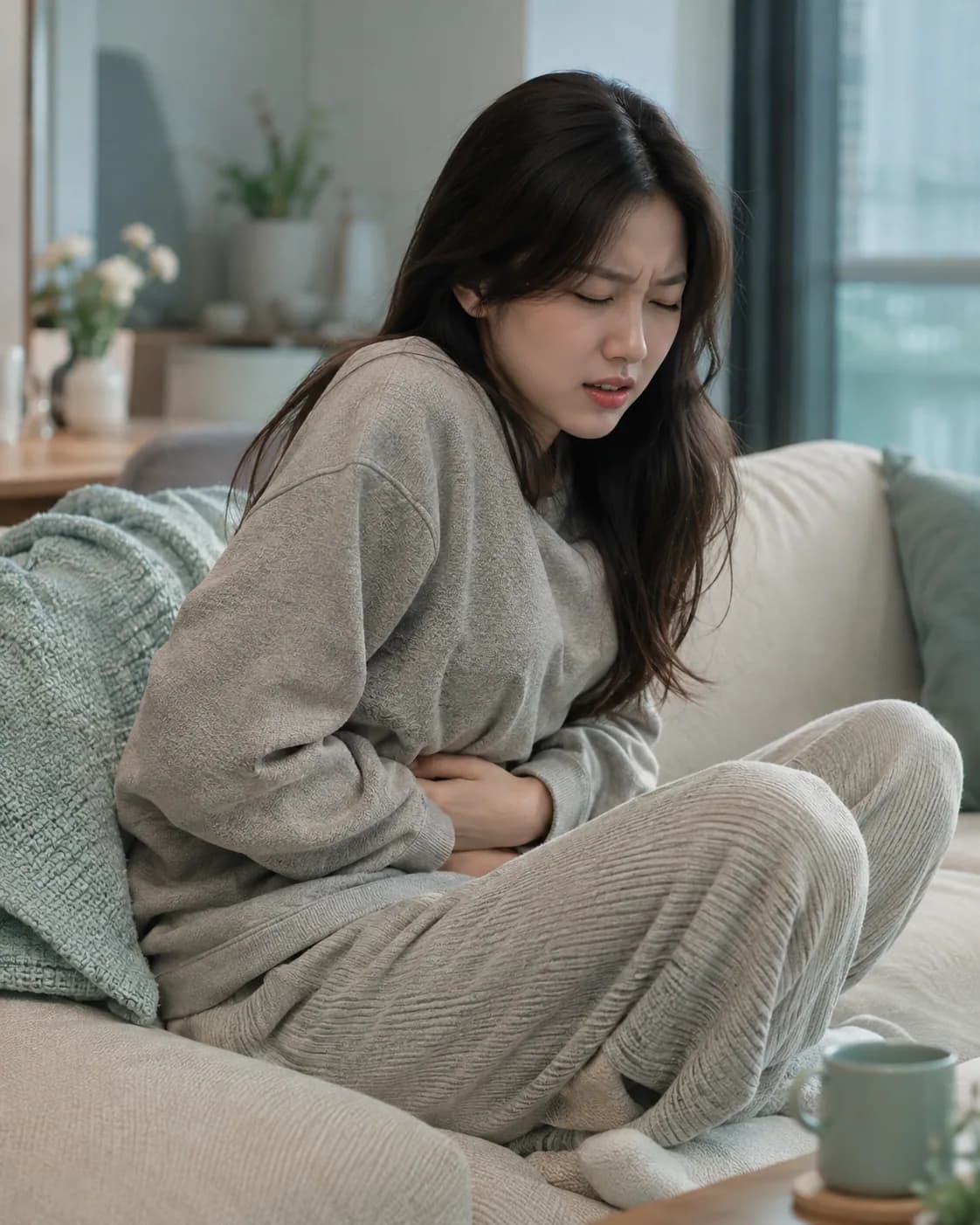
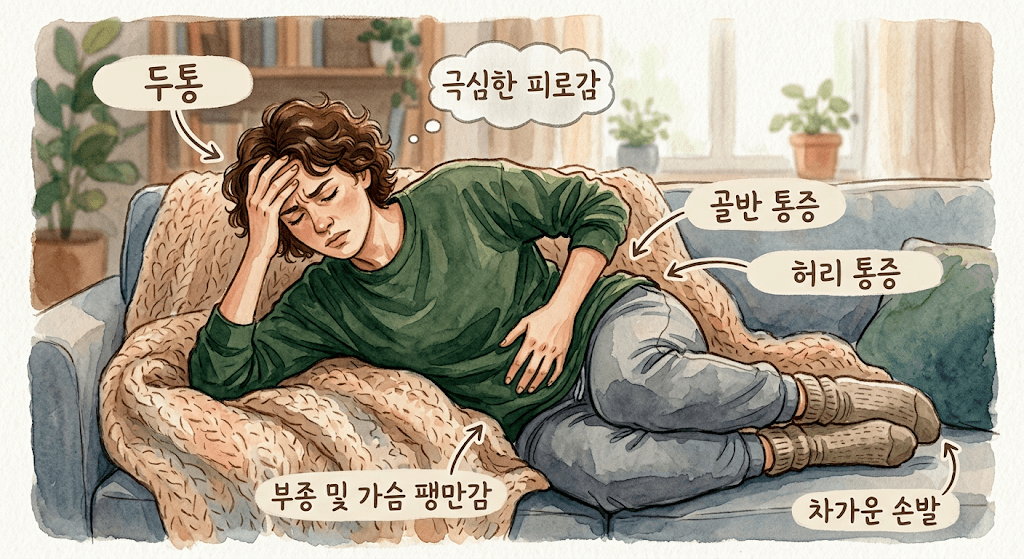
- 아랫배가 쥐어짜듯 아프고 밑이 빠질 것 같다
- 꼬리뼈와 허리까지 끊어질 듯 뻐근하다
- 생리 때 두통이나 어지럼증, 메스꺼움이 함께 온다
- 생리 며칠 전부터 가슴이 붓고 몸이 천근만근 무겁다
- 생리 때만 되면 변비나 가스가 심해진다
- 얼굴로는 열이 오르는데 아랫배와 손발은 얼음장처럼 차다
- 진통제를 먹어도 그때뿐이고 먹는 양이 점점 늘어난다
진단에서는 초경 무렵부터 이어진 통증인지, 없던 통증이 새로 생겼는지가 중요합니다. 초경 무렵부터 이어졌다면 원발성 생리통이 많고, 갑자기 생겼거나 점점 심해진다면 산부인과에서 초음파 검사로 자궁과 난소의 질환을 먼저 확인해야 합니다.
생리통은 왜 생기나요?
- 가족력: 어머니나 자매가 생리통을 겪었다면 위험 3.8배 이상
- 심한 스트레스와 긴장
- 수면 부족, 늦게 자는 습관
- 아랫배와 손발의 냉증
- 변비, 소화 불량
- 과로, 굶는 다이어트
생리통은 자궁만의 문제가 아닙니다. 스트레스가 높으면 생리통의 위험이 커지고[3], 유독 스트레스를 심하게 받은 달에 통증이 배로 심해지기도 합니다. 해움한의원은 피로와 스트레스로 교감신경이 항진되면 골반 주변 근육이 긴장하고 자궁으로 가는 혈관이 수축해 통증이 커진다고 봅니다. 잠도 얽혀 있습니다. 청소년 7,818명을 조사한 연구에서 우울은 생리통과 관련되어 있었고 수면의 질이 그 사이를 이었으며[4], 우리나라 여고생에서는 늦게 자는 습관이 생리통 점수에 영향을 주었습니다[5].
생리통의 표준 치료
생리통의 표준 치료는 소염진통제와 경구피임약입니다. 소염진통제는 자궁 수축 물질이 만들어지는 것을 막아, 위약에서 18%가 얻는 통증 완화를 45~53%가 얻게 합니다[1]. 다만 생리통 여성의 약 18%는 소염진통제가 잘 듣지 않습니다[6]. 경구피임약은 배란을 억제해 생리통과 생리량을 줄이는 약이고요. 둘 다 근본적인 해결책은 아닙니다.
진통제와 호르몬제는 통증을 일시적으로 누를 뿐, 굳은 골반 근육을 풀거나 차가운 아랫배의 순환을 되살리지는 못합니다. 스트레스, 변비, 냉증 같은 체질적 원인이 그대로 남아 있으면 통증은 매달 되풀이됩니다. 한의학 치료는 바로 이 바탕을 다스립니다.
한의원 생리통 치료에 대한 연구도 쌓여 있습니다. 침 치료는 60개 연구를 모은 분석에서 치료를 받지 않은 경우뿐 아니라 소염진통제보다도 생리통을 더 줄였습니다[7]. 당귀작약산은 진통제보다 치료 반응률이 1.31배 높았습니다[8]. 아랫배를 따뜻하게 하는 온열 치료도 진통제와 비교해 통증을 줄였습니다[9].
해움한의원은 이렇게 치료합니다

해움한의원은 아픈 날의 통증만 덜지 않고, 매달 되풀이되는 바탕을 찾아 치료합니다.
1단계. 원인이 되는 질환과 유형을 가립니다
통증이 시작된 시기와 양상, 생리량과 주기, 소화와 배변, 냉증을 자세히 살펴봅니다. 자궁 질환이 의심되면 산부인과 검사를 먼저 안내해 드립니다. 심박변이도와 적외선 체열검사로 자율신경의 균형과 아랫배의 냉증을 확인합니다.
2단계. 굳은 골반과 아랫배를 풉니다
침과 약침, 뜸으로 아랫배와 허리, 꼬리뼈 주변의 긴장을 풀고 순환을 돕습니다. 필요하면 추나로 골반의 균형을 바로잡습니다.
3단계. 유형에 맞춰 바탕을 다스립니다
체질과 상태에 맞춰 한약을 짓습니다.
4만 건의 처방 사례가 말해주는, 한방 맞춤 치료의 힘



생리통 치료후기 총 10건
환자분들이 남긴 치료후기입니다. 본문은 로그인 후 보실 수 있습니다.

극심한 생리통, 알고보니 자궁물혹이래요.. 아랫배 빵빵 생리통 심해짐, 한약으로 생리통 없어짐 가능할까요?
2025. 12. 27.
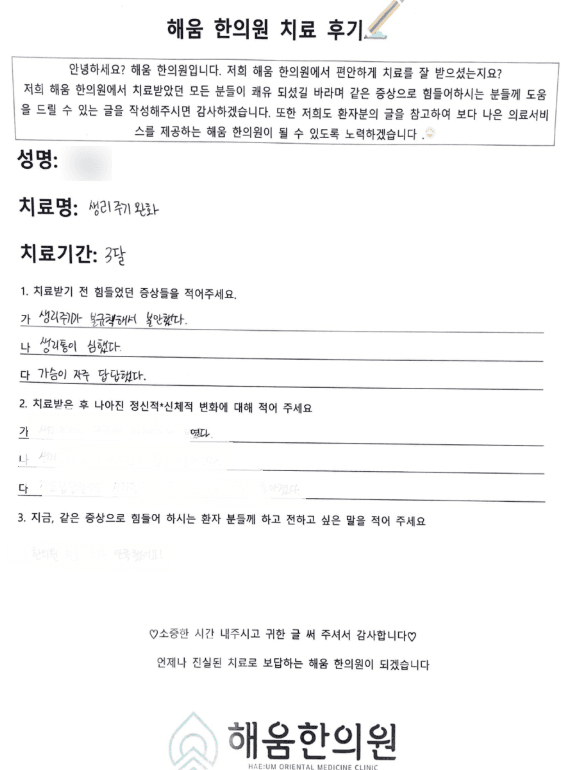
안하던 생리를 3일만에 시작했어요! 생리통 생리불규칙 무월경 몸이 가뿐해졌다는 환자 사례
2023. 12. 23.
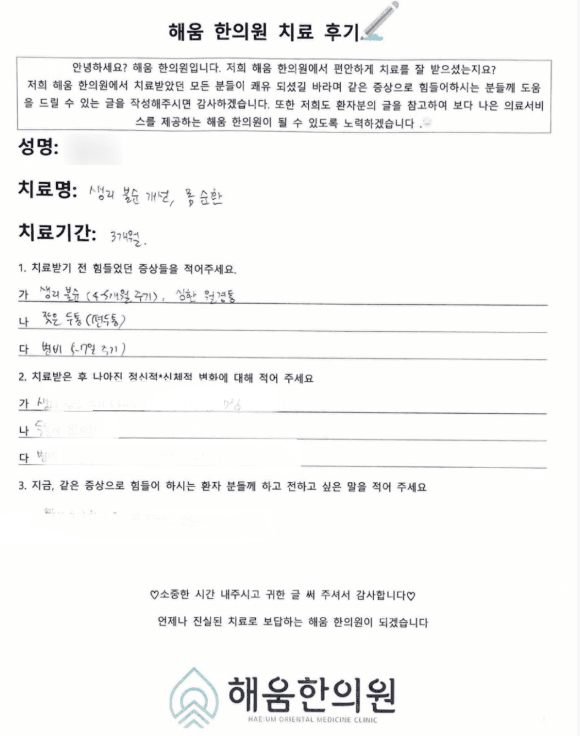
생리전증후군인가요? 진통제를 하루 8알씩.. 심각한 생리통 편두통 변비 한약 먹고 좋아진 사례
2023. 12. 13.
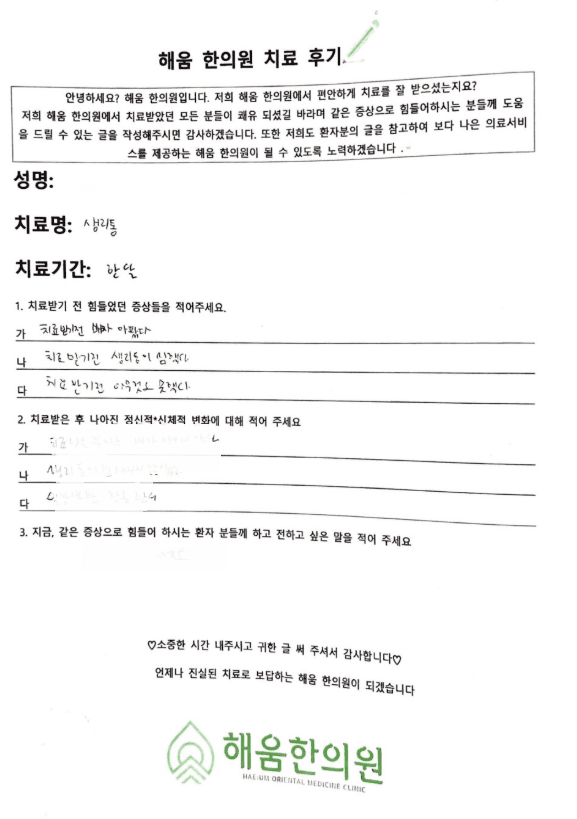
생리통 한약치료로 잘 낫나요? 귀여운 여중생의 한달
2022. 04. 12.
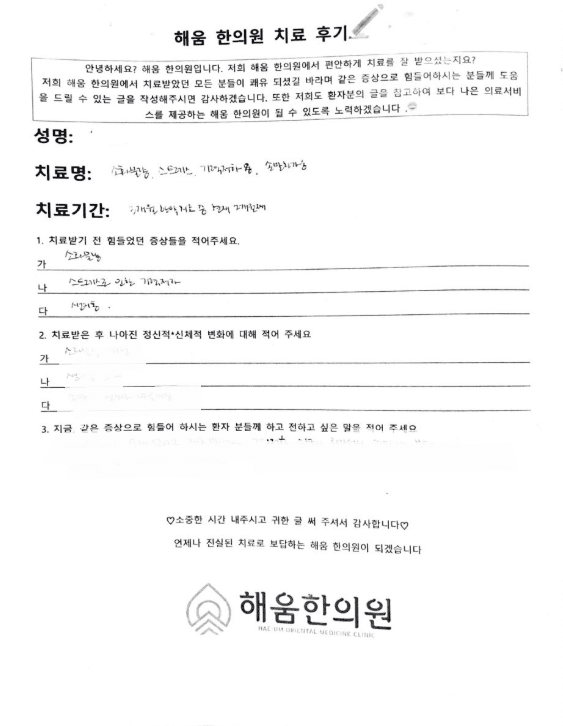
소화도 안되고 손발도 차고 생리통도 심하고.. 마르고 허약한 여자분 체질개선 치료기
2022. 03. 25.
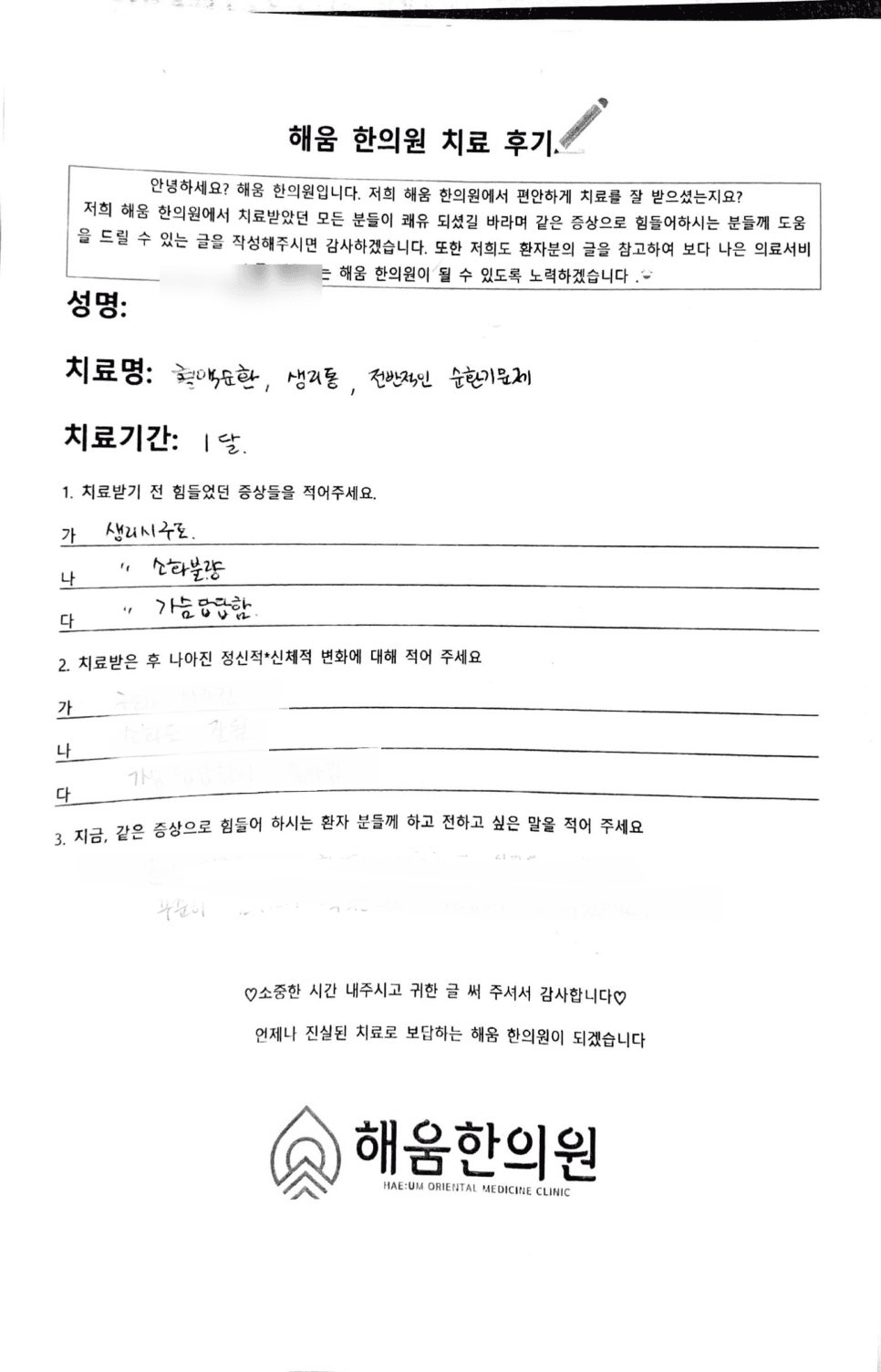
생리할때 구토, 소화불량, 가슴답답함으로 고생하셨던 환자분 1달만에 치료된 사례
2022. 03. 16.
생리통, 누가 진료하나요?
담당 의료진
대표원장 박재은

“병이 아니라 그 뒤의 사람을 봅니다”
경희대학교 한의과대학에서 석사·박사 과정을 마쳤습니다. 심리상담사 1급 자격과 4만 건 이상의 한약 처방 경험을 바탕으로 진료합니다.
의료진 소개 더보기생리통, 자주 묻는 질문
생리통은 원래 이렇게 심한 건가요?
진통제를 자주 먹어도 되나요?
시험 때만 되면 생리통이 심해질 수 있나요?
피임약이나 산부인과 치료와 같이 받아도 되나요?
청소년도 한약을 먹어도 되나요?
치료 기간은 얼마나 걸리나요?
생활에서 어떻게 관리해야 하나요?
해움한의원에서 생리통을 진료하나요?
생리통으로 내원하려면 어떻게 하나요?
생리통에 관해 알아두면 좋은 정보
15건생리통과 관련해 정리한 건강정보입니다.
생리아닌데갈색냉, 단순 현상일까 질환 신호일까
“생리도 아닌데 왜 갈색피가 나오죠?”샤워하다가속옷을 갈아입다가“생리도 아닌데 갈색피가 보여요”“갈색 냉이 계속 나와요”이런 상황, 정말 당황스럽죠.특히∙ 생리기간 아닌데 갈색피∙ 생리 아닌데 피∙ 생리 아닌데 갈색

여자아랫배땡김 콕콕 반복된다면, 생리 때문이라고 넘겨도 될까요?
아랫배가 콕콕 찌르듯 아픈데, 혹시 자궁에 문제가 생긴 걸까요?평소에는 괜찮다가 어느 날부터 아랫배가 묵직하게 당기거나 콕콕 찌르는 듯한 느낌이 반복되면 신경이 쓰일 수밖에 없습니다.특히 여성분들은 이런 증상이 생기
자궁내막얇음임신 준비 중이라면, 착상 환경부터 살펴보세요
“자궁내막이 얇아서 착상이 어려울 수 있다고 들었어요”임신을 준비하면서 생각보다 자주 듣게 되는 말 중 하나가 바로 **“자궁내막이 얇다”**는 이야기입니다.자연임신을 오랫동안 시도했거나 인공수정·시험관 시술을 준비
생리전유두가려움, 간지럽고 갈라지는 증상이 반복되는 이유는?
생리할 때만 되면 유두가 유독 가려워요평소에는 별다른 문제가 없는데 이상하게 생리가 가까워지면 유두 주변이 간지럽거나 따갑고 예민해지는 분들이 있습니다.처음에는 속옷 때문인가 싶어 바꿔보기도 하고, 피부가 건조해서
생리통갑자기심해짐, 진통제까지 잘 듣지 않는다면 이유가 뭘까요?
“원래 생리통이 거의 없었는데 이번에는 너무 아파요”평소 생리할 때도 크게 아프지 않았는데 어느 순간부터 아랫배를 쥐어짜는 것처럼 아프거나 허리까지 통증이 이어지는 경우가 있습니다.처음에는 이번 달에 유독 피곤해서
생리통은있는데생리를안해요, 배는 아픈데 생리가 시작되지 않는 이유
“분명 생리할 것처럼 아픈데 왜 시작을 안 할까요?”생리 예정일이 다가오면서 아랫배가 묵직하고 허리까지 뻐근합니다.평소 생리 전에 나타나던 것과 비슷해서 곧 시작하겠거니 생각했는데 며칠이 지나도 생리가 나오지 않습니

생리통없다가생김 원인은? 진통제도 듣지 않을 만큼 아프다면
“원래 생리통이 없었는데 갑자기 너무 아파요”평소에는 생리 기간에도 큰 불편함 없이 생활했는데, 어느 날부터 월경이 시작될 때마다 아랫배가 심하게 아프기 시작합니다.처음에는 일시적인 컨디션 문제라고 생각했지만 다음
생리늦어질때혈자리 관원혈·조해혈, 지압보다 중요한 근본 원인
“이번 달 생리가 왜 안 하지?” 불안해지는 순간이 있습니다여성이라면 한 달에 한 번 찾아오는 생리 주기에민감해질 수밖에 없습니다.평소에는 비슷한 날짜에 생리를 하다가도갑자기 며칠씩 늦어지면 걱정이 먼저 듭니다.“혹

생리통 속쓰림 반복된다면? 소화불량과 메스꺼움이 생기는 이유
생리통 속쓰림, 아랫배뿐 아니라 위장까지 불편한 이유생리 기간만 되면 아랫배가 아픈 것도 힘든데, 속까지 쓰리고 메스꺼워 식사조차 어려운 분들이 있습니다.평소에는 소화가 잘되다가도 생리가 시작될 무렵이면 갑자기 속이
생리통심할때응급실 방문이 필요할까? 심한 월경통의 원인과 치료
생리통심할때응급실 가야 할 정도라면? 참지 말고 원인부터 확인하세요생리 기간이 다가올 때마다 아랫배가 아프고 허리가 뻐근해지는 분들이 많습니다.그런데 단순히 불편한 정도를 넘어 식은땀이 나고, 구토가 나거나, 몸을
생리통 완화 지압 방법과 약 복용, 통증이 계속되는 이유
생리통 완화 약 지압 효과 없다면? 반복되는 통증의 원인생리 기간만 되면 아랫배가 묵직해지고 허리까지 뻐근해지는 분들이 있습니다.처음에는 참을 만한 통증이라 생각했지만, 시간이 지날수록 아픈 정도가 심해져 진통제를
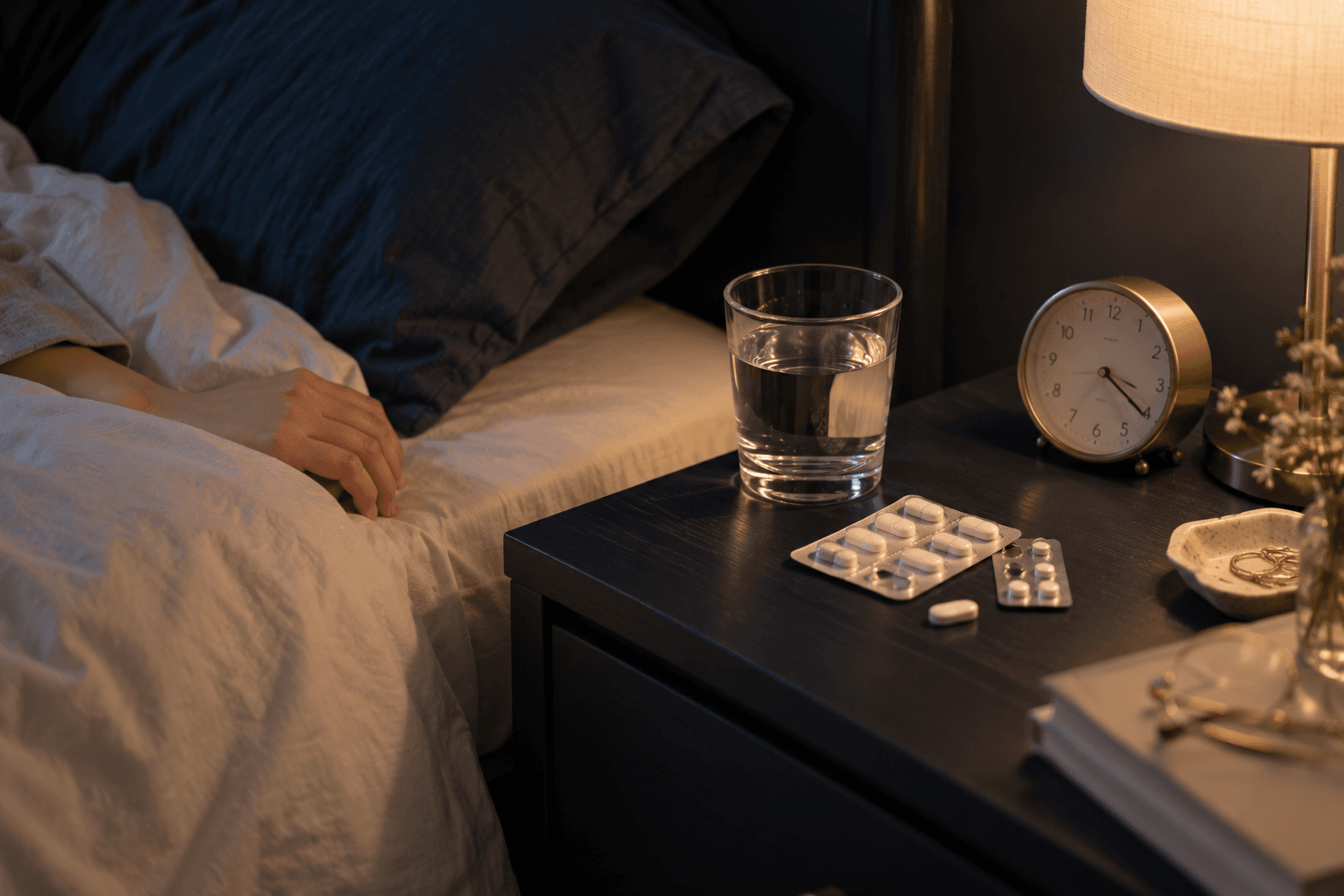
생리통 응급실 방문이 필요할 때와 심한 생리통 치료방법
생리통 응급실 갈 정도로 심하다면? 꼭 확인해야 할 원인생리 기간이 되면 아랫배가 묵직하거나 허리가 뻐근해지는 증상을 경험하는 분들이 많습니다.그런데 어떤 분들은 생리가 시작될 때마다 식은땀이 흐르고, 속이 메스꺼워
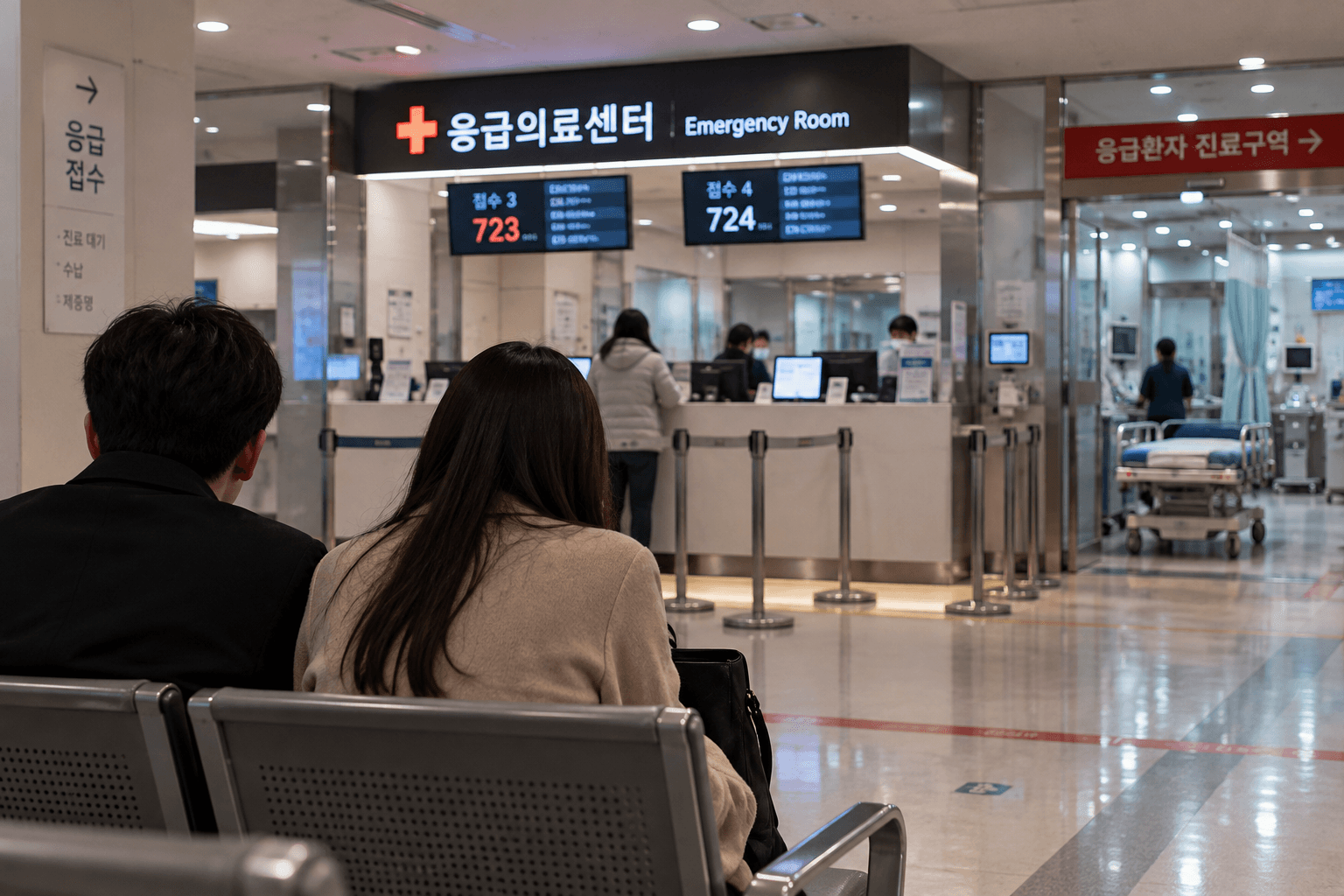
생리전속울렁, 단순 소화불량이 아니라 PMS 증상일 수 있습니다
생리 전만 되면 속이 울렁거리고 몸이 달라지는 느낌생리 날짜가 가까워질수록속이 메스껍고 울렁거리며,음식을 먹어도 편하지 않고괜히 토하면 나아질 것 같은 느낌이 들 때가 있습니다.가임기 여성에게 월경은한 달에 한 번

생리전냉증가 정상일까? 헷갈릴 때 꼭 알아야 할 기준
“생리 전인데 왜 이렇게 분비물이 많아질까요?”아침에 속옷이 평소보다 더 축축하게 느껴지거나, 냉의 양이 갑자기 늘어나 당황했던 경험 있으신가요?특히 생리 전에 이런 변화가 반복되면“혹시 질염인가?”“내 몸에 문제가

생리전배땡김, 배아픔, 배콕콕… 왜 매달 반복될까요?
“생리 전만 되면 배가 콕콕… 정상일까요?”생리 전만 되면 배가 당기고, 콕콕 찌르는 통증이 반복되시나요?어떤 날은 괜찮다가도, 어떤 달은 일상생활이 힘들 정도로 아프기도 하죠.“그냥 원래 그런 거겠지…” 하고 넘기

생리통, 질문 있어요
5건환자분들이 남긴 온라인 상담 질문과 의료진 답변입니다.
이런 경우에는 미루지 말고 진료를 받으세요
아래 증상은 생리통이 아니라 자궁외임신이나 골반 염증, 난소 질환일 수 있습니다. 지체하지 말고 응급실이나 산부인과를 먼저 찾으세요.
- 임신 가능성이 있는데 심한 복통이나 출혈이 있다: 119
- 갑자기 극심한 복통이 시작되어 움직일 수 없거나 정신이 아득하다: 119
- 고열과 함께 아랫배가 아프거나 냄새나는 분비물이 나온다
- 생리량이 갑자기 늘어 한 시간에 패드를 한 장 이상 적신다
- 없던 생리통이 새로 생겼거나 달마다 점점 심해진다
참고문헌 9편
[1]Marjoribanks J, Ayeleke RO, Farquhar C, Proctor M. Nonsteroidal anti-inflammatory drugs for dysmenorrhoea. Cochrane Database Syst Rev. 2015:CD001751. doi:10.1002/14651858.cd001751.pub3. PMID: 26224322.
요약 80개 연구, 5,820명을 모은 코크란 리뷰입니다. 원발성 생리통 여성은 프로스타글란딘 수치가 높습니다. 소염진통제는 위약보다 통증을 잘 줄여, 위약에서 18%가 얻는 통증 완화를 45~53%가 얻었습니다. 소화기·신경계 부작용은 더 많았습니다.원문은 출판사 저작권 자료로, 위 링크에서 확인하실 수 있습니다.
[2]Armour M, Parry K, Manohar N, Holmes K, Ferfolja T, Curry C, et al. The Prevalence and Academic Impact of Dysmenorrhea in 21,573 Young Women: A Systematic Review and Meta-Analysis. J Womens Health (Larchmt). 2019;28(8):1161-1171. doi:10.1089/jwh.2018.7615. PMID: 31170024.
요약 젊은 여성 21,573명을 다룬 38개 연구의 메타분석입니다. 생리통 유병률은 71.1%였고, 20.1%는 생리통으로 학교에 결석했으며, 40.9%는 수업이나 집중에 지장을 받았습니다.원문은 출판사 저작권 자료로, 위 링크에서 확인하실 수 있습니다.
[3]Ju H, Jones M, Mishra G. The prevalence and risk factors of dysmenorrhea. Epidemiol Rev. 2014;36:104-113. doi:10.1093/epirev/mxt009. PMID: 24284871.
요약 지역사회 연구 15편을 정리한 리뷰입니다. 가임기 여성의 생리통 유병률은 16~91%, 심한 통증은 2~29%였습니다. 나이가 많을수록, 출산 경험이 있을수록, 경구피임약을 쓸수록 적었고, 스트레스가 높으면 위험이 커졌습니다. 가족력은 위험을 3.8~20.7배 높였습니다.원문은 출판사 저작권 자료로, 위 링크에서 확인하실 수 있습니다.
[4]Li Y, Kang B, Zhao X, Cui X, Chen J, Wang L. Association between depression and dysmenorrhea among adolescent girls: multiple mediating effects of binge eating and sleep quality. BMC Womens Health. 2023;23(1):140. doi:10.1186/s12905-023-02283-6. PMID: 36978063.
초록 (Abstract)
Background: Dysmenorrhea has a significant negative impact on teenagers’ quality of life, and its prevalence is increasing annually. Although studies have explored the factors affecting dysmenorrhea, it remains unclear how these factors interact with one another. This study aimed to explore the mediating role of binge eating and sleep quality between depression and dysmenorrhea.
Methods: This cross-sectional study recruited adolescent girls from the Health Status Survey of adolescents in Jinan, Shandong Province, and used multistage stratified cluster random sampling. Data was collected using an electronic questionnaire between March 9, 2022, and June 20, 2022. The Numerical Rating Scale and Cox Menstrual Symptom Scale were used to assess dysmenorrhea and the Patient Health Questionnaire-9 to assess depression. The mediation model was tested by Mplus 8.0, and the mediating effect was analyzed using the Product of Coefficients approach and the Bootstrap method.
Results: Among the total of 7818 adolescent girls included in this study, the prevalence of dysmenorrhea is 60.5%. A significant positive association was found between dysmenorrhea and depression. Binge eating and sleep quality seemingly mediate this association. The mediating effect of sleep quality (21.31%) was greater than that of binge eating (6.18%).
Conclusions: The findings of this study point in the right direction for preventing and treating dysmenorrhea in adolescents. For adolescent dysmenorrhea, mental health should be considered and proactive steps taken for educating adolescents on healthy lifestyles to reduce negative consequences of dysmenorrhea. Longitudinal studies on the causal link and influence mechanisms between depression and dysmenorrhea should be conducted in the future.
Supplementary Information: The online version contains supplementary material available at 10.1186/s12905-023-02283-6.
결과 (Results)
Sample characteristics: The mean age of the 7,818 adolescent girls included in this study was 15.71 ± 1.617 years. The prevalence of dysmenorrhea is 60.5% (n = 4732), and that of mild, moderate, severe, and very severe dysmenorrhea was 12.8%, 33.7%, 12.4%, and 1.6%, respectively. In addition, information about the frequency of CMSS and PHQ-9 are shown in Supplementary Table 3 and 4.
Table 1 summarizes the sociodemographic information of the 4,732 girls with dysmenorrhea and the univariate analysis of the total CMSS scale score in the subgroups of different category variables. Univariate analysis showed that age, type of school, boarding at school, maternal history of dysmenorrhea, sleep duration, sleep quality, and binge eating were significantly associated with dysmenorrhea.Table 1Characteristics of the sample (N = 4732)VariablesN(%)CMSS ScoreH/ZPM(P25-P75)Observation variable4732(100.0)27.0(14.00–45.00)Age59.259a0.000 10–13394(8.3)19.0(8.75–34.00) 14–173611(76.3)27.0(14.00–46.00) 18–20727(15.4)30.0(15.00–48.00)Type of school173.956a0.000 Junior high school1776(37.5)21.0(10.00–37.00) Vocational high school844(17.8)33.0(18.00–56.00) Senior high school2112(44.6)30.0(15.25–48.00)Father's education0.586a0.746 Junior high school and below2371(50.1)27.0(14.00–45.00) Senior high school1242(26.2)26.0(13.00–45.00) Bachelor’s/college degree and above1119(23.6)27.0(14.00–45.00)Mother’s education3.582a0.167 Junior high school and below2677(56.6)26.0(13.00–45.00) Senior high school1101(23.2)26.0(13.00–45.00) Bachelor’s/college degree and above954(20.2)29.0(14.00–46.00)Boarding at school2.198b0.028 Yes2130(45.0)28.0(14.00–47.00) No2602(55.0)26.0(14.00–44.00)Mother's history of dysmenorrhea49.071a0.000 Yes2305(48.7)29.0(16.00–48.00) No1050(22.2)23.0(10.00–41.00) No clear1377(29.1)27.0(14.00–45.00)Sleep duration61.692a0.000 Inadequate3348(70.8)29.0(15.00–47.00) Normal1351(28.6)23.0(10.00–40.00) Excessive33(0.7)30.0(21.00–59.50)Sleep quality906.332a0.000 Good1953(41.3)17.0(8.00–32.00) General2195(46.4)31.0(18.00–46.00) Poor584(12.3)55.0(36.00–76.00)Binge eating265.551a0.000 Often126(2.7)43.0(19.75–69.00) Sometimes1223(25.8)36.0(21.00–56.00) Never3383(71.5)23.0(11.00–40.00)CMSS the Cox Menstrual Symptom ScaleaKruskal-wallis testbMann-Whitney U test
Preliminary analyses: Table 2 presents the Spearman’s rank correlation coefficients for the main study variables. Depression was positively associated with dysmenorrhea (r = 0.543, p < 0.01), binge eating behavior (r = 0.262, p < 0.01), and poor sleep quality (r = 0.334, p < 0.01). Binge eating behavior was positively associated with dysmenorrhea (r = 0.237, p < 0.01) and poor sleep quality (r = 0.112, p < 0.01). Poor sleep quality was positively associated with dysmenorrhea (r = 0.428, p < 0.01).Table 2The correlations among the main study variablesVariables1234Depression score1CMSS score0.543**1Binge eating0.262**0.237**1Sleep quality0.334**0.428**0.112**1CMSS the Cox Menstrual Symptom Scale** p < 0.01
Testing for the mediating effect: The mediator model showed an acceptable fit: χ2/df = 1.705, CFI = 0.994, TLI = 0.990, RMSEA = 0.012, and SRMR = 0.059.
As shown in Table 3 and Fig. 1, binge eating and sleep quality had partial mediating effects on depression and dysmenorrhea, respectively. The difference in the mediating effects between binge eating and sleep quality was statistically significant (Table 4), and the mediating effect of sleep quality (21.31%) was greater than that of binge eating (6.18%); however, the binge eating to sleep quality pathway was not statistically significant (P = 0.213).Table 3The chained mediation model and 95% CIsModel pathwaysPointEstimateProduct of CoefficientsBootstrap 5000 Times95%CIS.EEst./S.EP ValueLowerUpperPath A0.1070.00813.6440.0000.0920.122Path B0.0310.0056.2170.0000.0220.042Path C0.0020.0021.2450.213-0.0020.006Path D0.3620.01820.4750.0000.3230.391Total indirect0.1400.00915.5180.0000.1230.158Total0.5020.01534.5420.0000.4670.565Adjusted for age, school type, educational level of parents, boarding at school, mother's history of dysmenorrhea, and sleep duration. The values listed in the table are all standardized values. S.E Standard errorPath A: Depression- > Sleep Quality- > DysmenorrheaPath B: Depression- > Binge Eating- > DysmenorrheaPath C: Depression- > Binge Eating- > Sleep quality- > DysmenorrheaPath D: Depression- > DysmenorrheaFig. 1Mediating effects of binge eating and sleep quality on depression and dysmenorrhea. Note: adjusted for age, school type, educational level of parents, boarding at school, mother's history of dysmenorrhea, and sleep duration. Standardized pathway coefficients are shown outside in parentheses, and standard errors are shown in parentheses, * p < 0.01Table 4The parallel mediation, 95% CIs and comparison between the mediation effectsModel pathwaysPointEstimateProduct of CoefficientsBootstrap 5000 Times95%CIS.EEst./S.EP ValueLowerUpperIndirect Effects Path AB10.1530.0236.6330.0000.1120.205 Path AB20.5000.03514.2050.0000.4360.575 Total indirect0.6530.04315.0630.0000.5780.747 Direct1.6260.08020.2250.0001.4641.775 Total2.2790.04732.1350.0002.1372.418Contrast Path AB1 vs. Path AB2-0.3470.041-8.4910.000-0.428-0.270Note: adjusted for age, school type, educational level of parents, boarding at school, mother's history of dysmenorrhea, and sleep duration. The values listed in the table are all non-standardized values. S.E Standard errorPath AB1: Depression- > Binge eating- > DysmenorrheaPath AB2: Depression- > Sleep Quality- > Dysmenorrhea
원문 발췌 · Li Y, Kang B, Zhao X, Cui X, Chen J, Wang L, BMC Womens Health 2023 · CC BY 4.0 라이선스에 따라 수정 없이 인용했습니다(본문 속 인용 번호는 생략).
[5]Jeong D, Lee H, Kim J. Effects of sleep pattern, duration, and quality on premenstrual syndrome and primary dysmenorrhea in korean high school girls. BMC Womens Health. 2023;23(1):456. doi:10.1186/s12905-023-02600-z. PMID: 37641079.
초록 (Abstract)
Background: Sleep deprivation is known to be a risk factor for premenstrual syndrome and primary dysmenorrhea in adults. However, it has rarely been investigated in adolescents. The aim of this study was to investigate whether sleep pattern, duration, and quality independently affect premenstrual syndrome and primary dysmenorrhea in adolescent girls. An additional purpose was to investigate the sleep status in Korean adolescent girls during the COVID-19 pandemic.
Methods: A cross-sectional survey study was conducted in 519 high school girls aged 15 to 18 years in Gyeonggido, South Korea, in 2021 during the COVID-19 lockdown. Menstrual pain intensity and menstrual symptoms were assessed using the visual analogue scale (VAS) and Cox menstrual symptom scale (CMSS), respectively. Premenstrual syndrome was assessed by the premenstrual symptoms screening tool (PSST). Sleep was assessed by the Pittsburgh Sleep Quality Index (PSQI). The known risk factors of dysmenorrhea, including menstrual and lifestyle characteristics and stress, were assessed as covariates.
Results: During the pandemic, approximately 68% of girls slept 7 h or less, while about 60% reported poor sleep quality. Additionally, 64% of participants had a bedtime later after 1AM, and 34% woke up later after 8AM. Late bedtime significantly affected VAS (P = 0.05), CMSS severity and frequency (both P < 0.01), and PSST symptom (P < 0.01). Waking up late affected CMSS severity (P < 0.05), PSST symptom (P = 0.05), and PSST function (P < 0.05). However, the significance of these effects disappeared after controlling for covariates. Sleeping less than 5 h affected CMSS frequency (P < 0.05) and PSST symptoms (P < 0.001). After controlling for covariates, the significance of the effect on PSST symptom remained (P < 0.05). General sleep quality and PSQI components, including subjective sleep quality, sleep latency, sleep disturbance, use of sleeping medication, and daytime dysfunction, significantly affected CMSS frequency and severity and PSST symptom after controlling for covariates (P < 0.05, P < 0.01, or P < 0.001). The multiple regression analysis revealed that among sleep characteristics, sleep quality was the most important risk factor of premenstrual syndrome and dysmenorrhea.
Conclusion: Our study result heightens the importance of healthy sleep hygiene, especially sleep quality in the management of premenstrual syndrome and dysmenorrhea in adolescent girls.
결과 (Results)
Participant characteristics: Most participants had dysmenorrhea, with 17.3% (n = 90) experiencing mild pain (0 < VAS < 3) and 76.5% (n = 397) experiencing moderate-to-severe pain (3 ≦ VAS), while 6.2% had no pain (VAS = 0) when dysmenorrhea was defined by the intensity of menstrual pain measured by VAS. Regarding classification of PMS defined by PSST, 60.9% of participants (n = 316) reported either no symptoms or mild symptoms, whereas 39.1% of them (n = 203) experienced moderate-to-severe PMS symptoms. Additionally, 4.8% of the participants (n = 25) did not report any of the 14 PMS symptoms and 5 functional impairments.
Characteristics of 519 study participants are presented in Table 1. The study participants were high-school students (1st year to 3rd year) with a mean age of 16.2 ± 0.8 years (aged 15 to 18 years). Most participants had their menarche after 12 years (71.7%) and had a normal length of menstrual cycle (89.2%) and period length (86.7%). About half of them had an irregular menstrual cycle, and 22.5% of participants had heavy menstrual volume. About 36% of them had a family history of dysmenorrhea. The majority of participants were non-smokers (94.4%), did not drink alcohol beverages (79.8%), ate breakfast (77.8%), consumed caffeine beverages (60.9%), and did not engage in moderate or vigorous exercise (79.4%). The average PSS score of participants was 20.6 ± 6.1, and the mean sleep duration of participants was 6.2 ± 1.6 h. Overall, 59.7% of the total sample had a global PSQI score of more than 5, indicating poor sleep quality.
Differences in participant characteristics between the groups with good and poor sleep quality are presented in Table 1. Among menstrual and lifestyle characteristics, period regularity (P < 0.001), volume of menstrual fluid (P < 0.01) and caffeine consumption (P < 0.01) showed the significant group-differences, revealing that proportions of irregular menstrual cycle, heavy menstrual volume, and caffeine consumer were higher in the group with poor sleep quality. There were no group-differences in all other menstrual and lifestyle characteristics, age, and BMI. Significant group-differences were observed in PSS, sleep duration, and the global PSQI score, as well as average scores for the 7 PSQI components (P < 0.01 or P < 0.001), revealing a higher stress level, higher PSQI scores, and shorter sleep time in the group with poor sleep quality.
Sleep and menstrual characteristics during the COVID-19 pandemic: The sleep pattern of Korean high school girls during the COVID-19 pandemic and menstrual differences according to sleep pattern are shown in Table 2. The proportion of participants who went to bed between 10PM and 1AM was 36%, and the rest of them slept after 1AM. The CMSS severity and frequency, as well as the number of moderate-to-severe PSST symptoms, were higher in girls who slept after 1AM, compared to those who slept earlier (all P < 0.01). Most girls got up between 5AM and 8AM (66.5%),while 33.5% of them woke up later.
Girls who got up late had worse CMSS severity (P < 0.05) and PSST functional impairments (P < 0.05). Approximately 60% of high school girls had a poor sleep quality. The VAS, CMSS severity and frequency, and PSST symptoms and functional impairment were worse in girls with poor sleep quality compared to those with good sleep quality (P < 0.01 or P < 0.001). Half of the girls (53.6%) slept 5–7 h, 32.4% of them slept more than 7 h, and 14.1% slept less than 5 h. The CMSS frequency tended to be higher in girls who slept less than 5 h compared to those who slept more than 7 h (P = 0.06). Additionally, the number of moderate-to-severe PSST symptoms was higher in girls who slept less than 5 h, compared to those who slept 5–7 h or more than 7 h (both P < 0.01).
Correlations between sleep and menstrual variables: The results of Pearson correlation coefficients are presented in Table 3. Sleep duration was not associated with any of the five menstrual variables related to dysmenorrhea and premenstrual symptoms. The correlations between the global PSQI score and all menstrual variables (VAS, CMSS severity and frequency, and number of PSST symptoms and functional impairment) were found to be significant (all P < 0.001), indicating that poorer sleep quality was associated with more severe dysmenorrhea and premenstrual symptoms. All five menstrual variables were positively correlated with five of the seven PSQI component scores: subjective sleep quality, sleep latency, sleep disturbance, use of sleeping medication, and daytime dysfunction (P < 0.05, P < 0.01 or P < 0.001), showing that better scores on these components were associated with less severe dysmenorrhea and premenstrual symptoms. The PSQI sleep duration was associated with the number of moderate-to-severe PSST symptoms (P < 0.05).
Impacts of sleep variables on menstrual variables: The result of significant unstandardized and standardized regression coefficients from simple and multiple regression analyses are presented in Table 4 (Vertical line of the first row should be adjusted as shown in Table 5.). The results of simple regression analyses regarding effect of bedtime (10PM-1AM vs. After 1AM) on variables of dysmenorrhea and premenstrual symptoms showed that bedtime affected VAS (P = 0.05), the CMSS severity and frequency (both P < 0.01), and the number of PSST symptoms (P < 0.01). These findings indicate that going to bed late after 1AM increased menstrual pain intensity, the severity and frequency of menstrual symptoms, and the number of moderate-to-severe premenstrual symptoms. However, the results of multiple linear regression analyses showed that the significance of the effect of bedtime disappeared after controlling for other risk factors for dysmenorrhea (covariates).
The unadjusted β of wake-up time was significant for CMSS severity (P < 0.05) and the number of PSST symptoms (P = 0.05) and functional impairment (P < 0.05), indicating that getting up between 5AM and 8AM was associated with less severe menstrual symptoms and a lower occurrence of moderate-to-severe premenstrual symptoms and functional impairment, compared to getting up later in the morning and in the afternoon. However, when covariates were entered, the adjusted β was not significant.
The unadjusted β of sleep duration (< 5 h vs. ≥5 h) for CMSS frequency (P < 0.05) and PSST symptoms (P < 0.001) were significant, indicating that sleeping less than 5 h was associated with more frequent occurrence of menstrual symptoms and worse premenstrual symptoms. After controlling for covariates, only the adjusted β for PSST symptoms remained significant (P < 0.05).
The results of simple regression analyses showed that general PSQI sleep quality (poor vs. good) had significant effects on all 5 dependent variables, including VAS, CMSS severity and frequency, and the number of PSST symptoms and functional impairment (all P < 0.001). These results indicated that girls with poor sleep quality experienced more severe menstrual pain and symptoms, more frequent menstrual symptoms, and more severe premenstrual symptoms and functional impairments. In multiple regression analyses, after controlling for covariates, the effect of sleep quality remained significant for the CMSS severity (P < 0.01) and frequency (P < 0.001), as well as the number of moderate-to-severe PSST symptoms (P < 0.01).
Among the 7 PSQI components, 5 components (subjective sleep quality, sleep latency, sleep disturbance, daytime dysfunction, and use of sleep medication) significantly affected all 5 dependent variables (P < 0.05, P < 0.01, or P < 0.001), showing that higher components scores resulted in worse dysmenorrhea and premenstrual symptoms. After controlling for covariates, all 5 PSQI components significantly affected the CMSS frequency and severity and PSST symptoms and functional impairments (P < 0.05, P < 0.01, or P < 0.001), while only sleep disturbance significantly affected VAS (P < 0.01). The PSQI sleep duration and habitual sleep efficiency were not significant factors affecting dysmenorrhea and premenstrual symptoms.
The most important sleep-related risk factors of dysmenorrhea and premenstrual symptoms: To examine which variables were the most important risk factors of dysmenorrhea and premenstrual symptom among sleep variables, multiple regression analyses were performed. Bedtime, wake-up time, sleep duration, and general sleep quality were entered together in the regression model with all covariates. As shown in Table 5, the results of multiple regression analyses showed that the significant risk factors of VAS included PSS (P < 0.001) and menstrual volume (P < 0.001). The significance of the adjusted beta coefficient for sleep quality was close to the significance level (P = 0.058). The significant risk factors of the CMSS severity included general sleep quality (P < 0.001), PSS (P < 0.001), menstrual volume (P < 0.001), family history of dysmenorrhea (P < 0.001), having menarche before 12 years (P < 0.05), eating breakfast (P < 0.01), and drinking (P < 0.01). The significant risk factors of the CMSS frequency included general sleep quality (P < 0.001), PSS (P < 0.001), menstrual volume (P < 0.001), family history of dysmenorrhea (P < 0.01), and eating breakfast (P < 0.01).
The significant risk factors of the PSST symptoms included general sleep quality (P < 0.01), PSS (P < 0.001), menstrual volume (P < 0.01), having menarche before 12 years (P < 0.05), and eating breakfast (P < 0.05). In addition, the significant risk factors for PSST functional impairment included PSS (P < 0.001) and menstrual volume (P < 0.01). The significance of the adjusted beta coefficients for general sleep quality (P = 0.054) and drinking (P = 0.054) was close to the significance level.
원문 발췌 · Jeong D, Lee H, Kim J, BMC Womens Health 2023 · CC BY 4.0 라이선스에 따라 수정 없이 인용했습니다(본문 속 인용 번호는 생략).
[6]Oladosu FA, Tu FF, Hellman KM. Nonsteroidal antiinflammatory drug resistance in dysmenorrhea: epidemiology, causes, and treatment. Am J Obstet Gynecol. 2018;218(4):390-400. doi:10.1016/j.ajog.2017.08.108. PMID: 28888592.
요약 소염진통제가 듣지 않는 생리통을 다룬 리뷰입니다. 생리통 여성의 약 18%는 소염진통제에 반응하지 않습니다.원문은 출판사 저작권 자료로, 위 링크에서 확인하실 수 있습니다.
[7]Woo HL, Ji HR, Pak YK, Lee H, Heo SJ, Lee JM, et al. The efficacy and safety of acupuncture in women with primary dysmenorrhea: A systematic review and meta-analysis. Medicine (Baltimore). 2018;97(23):e11007. doi:10.1097/md.0000000000011007. PMID: 29879061.
초록 (Abstract)
Supplemental Digital Content is available in the text
결과 (Results)
Study selection: A total of 4244 articles were screened, and 3962 were retrieved. The full texts of 282 studies were reviewed; 222 did not meet our inclusion criteria. Finally, 60 RCTs meeting our criteria were included. All studies were published between January 1987 and November 2017. Forty-four studies were published in Chinese, 15 in English, and 1 in Korean.Figure 1 shows a Preferred Reporting Items for Systematic reviews and Meta-Analyses (PRISMA) flow of the study selection process.
Study characteristics / Patients: A total of 3171 patients were treated with MA, EA, warm acupuncture (WA), AA, or catgut embedding therapy (CET); 2730 control patients received no treatment, placebo acupuncture, or oral medications. Of 60 trials, 55 were conducted in China (5653 patients), and 1 each was conducted in America (22 patients), Turkey (35 patients), Australia (92 patients), Thailand (52 patients), and South Korea (47 patients), respectively. The age range of the participants was 10 to 43 years. Table 1 summarizes the characteristics of the included studies.
Acupuncture interventions: Of 60 trials, 35 used MA, 11 used EA, 11 used WA, 1 used AA, and 2 used CET. The number of acupoints used varied from 1 to 21. The most frequently used point was Sanyinjiao (SP6), followed by Guanyuan (CV4), Diji (SP8), Cialiao (BL32), Zusanli (ST36), Xuehai (SP10), Taichong (LR3), Zhongji (CV3), Shiqizhui (EX-B8), and Shenshu (BL23). The only point used in 9 trials that used EA was Sanyinjiao (SP6). Twenty-one trials used different acupoints or added acupoints based on traditional Chinese medicine patterns. Treatment duration ranged from one day to 3 menstrual cycles; 25 trials included follow-ups, which varied from 180 minutes to one year. The time of intervention started before menstruation started in 31 trials, when menstruation started in 4 trials, when pain occurred in 10 trials, and continuous treatment except for menstrual periods in 6 trials.De-qi sensation was performed in most trials, but 4 studies did not mention about De-qi sensation. Additional interventions to acupuncture were included in 15 trials.Table 2 shows the acupuncture points and treatment methods of the included studies based on STandards for Reporting Interventions in Clinical Trials of Acupuncture (STRICTA) recommendations.
Control interventions: Of the 35 trials that used MA, 14 compared MA to no treatment, 3 compared MA to placebo acupuncture, and 18 compared MA to oral medications. Most of the medications were NSAIDs, and only 1 was an OC. Of the 11 trials that used EA, 4 compared EA to nonacupoint EA (placebo EA), or no treatment, 5 compared EA to nonacupoint EA, and 2 compared EA to NSAIDs. Of 11 trials that used WA, 2 trials compared WA plus NSAIDs to NSAIDs and 9 trials compared WA to NSAIDs. One trial compared AA to NSAIDs. Two trials compared CET to NSAIDs. All of the placebo controls used nonacupoint acupuncture, not sham acupuncture.
Outcome measures: Twenty-seven trials measured pain intensity using VAS, 1 used NRS, 9 used CMSS, 5 used VRS, and 8 used RSS. Thirty trials measured pain relief. Six trials measured overall menstruation symptoms using MSS. Three trials measured the quality of life using SF-36. Twelve trials reported AEs. Finally, of 25 trials conducting follow-ups, 10 trials reported the pain intensity after a follow-up period,,which varied from 180 minutes to 9 months by study. Most studies reported various outcomes measuring dysmenorrhea and related symptoms.
Risk of bias: All 60 studies mentioned randomization. Twenty trials used random number tables, 10 used a computer-generated sequence, 5 used central random method, and 1 used the draw method. Three trials used the order of joining the study, and the other studies did not report the details of randomization. Sixteen studies reported appropriate allocation concealment using computer programs, central telephone controls, sealed envelopes, or independent individual controls.
It is difficult to achieve blinding to both participants and practitioners for the characteristics of study design in acupuncture intervention, but 14 studies mentioned efforts to minimize performance bias, so we assessed the risk of bias as low. Twelve studies reported assessor blinding, but most of the others did not report the details.
Most of the studies had no missing data, performed intention-to-treat (ITT) analysis, or had similar numbers and reasons of drop-outs. However, the details of drop-outs and withdrawals were not reported in 6 studies, considered to be a high risk in reporting bias. Forty-nine studies reported all outcomes clearly as mentioned in protocol studies or methods and were assessed as a low risk of bias in selective reporting. Six studies reported the outcomes unclearly and were assessed as an unclear risk of bias, and 5 studies did not report all outcomes as planned and were assessed as a high risk of bias. There was a low risk of other sources of bias based on lack of clear evidence. As shown in Figures 2 and 3, most of the studies included in this meta-analysis achieved a low or unclear risk of bias of the quality assessment items.
Data synthesis / Manual acupuncture / MA versus no treatment: VAS. Five studies were included in the meta-analysis to synthesize VAS data. As shown in Figure 4A, the pooled results showed serious heterogeneity (I2 = 98%). We conducted a subgroup analysis, and the pooled results showed that after treatment of 1 day, MA more effectively reduced primary dysmenorrhea than no treatment (n = 210, SMD = −1.59, 95% CI [−2.12, −1.06], P <.001, I2 = 60%).
VRS. One study reported that after the treatment of 3 menstrual cycles, MA more effectively reduced primary dysmenorrhea than no treatment (n = 96, MD = −2.04, 95% CI [−2.11, −1.97], P <.001).
CMSS for pain intensity. Six studies were included in the meta-analysis to synthesize CMSS for pain intensity data. As shown in Figure 4B, after treatment of 3 menstrual cycles, MA more effectively reduced pain than no treatment (n = 838, MD = −7.08, 95% CI [−8.53, −5.63], P <.001, I2 = 50%). Two studies reported the subscales of CMSS for pain intensity; 1 study reported the MA significantly reduced abdominal pain, and the other reported that the MA significantly reduced extra bed time.
RSS. Two studies were included for meta-analysis to synthesize RSS data. As shown in Figure 4C, after treatment of 3 menstrual cycles, MA more effectively reduced pain than no treatment (n = 141, MD = −10.47, 95% CI [−10.74, −10.20], P <.001, I2 = 93%).
VAS after follow-up. Five studies were included for meta-analysis to synthesize VAS after follow-up data. As shown in Figure 4D, the pooled results showed serious heterogeneity (I2 = 98%). We conducted a subgroup analysis, and after a 180-minute follow-up, MA was significantly more effective than no treatment (n = 210, SMD = −1.22, 95% CI [−1.53, −0.91], P <.001, I2 = 0%).
MA versus placebo acupuncture: Pain intensity. Three studies reported pain scores, but data were unsuitable for pooling because the score systems of the studies were different from each other. One study reported that MA lowered monthly pain score after treatment of 3 menstrual cycles (n = 22, MD = −70.67, 95% CI [−126.52, −14.82], P =.01) and another study reported that MA lowered the pain score after treatment of 3 menstrual cycles without significant differences (n = 92, MD = −0.7, 95% CI [−1.8, 0.4], P =.21). The other study also reported that there were no significant differences between groups after treatment of 3 menstrual cycles (n = 47).
Pain relief. One study reported that after treatment of 3 menstrual cycles, MA provided a significant improvement in pain compared to placebo acupuncture (n = 22, RR = 2.50, 95% CI [1.12, 5.58], P <.05).
SF-36. One study reported that after treatment of 3 menstrual cycles, there was no significant difference in all SF-36 subscales or both component scores between the 2 groups (n = 92, bodily pain MD = −6.1, 95% CI [−15.1, 2.8], P =.18; General health MD = 5.1, 95% CI [−3.0, 13.2], P =.22; Vitality MD = 3.2, 95% CI [−5.1, 11.6], P =.44; Social function MD = 1.1, 95% CI [−8.0, 10.3], P =.81; Role emotional MD = 2.2, 95% CI [−12.7, 17.1], P =.77; Mental health MD = 6.0, 95% CI [−1.7, 13.6], P =.13; Overall Physical Component MD = −2.3, 95% CI [−5.9, 1.2], P =.19; Overall Mental Component MD = 3.5, 95% CI [−1.1, 8.1], P =.71).
Pain intensity after follow-up. Two studies reported this outcome. One study reported MA maintained pain reduction until 9 months after the completion of treatment (n = 22, MD = −64.90, 95% CI [−122.11, −7.69], P =.03). The other reported there were no significant differences between the groups after 3- and 9-month follow-up periods.
AEs. Two studies reported there were no AEs.
MA versus oral medications: Pain intensity. Five studies comparing MA to NSAIDs reported VAS, and 1 study comparing MA to OCs reported a change in NRS. As shown in Figure 4E, the MA was significantly more effective at reducing pain than NSAIDs (n = 255, SMD = −0.63, 95% CI [−0.88, −0.37], P <.001, I2 = 0%). Meanwhile, OCs were more effective than MA after treatment of 3 menstrual cycles (n = 52, MD = 1.58, 95% CI [0.36, 2.80], P <.01).
Pain relief. Fourteen studies comparing MA to NSAIDs were included for meta-analysis to synthesize TER data. As shown in Figure 4F, MA provided significant pain relief compared to NSAIDs (n = 1,049, RR = 1.17, 95% CI [1.11, 1.22], P <.001, I2 = 0%). The funnel plot of those studies did not show asymmetry. One study reported pain relief as percentage using 6-Likert score, and also showed significant pain relief compared to NSAIDs (n = 84, RR = 2.97, 95% CI [1.75, 5.05], P <.01).
MSS. Three studies comparing MA to NSAIDs reported MSS. As shown in Figure 4G, MA was significantly more effective at improving menstrual symptoms than NSAIDs after treatment of 3 menstrual cycles (n = 190, SMD = −0.53, 95% CI [−0.84, −0.23], P <.001, I2 = 2%).
SF-36. One study reported that there was no significance difference between the 2 groups after treatment of 3 menstrual cycles (n = 52, MD = −1.82, 95% CI [−9.36, 5.72], P =.64).
VAS after follow-up. One study reported that after a 3-month follow-up, MA was significantly more effective than NSAIDs (n = 60, MD = −1.39, 95% CI [−2.65, −0.13], P <.05).
AEs. Two studies reported AEs. One study reported one case of regional discomfort or hemorrhage, 4 cases of headache or myalgia, and 1 case of fever in the MA group, which were all mild. Meanwhile, in the OCs group, 9 cases of abnormal uterine bleeding, 5 cases of headache or myalgia, 3 cases of weight gain, 2 cases of nausea or vomiting, and 1 case of breast bleeding were reported; they were all already known AEs of OCs and were not severe. The other study reported 3 cases of elevated alanine transaminase (ALT), 2 cases of blurred vision, 3 cases of lumbar and leg pain, and 5 cases of others, which were predictable reactions, and soon disappeared.
Electroacupuncture / EA versus no treatment: VAS. Four studies reported that EA was significantly more effective at reducing pain than no treatment (n = 97, MD = −15.56, 95% CI [−22.16, −8.95], P <.001; n = 26, MD = −23.19, 95% CI [−32.06, −14.33], P <.001; n = 20, MD = −22.50, 95% CI [−31.70, −13.30], P <.005; n = 97, P <.001; details of data not shown). Data were unsuitable for pooling for means and SDs were not reported.
VRS. Two studies reported that there was no significant difference between the groups. Data were unsuitable for pooling because they reported the results only in graphs, which made it hard to extract raw data.
RSS. Three studies reported this outcome. Two studies showed there was no significant difference in RSS, but the other study showed that EA was significantly more effective than no treatment in RSS-COX2 (P <.05). Data were unsuitable for pooling because they reported the results only as graphs, which made it hard to extract raw data.
AEs. Four studies reported AEs, but 1study showed 1 case of dizziness after EA.
EA versus placebo acupuncture: VAS. Nine studies reported this outcome; only 6 studies were included in the meta-analysis because the other 3 did not provide SDs. As shown in Figure 5A, the VAS of the EA group was significantly lower than placebo group (n = 826, SMD = −0.32, 95% CI [−0.63, −0.01], P =.04, I2 = 69%). Of the 3 studies excluded from meta-analysis, 1 study reported that EA was significantly more effective in reducing pain than the placebo group in cold-dampness stagnation after one session of treatment (n = 487, MD = −8.2, 95% CI [−13.5, −2.9], P <.005); in other types, there was no significant difference. Another study showed the same result after treatment of 1 menstrual cycle (n = 25, MD = −20.78, 95% CI [−29.82, −11.73], P <.001). The other RCT reported that there was no significant difference between the groups after treatment of 1 menstrual cycle (n = 97, details of data not shown).
VRS. Three studies reported VRS, but only 2 were included in the meta-analysis because the third did not provide SDs. As shown in Figure 5B, after treatment of 1 menstrual cycle, the VRS in the EA group was lower than the placebo group, but there was no significance (n = 347, MD = −0.20, 95% CI [−0.43, 0.03], P =.10, I2 = 61%). The other study also reported a change of VRS in the EA group that was lower than the placebo group, but there was no significance (n = 322, reduction from 3.94 to 3.08 vs reduction 3.72 to 3.02).
RSS. Four studies reported RSS, but the data were unsuitable for pooling due to insufficient reporting. One study reported there was no significant difference between the groups (RSS-COX1: reduction from 18.98 to 18.38 vs reduction from 19.44 to 20.20; RSS-COX2: reduction from 11.88 to 11.38 vs reduction from 10.22 to 10.51), and another study showed no significance after 3 cycles, either (n = 97, RSS-COX1 MD = −0.8, 95% CI [−2.2, 0.7], P =.28; RSS-COX2 MD = −0.5, 95% CI [−1.4, 0.4], P =.28). The other 2 studies also showed no significance in RSS (data not shown).
VAS after follow-up. One study reported that after one-cycle follow-up, there were no significance differences between EA and PA groups (n = 322, MD = −4.40, 95% CI [−9.55, 0.75], P =.09).
AEs. Five studies reported AEs. Three studies reported there were no AEs, and one of the other studies reported one case of dizziness after EA. The other study reported one case of minimal bleeding in the EA group, and one case of minimal bleeding and one case of pain after insertion in the placebo group.
EA versus NSAIDs: VAS. One study reported that after treatment of 3 menstrual cycles, EA was significantly effective at reducing pain than NSAIDs (n = 60, MD = −1.40, 95% CI [−2.21, −0.59], P <.01).
Pain relief. Two studies reported TER, but as shown in Figure 5C, the pooled results showed no significant differences between 2 groups (n = 140, RR = 1.80, 95% CI [0.99, 1.18], P =.09, I2 = 0%).
Auricular acupuncture / AA versus NSAIDs: VAS. One study reported that after treatment of 3 menstrual cycles, there were no significant differences between the 2 groups (n = 70, MD = −0.20, 95% CI [−0.90, −0.50], P =.58).
Warm acupuncture / WA versus NSAIDs: VAS. Three studies were included in the meta-analysis to synthesize VAS data. A meta-analysis of the 3 studies involving 178 participants was implemented, but the results showed serious heterogeneity (I2 = 94%). We conducted a sensitivity analysis by excluding the trial with effect sizes largely different from the others. Statistical heterogeneity was reduced after exclusion. As shown in Figure 6A, with 2 remaining studies, the VAS of the WA group was significantly lower than NSAIDs group (n = 114, SMD = −1.12, 95% CI [−1.81, −0.43], P =.002, I2 = 66%).
TER. Eight studies were included in the meta-analysis to synthesize TER data. A meta-analysis of the 3 studies involving 614 participants was implemented, but the results showed serious heterogeneity (I2 = 77%). We conducted a sensitivity analysis by excluding the trial with effect sizes largely different from the others. As shown in Figure 6B, with 6 remaining studies, the WA provided significant pain relief compared to NSAIDs after the treatment of 3 menstrual cycles (n = 570, RR = 1.22, 95% CI [1.10, 1.35], P <.001, I2 = 53%).
CMSS for pain intensity. One study reported that after the treatment of 3 menstrual cycles, WA more effectively reduced primary dysmenorrhea than NSAIDs (n = 70, MD = −8.00, 95% CI [−9.54, −6.46], P <.001).
MSS. One study reported that there were no significant differences between WA and NSAIDs groups (n = 80, MD = −1.09, 95% CI [−2.65, −0.47], P =.17).
AEs. Two studies reported AEs. One study reported 5 cases of nausea, vomiting, and fever in the NSAIDs group, and the other study reported there were no AEs.
WA plus NSAIDs versus NSAIDs: TER. Two studies reported that WA adding on NSAIDs provided significant pain relief compared to only NSAIDs after treatment of 3 menstrual cycles (n = 160, RR = 1.28, 95% CI [1.12, 1.46], P <.001, I2 = 0%).
Catgut embedding therapy / CET versus NSAIDs: VAS. One study reported that CET was significantly more effective than NSAIDs after treatment of 3 menstrual cycles (n = 70, t = −2.70, P <.01).
TER. Two studies reported that CET provided significant pain relief compared to NSAIDs after treatment of 3 menstrual cycles as shown in Figure 7A (n = 162, RR = 1.40, 95% CI [1.19, 1.65], P <.001, I2 = 54%).
MSS. Two studies reported that CET effectively reduced menstrual symptoms compared to NSAIDs after treatment of 3 menstrual cycles with serious heterogeneity as shown in Figure 7B (n = 162, SMD = −1.57, 95% CI [−1.95, −1.19], P <.001, I2 = 98%).
SF-36. One study reported that SF-36 in the CET group was significantly higher than the NSAIDs group after treatment of 3 menstrual cycles (n = 70, t = 2.535, P <.05).
VAS after follow-up. One study reported that after a 3-month follow-up, CET was significantly more effective than NSAIDs (n = 70, t = −4.72, P <.01).
AEs. One study reported 6 cases of gastrointestinal discomforts, headache, dizziness, and insomnia in the NSAIDs group.
원문 발췌 · Woo HL, Ji HR, Pak YK, Lee H, Heo SJ, Lee JM, Park KS, Medicine (Baltimore) 2018 · CC BY 4.0 라이선스에 따라 수정 없이 인용했습니다(본문 속 인용 번호는 생략).
[8]Lee HW, Jun JH, Kil KJ, Ko BS, Lee CH, Lee MS. Herbal medicine (Danggui Shaoyao San) for treating primary dysmenorrhea: A systematic review and meta-analysis of randomized controlled trials. Maturitas. 2016;85:19-26. doi:10.1016/j.maturitas.2015.11.013. PMID: 26857875.
요약 당귀작약산을 다룬 무작위 대조 연구 4편의 메타분석입니다. 당귀작약산은 진통제보다 반응률이 1.31배 높았습니다. 포함된 연구의 비뚤림 위험이 높아 근거 수준은 낮음에서 중간으로 평가되었습니다.원문은 출판사 저작권 자료로, 위 링크에서 확인하실 수 있습니다.
[9]Jo J, Lee SH. Heat therapy for primary dysmenorrhea: A systematic review and meta-analysis of its effects on pain relief and quality of life. Sci Rep. 2018;8(1):16252. doi:10.1038/s41598-018-34303-z. PMID: 30389956.
초록 (Abstract)
Primary dysmenorrhea, which is menstrual pain without pelvic pathology, is the most common gynecologic condition in women. Heat therapy has been used as a treatment. We assessed the evidence on heat therapy as a treatment for primary dysmenorrhea. We searched 11 databases for studies published through July 2018. All randomized controlled trials (RCTs) that addressed heat therapy for patients with primary dysmenorrhea were included. Data extraction and risk-of-bias assessments were performed by two independent reviewers. Risk of bias was assessed using the Cochrane risk-of-bias tool. Six RCTs met our inclusion criteria. Two RCTs found favorable effects of heat therapy on menstrual pain compared with unheated placebo therapy. Three RCTs found favorable effects of heating pads on menstrual pain compared with analgesic medication (n = 274; SMD −0.72; 95% confidence interval −0.97 to −0.48; P < 0.001; two studies). One RCT showed beneficial effects of heat therapy on menstrual pain compared with no treatment (n = 132; MD −4.04 VAS; 95% CI −4.88 to −3.20; P < 0.001). However, these results are based on relatively few trials with small sample sizes. Our review provided suggestive evidence of the effectiveness of heat therapy for primary dysmenorrhea, but rigorous high-quality trials are still needed to provide robust evidence.
결과 (Results)
Description of included trials: After removing duplicates, 1052 studies were screened and 15 full-text articles were assessed for eligibility. Three studies that used moxibustion were excluded because it delivers heat and excites the nervous system by acupoint stimulation. Two observational studies, one summary, and one trial protocol were also excluded. One study compared infrared heat to hot packs, and the other study was conducted in a non-randomized setting. Therefore, six RCTs were ultimately included in the analysis (Fig. 1). The characteristics of the included studies are summarized in Table 1. Two RCTs were conducted in America, and one RCT each was conducted in Iran, Korea, Taiwan, and Turkey. All of the studies were published in peer-reviewed journals. Four studies used a heating device, such as a patch or wrap, and two studies used a ceramic belt emitting far-infrared radiation (FIR). Details of the heat treatment are listed in Table 2. Akin et al. (2001 and 2004) reported only the mean value or the mean value and standard error of the reduction in pain scores. Furthermore, the exact number of participants in the intervention and control groups was unclear. Akin et al. (2004) reported that 357 participants finished the trial, and 11 participants were excluded; however, they finally analyzed 344 participants. Ke et al. just reported pain scores using figures with no numerical values. One of the authors (JJ) contacted the corresponding authors by electronic mail to request additional information, but the authors replied either that they had no raw data or did not respond. Therefore, meta-analyses were performed using the other two studies that compared a heat patch with an analgesic. Another study that compared the FIR belt with a heat pack with a placebo belt with a heat pack was reported separately. We used data from the first menstrual cycle after treatment, with the exception of one study, which reported a baseline difference in pain intensity during the first menstrual cycle.
Risk of bias in the included studies: The risk of bias in studies involving random sequence generation and blinding of outcome assessment was low in 33% of the trials (2/6) and unclear in 66% of the trials (4/6). The risk of bias for allocation concealment was low in 33% of the trials (2/6), unclear in 50% of the trials (3/6), and high in 17% of the trials (1/6). The risk of bias in blinding the participants and personnel was high in 33% of the studies (2/6) and low in 66% of the studies (4/6). There was a low risk of bias of incomplete outcome data, selective reporting, and other sources in all studies. Figure 2 summarizes the risks of bias and Appendix S2 provides the authors’ judgments on the risk of bias.
Outcome measures / Self-reported pain severity: Each of the six RCTs measured pain severity to identify the effects of heat therapy on alleviating menstrual pain. The meta-analysis of two studies showed that the heat patch had a more favorable effect on the severity of menstrual pain compared with analgesic medication (n = 274; SMD −0.72; 95% confidence interval [CI] −0.97 to −0.48; P < 0.001) and no treatment (n = 132; MD −4.04 VAS; 95% CI −4.88 to −3.20; P < 0.001) (Fig. 3). In two studies, Akin et al. reported that the heat patch demonstrated significant menstrual pain relief compared with unheated placebo therapy or acetaminophen. However, concurrent use of the heat patch and ibuprofen produced similar pain relief as the combined use of the unheated placebo patch and ibuprofen. Ke et al. showed a general trend towards a lower pain score in the FIR-belt group compared with the placebo-belt or blank group. Lee et al. found that the FIR belt with a heat pack and the placebo belt with a heat pack had similar effects on pain relief (n = 104; MD −0.73 maximal VAS; 95% CI −1.56 to 0.10; P = 0.08) (Fig. 3). However, we found a significantly greater effect on pain relief in the FIR-belt group (maximal VAS: 5.08 ± 2.24) compared with the placebo-belt group (maximal VAS 6.47 ± 2.24) in the two menstrual cycles immediately following the end of treatment (P = 0.002).
Validated pain questionnaires: One study used a shortened revision of the McGill questionnaire, which has proven validity and reliability, to measure pain. Pain severity was measured using 11 phrases describing sensory pain (0 to 33 points) and 4 phrases describing emotional pain (0 to 12 points). However, there were no significant differences between the heat patch and ibuprofen in terms of sensual and emotional pain (sensual pain MD = −0.04; 95% CI −2.25 to 2.17; P > 0.05; emotional pain MD = −0.50; 95% CI −1.40 to 0.40; P > 0.05).
Validated quality-of-life questionnaires: One study measured menstrual symptom severity (menstrual quality of life) using a standardized 17-item questionnaire. The four core symptom clusters (pain, negative affect, water retention, and food) were derived from a previous study. The heat-wrap group reported less severe menstrual symptoms (0.91 ± 0.49) compared with the acetaminophen group (0.99 ± 0.49); however, the difference was not statistically significant (MD = −0.08; 95% CI −0.19 to 0.03; P = 0.065). The pain cluster score (lower abdominal cramping, low backache, and generalized aches/pains) of the heat-wrap group (1.20 ± 0.74) was significantly lower than that of the acetaminophen group (1.35 ± 0.73; MD = −0.15; 95% CI −0.32 to 0.02; P = 0.040). Additionally, the heat-wrap group had significantly lower scores regarding mood swings (P = 0.046), fatigue (P = 0.012), and lower abdominal cramping (P = 0.008).
Adverse effects: Among the six studies, three noted if AEs were associated with treatment. Specifically, two studies reported AEs, and one study had no reported AEs. Mild conjunctivitis and moderate application site reactions occurred in the heat-wrap group, whereas moderate headache, rhinitis, and upper respiratory infection and severe anxiety occurred in the acetaminophen group. The frequency of AEs, including first-degree burns and itching, in the group that used the FIR belt with the heat pack was equal to that of the group that used the placebo belt with the heat pack. All AEs disappeared within a few days without treatment. There were no serious AEs, and no clinically relevant changes in vital signs; no patient discontinued the clinical trial due to an AE.
원문 발췌 · Jo J, Lee SH, Sci Rep 2018 · CC BY 4.0 라이선스에 따라 수정 없이 인용했습니다(본문 속 인용 번호는 생략).