
양천구 목동 생리불순 한의원
생리불순
이번 달은 25일 만에, 다음 달은 50일 만에 생리가 옵니다. 언제 시작할지 몰라 늘 생리대를 챙기고, 늦어질 때마다 불안합니다. 우리나라 여성 7명 중 1명이 겪는 생리불순입니다.
생리불순 한눈에 보기
- 생리불순은 생리 주기가 21일보다 짧거나 35일보다 길고, 달마다 7~9일 넘게 들쑥날쑥한 상태입니다.
- 우리나라 19~40세 여성의 14.3%가 겪고, 가장 뚜렷한 요인은 스트레스였습니다. 오래 두면 배란장애, 난임, 당뇨병 위험과도 이어집니다.
- 생리 주기는 뇌와 난소가 주고받는 신호로 정해져서 스트레스, 수면 부족, 체중 변화로 자율신경이 흔들리면 가장 먼저 흐트러집니다.
- 치료후기 6건
- 의료진 칼럼 1편
- 건강정보 5편
- 온라인 상담 2건
생리불순이란?
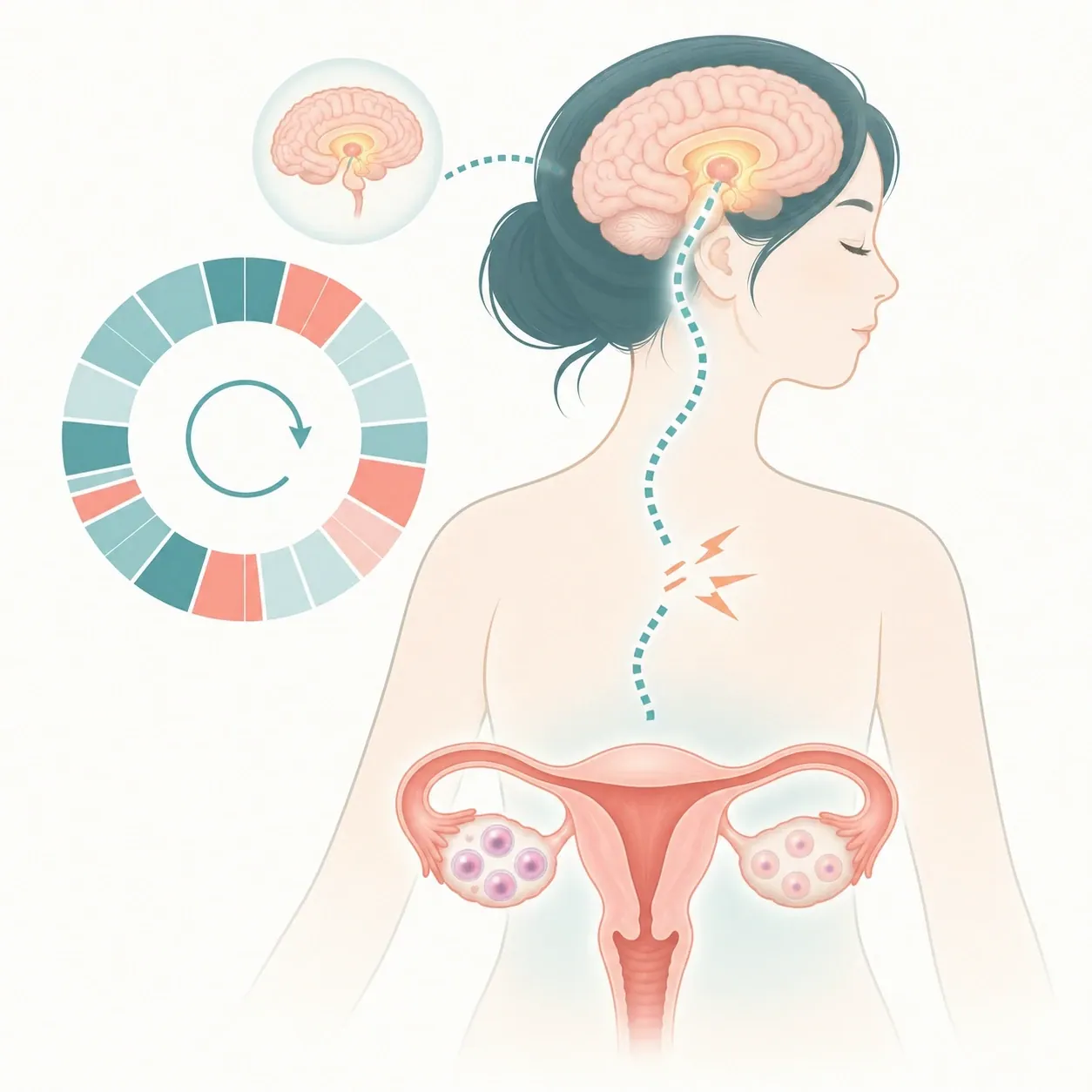
이런 증상이 있나요?

- 생리 주기가 35일보다 길어 두세 달에 한 번 한다
- 생리가 21일도 안 되어 한 달에 두 번 오기도 한다
- 다음 생리가 언제 올지 짐작할 수 없다
- 생리가 늦어지면 냉이 늘고 아랫배가 묵직하다
- 바쁘거나 스트레스를 받은 달에 주기가 크게 흐트러진다
- 생리량이 갑자기 줄거나 늘었다
진단은 생리 시작일을 서너 달 기록하는 것에서 시작합니다. 산부인과에서 임신 여부를 먼저 확인하고, 초음파로 자궁과 난소를, 피 검사로 갑상선, 프로락틴, 난소 호르몬을 봅니다. 다낭성난소증후군, 갑상선 질환, 자궁근종 같은 원인이 있으면 그 질환을 함께 치료합니다.
생리불순은 왜 생기나요?
- 스트레스: 생리불순 1.46배
- 우울감: 생리불순 2.07배
- 하루 5시간 이하 수면: 3개월 넘게 생리가 없는 심한 불규칙 2.67배
- 무리한 다이어트나 급격한 체중 변화
- 다낭성난소증후군, 갑상선 질환
- 초경 직후, 폐경 무렵처럼 호르몬이 바뀌는 시기
생리불순의 가장 뚜렷한 요인은 스트레스입니다. 우리나라 여성을 분석한 연구에서 스트레스를 많이 느끼면 1.46배, 우울하면 2.07배 생리가 불규칙했습니다[2]. 잠도 중요해서 하루 5시간 이하로 자면 3개월 넘게 생리를 하지 않는 심한 불규칙이 2.67배 많았습니다[4]. 해움한의원은 스트레스로 자율신경이 긴장하면 피가 머리와 가슴으로 쏠리고 아랫배는 차가워져 자궁과 난소가 제 일을 하기 어려워진다고 봅니다.
생리불순은 그 자체보다 몸이 보내는 신호로 봐야 합니다. 젊을 때 생리 주기가 40일 이상이거나 너무 불규칙했던 여성은 2형 당뇨병이 2.08배 많았고[5], 이란 여성을 15년간 추적한 연구에서도 당뇨병 위험이 2.01배 높았습니다[6].
생리불순의 표준 치료
표준 치료는 원인 질환을 먼저 치료하는 것입니다. 원인 질환이 없고 임신 계획도 없다면 경구피임약이나 황체호르몬제로 주기를 맞추거나 생리를 일으킵니다. 임신을 원하면 배란유도제를 씁니다.
호르몬제로 오는 생리는 약이 만든 주기입니다. 약을 끊으면 다시 들쑥날쑥해지는 분이 많은 이유는 주기를 흐트러뜨린 스트레스, 수면 부족, 냉증, 체중 변화가 그대로이기 때문입니다. 한의학 치료는 바로 이 바탕을 다스립니다.
다낭성난소증후군 여성에서는 전침 치료로 월경 횟수가 한 달 0.28회에서 0.69회로 늘었습니다[7]. 생리불순 전체를 대상으로 한 한약 연구는 아직 적어 추가적인 연구가 필요합니다.
해움한의원은 이렇게 치료합니다

해움한의원은 약으로 생리를 맞추는 데서 그치지 않고, 스스로 규칙적인 주기를 되찾을 수 있게 몸의 바탕을 찾아 치료합니다.
1단계. 주기가 흐트러진 원인을 가립니다
생리 기록과 생리량, 체중 변화, 식사와 수면, 스트레스를 자세히 살펴봅니다. 산부인과 검사가 필요하면 먼저 안내해 드립니다. 심박변이도와 적외선 체열검사로 자율신경의 균형과 아랫배의 냉증을 확인합니다.
2단계. 긴장을 풀고 아랫배를 데웁니다
침과 뜸으로 자율신경의 긴장을 풀고 아랫배와 골반의 순환을 돕습니다. 생리 주기에 맞춰 치료 시기를 정합니다.
3단계. 유형에 맞춰 바탕을 다스립니다
체질과 상태에 맞춰 한약을 짓습니다.
4만 건의 처방 사례가 말해주는, 한방 맞춤 치료의 힘




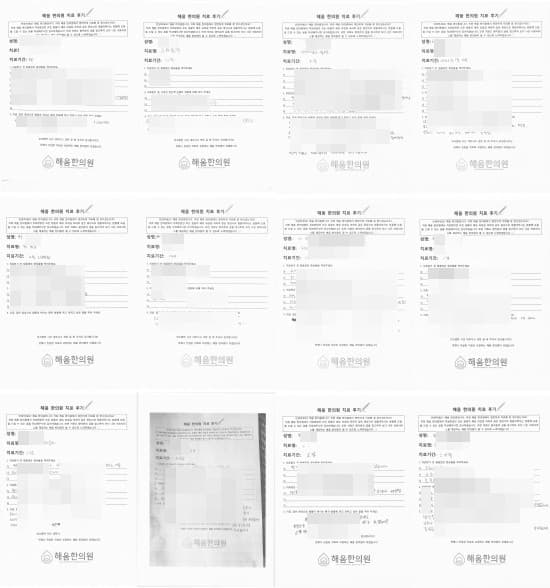
생리불순 치료후기 총 6건
환자분들이 남긴 치료후기입니다. 본문은 로그인 후 보실 수 있습니다.
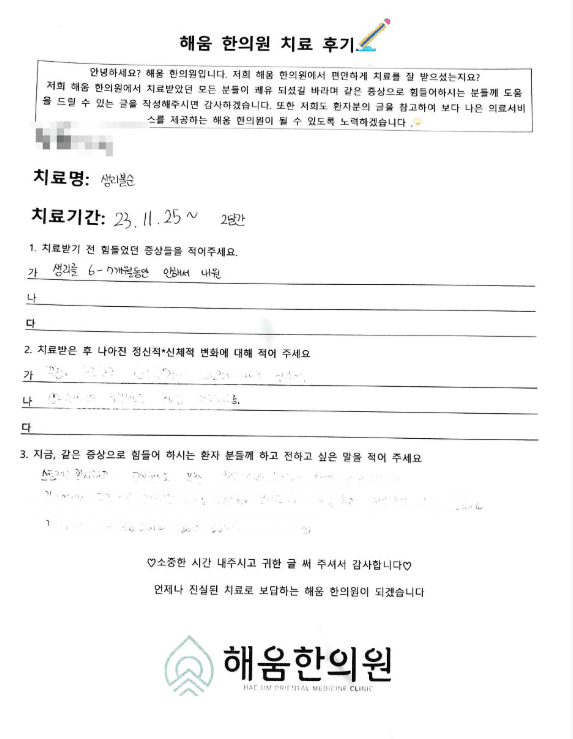
6개월간 생리를 안해서 내원하신 생리불순
2024. 06. 08.
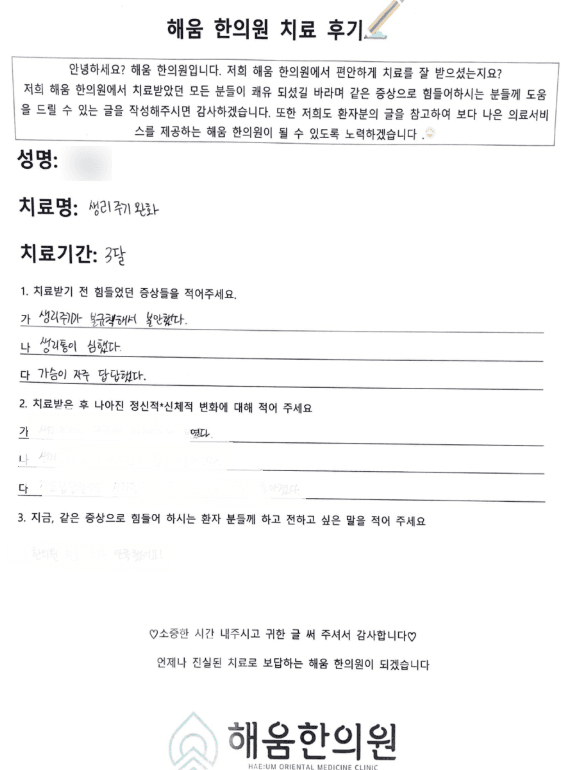
안하던 생리를 3일만에 시작했어요! 생리통 생리불규칙 무월경 몸이 가뿐해졌다는 환자 사례
2023. 12. 23.
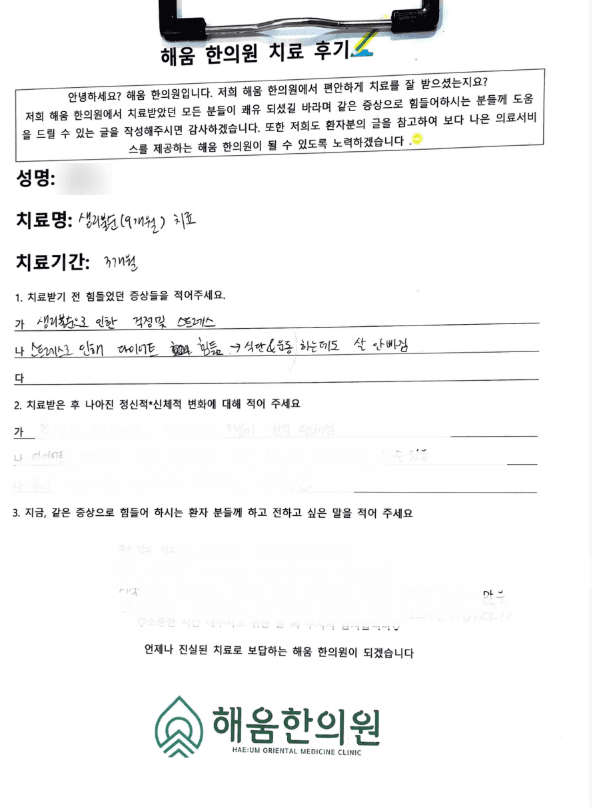
잘못된 다이어트로 9개월동안 안하던 생리, 3주만에 다시 시작한 환자 사례
2021. 11. 05.
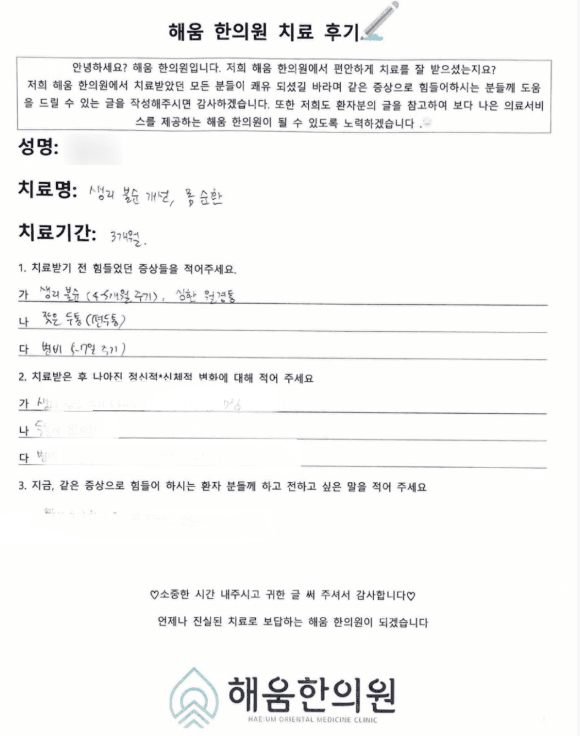
다낭성난소증후군 pcos로 인한 생리불순, 다이어트와 함께
2021. 10. 16.
 관련 후기
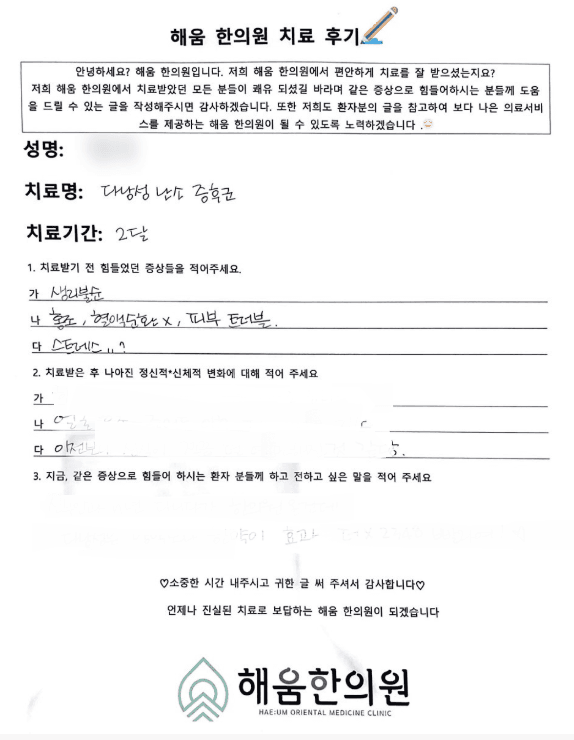
생리전증후군인가요? 진통제를 하루 8알씩.. 심각한 생리통 편두통 변비 한약 먹고 좋아진 사례
2023. 12. 13.
 관련 후기
이노시톨부작용 여드름으로 고생하던 다낭성증후군 PCOS 환자, 한약 치료로 3개월만에 해결
2023. 12. 12.
생리불순, 누가 진료하나요?
담당 의료진
대표원장 박재은

“병이 아니라 그 뒤의 사람을 봅니다”
경희대학교 한의과대학에서 석사·박사 과정을 마쳤습니다. 심리상담사 1급 자격과 4만 건 이상의 한약 처방 경험을 바탕으로 진료합니다.
의료진 소개 더보기생리불순, 자주 묻는 질문
생리가 며칠 늦으면 생리불순인가요?
생리불순을 그냥 두면 어떻게 되나요?
피임약을 먹고 있는데 한약을 같이 먹어도 되나요?
청소년도 치료가 필요한가요?
치료 기간은 얼마나 걸리나요?
생활에서 어떻게 관리해야 하나요?
해움한의원에서 생리불순을 진료하나요?
생리불순으로 내원하려면 어떻게 하나요?
생리불순에 관해 알아두면 좋은 정보
5건생리불순과 관련해 정리한 건강정보입니다.
생리통은있는데생리를안해요, 배는 아픈데 생리가 시작되지 않는 이유
“분명 생리할 것처럼 아픈데 왜 시작을 안 할까요?”생리 예정일이 다가오면서 아랫배가 묵직하고 허리까지 뻐근합니다.평소 생리 전에 나타나던 것과 비슷해서 곧 시작하겠거니 생각했는데 며칠이 지나도 생리가 나오지 않습니
생리늦어질때냉 왜 계속 나올까요? 생리 지연과 분비물 변화의 원인
“생리는 안 하는데 냉만 계속 나와요”평소라면 이미 생리를 시작했어야 하는데 예정일이 며칠이나 지났습니다.그런데 생리는 시작되지 않고 속옷에 묻는 냉은 오히려 평소보다 많아진 것처럼 느껴집니다.아랫배도 조금 묵직하고

생리주기느려짐, 28일이던 주기가 40일로 길어지는 이유는?
“원래 규칙적이었는데 생리 예정일이 자꾸 늦어져요”평소에는 28~30일 간격으로 생리를 했는데 어느 순간부터 주기가 조금씩 길어지는 경우가 있습니다.처음에는 3~4일 정도 늦어지더니 다음 달에는 일주일, 그다음에는

생리늦어질때혈자리 관원혈·조해혈, 지압보다 중요한 근본 원인
“이번 달 생리가 왜 안 하지?” 불안해지는 순간이 있습니다여성이라면 한 달에 한 번 찾아오는 생리 주기에민감해질 수밖에 없습니다.평소에는 비슷한 날짜에 생리를 하다가도갑자기 며칠씩 늦어지면 걱정이 먼저 듭니다.“혹

한달내내 생리할 때 치료방법, 자궁근종 때문일까요?
한달내내 생리하는 이유, 출혈이 멈추지 않는다면 확인하세요생리가 시작된 지 일주일이 지났는데도 출혈이 멈추지 않아 걱정하는 분들이 있습니다.처음에는 평소보다 생리가 조금 길어지는 것이라고 생각했지만, 2주가 지나고

이런 경우에는 미루지 말고 진료를 받으세요
아래 증상은 생리불순 말고도 다른 질환이 숨어 있을 수 있습니다. 산부인과 진료를 먼저 받으세요.
- 임신 가능성이 있는데 아랫배가 아프거나 피가 비친다: 응급실
- 생리 양이 갑자기 많아져 한 시간에 패드를 한 장 이상 적시거나 어지럽다
- 생리가 3개월 넘게 없다
- 폐경 뒤에 다시 피가 비친다
- 생리를 하지 않는데 젖이 나오거나 두통, 시야 이상이 있다
참고문헌 7편
[1]Bull JR, Rowland SP, Scherwitzl EB, Scherwitzl R, Danielsson KG, Harper J. Real-world menstrual cycle characteristics of more than 600,000 menstrual cycles. NPJ Digit Med. 2019;2:83. doi:10.1038/s41746-019-0152-7. PMID: 31482137.
초록 (Abstract)
The use of apps that record detailed menstrual cycle data presents a new opportunity to study the menstrual cycle. The aim of this study is to describe menstrual cycle characteristics observed from a large database of cycles collected through an app and investigate associations of menstrual cycle characteristics with cycle length, age and body mass index (BMI). Menstrual cycle parameters, including menstruation, basal body temperature (BBT) and luteinising hormone (LH) tests as well as age and BMI were collected anonymously from real-world users of the Natural Cycles app. We analysed 612,613 ovulatory cycles with a mean length of 29.3 days from 124,648 users. The mean follicular phase length was 16.9 days (95% CI: 10–30) and mean luteal phase length was 12.4 days (95% CI: 7–17). Mean cycle length decreased by 0.18 days (95% CI: 0.17–0.18, R2 = 0.99) and mean follicular phase length decreased by 0.19 days (95% CI: 0.19–0.20, R2 = 0.99) per year of age from 25 to 45 years. Mean variation of cycle length per woman was 0.4 days or 14% higher in women with a BMI of over 35 relative to women with a BMI of 18.5–25. This analysis details variations in menstrual cycle characteristics that are not widely known yet have significant implications for health and well-being. Clinically, women who wish to plan a pregnancy need to have intercourse on their fertile days. In order to identify the fertile period it is important to track physiological parameters such as basal body temperature and not just cycle length.
결과 (Results)
Study population: Totally, 17.4 million non-deviating BBT measurements and 1.4 million cycles were recorded by 124,648 anonymised users of the app. They were mostly residents of Sweden, the UK and USA. Users had a mean age of 30.3 (range: 18–45) and mean BMI of 23.6 (range: 15–50). 80% started using the app with the stated intention to prevent a pregnancy and recorded an average of 8.5 cycles (5.0 ovulatory) in the study. In all, 20% started using the app to plan a pregnancy and they recorded an average of 9.0 cycles (5.6 ovulatory) in the study.
Cycle selection: Out of 1.4 million cycles recorded by all eligible users, 3182 cycles were excluded due to pregnancy and 1886 were excluded due to being outside the 10–90 day accepted length range. Less than 1% of cycles were longer than 50 days in length. Totally, 665,603 cycles in which ovulation was not detected were excluded, of which 75% had valid temperatures entered on less than 50% of the days, which partly explains why the algorithm was unable to assign an estimated day of ovulation (EDO). An EDO was assigned in 724,134 cycles, of which 612,613 (85%) were included in the study due to having valid temperature entries entered on at least 50% of the days.
Validation of estimated day of ovulation: The distributions of the follicular and luteal phase lengths across the study population are used to validate the app’s algorithm EDO since there is good clinical data on the expected distributions of both. We compared the distribution of follicular and luteal phase lengths in our sample of 612,613 cycles to two reference data sets: a sample of 688 cycles obtained by Baird et al. and a sample of 327 cycles obtained by Lenton et al. (Supplementary Results). The adjusted phase length distribution is a close fit to that of Baird et al. and has a slightly higher fraction of short luteal phases than that of Lenton et al.
Cycle characteristics by cycle length: Table 1 lists the mean cycle lengths, follicular phase lengths, luteal phase lengths and bleed lengths with 95% confidence intervals (CI) in cohorts of cycles by cycle length (n = 612,613). Totally, 81,605 cycles (13%) were 28 days long and these cycles had mean follicular and luteal phase lengths of 15.4 and 12.6 days, respectively. Compared to the 560,078 normal length cycles (21–35 days), very short cycles had shorter bleed lengths by 0.5 days or 12% (95% CI: 0.4–0.5 days). Very long cycles had longer bleed lengths by 0.2 days or 6% (95% CI: 0.2–0.3 days). The very short cycles had shorter follicular phase by 5.4 days or 34% (95% CI: 5.3–5.5 days) and shorter luteal phases by 4.4 days or 35% (95% CI: 4.3–4.5 days). The very long cycles had longer follicular phase by 11.0 days or 66% (95% CI: 10.9–11.0 days) and longer luteal phases by 0.6 days or 5% (95% CI: 0.5–0.6 days). Less than 1% of cycles were longer than 50 days.
Cycle characteristics by user age: Table 2 lists the mean cycle length, follicular phase length, luteal phase length, bleed length and per-user cycle length variation in cohorts of cycles by user age (n = 612,613). Cycle length decreased with increasing age with a mean difference of 2.9 days or 10% (95% CI: 2.9–3.0) between the youngest and oldest cohorts. The bleed length reduced slightly with age with a mean difference of 0.5 days or 12% (95% CI: 0.4–0.5) between the youngest and oldest cohorts. Per-user cycle length variation reduced by 0.5 days or 20% (95% CI: 0.4–0.6 days) between the youngest and oldest cohorts. The follicular phase length became shorter with age with a mean difference of 3.2 days or 20% (95% CI: 3.2–3.3 days) between the youngest and oldest cohorts. The luteal phase length varied very little between age cohorts.
Figures 1–4, respectively, show mean cycle length, follicular phase length, luteal phase length and per-user cycle length variation against age with error bars corresponding to 95% CI. Each point is the mean value for cycles from users of equal age and the points are labelled with the number of users. In Figs 1 and 2, linear regressions are fitted in the age range 25–45 years with 95% CI shaded in pink. Age is negatively correlated with cycle length (slope = −0.176, 95% CI: −0.168 to −0.183, R2 = 0.994) and follicular phase length (slope = −0.194, 95% CI: −0.186 to −0.202, R2 = 0.987). Mean cycle length and follicular phase length in cycles from users aged 18–24 did not fit the linear regressions. In Fig. 3, there were no significant differences between luteal phase length with age. In Fig. 4, a linear regression is fitted to the per-user cycle length variation in the age range 25–40 years with 95% CI shaded in pink. Age is negatively correlated with the per-user cycle length variation (slope = −0.060, 95% CI: −0.055 to −0.066, R2 = 0.975). Below age 25 there is little change in mean cycle length variation, but the large confidence intervals suggest that some users have a large cycle length variation. Above age 40 the variation increased markedly to its highest level of 3.1 days at age 45.
Cycle characteristics by user BMI: Table 3 lists the mean cycle length, follicular phase length, luteal phase length and bleed length in cohorts of cycles by user BMI (n = 612,613). The median cohort was cycles from women with normal BMI (18.5–25). Underweight women (BMI 15–18.5) had a longer mean bleed length by 0.2 days or 5% (95% CI: 0.18–0.22 days) and morbidly obese women (BMI over 35) had higher cycle length variation by 0.4 days or 14% (95% CI: 0.3–0.5 days) and longer follicular phase length by 0.9 days or 5% (95% CI: 0.8–1.0 days), than women in the ‘healthy weight’ range (BMI 18.5–25). No other clinically significant differences between BMI cohorts were observed. Figure 5 shows the mean per-user cycle length variation against BMI with error bars corresponding to 95% CI. In the BMI range 18–35 the cycle length variation is flat and above a BMI of 35 it increases although the confidence intervals are very large.
원문 발췌 · Bull JR, Rowland SP, Scherwitzl EB, Scherwitzl R, Danielsson KG, Harper J, NPJ Digit Med 2019 · CC BY 4.0 라이선스에 따라 수정 없이 인용했습니다(본문 속 인용 번호는 생략).
[2]Jung EK, Kim SW, Ock SM, Jung KI, Song CH. Prevalence and related factors of irregular menstrual cycles in Korean women: the 5th Korean National Health and Nutrition Examination Survey (KNHANES-V, 2010-2012). J Psychosom Obstet Gynaecol. 2018;39(3):196-202. doi:10.1080/0167482x.2017.1321631. PMID: 28472893.
요약 국민건강영양조사에 참여한 19~40세 여성 3,194명을 분석한 연구입니다. 생리 주기가 불규칙한 여성은 14.3%였습니다. 스트레스를 많이 느끼면 1.46배, 우울하면 2.07배 불규칙할 가능성이 높았고, 체질량지수도 관련이 있었습니다. 출산력이나 대사 질환보다 스트레스가 가장 뚜렷한 요인이었습니다.원문은 출판사 저작권 자료로, 위 링크에서 확인하실 수 있습니다.
[3]Nam GE, Han K, Lee G. Association between sleep duration and menstrual cycle irregularity in Korean female adolescents. Sleep Med. 2017;35:62-66. doi:10.1016/j.sleep.2017.04.009. PMID: 28619183.
요약 국민건강영양조사의 여자 청소년 801명을 분석한 연구입니다. 15%가 생리 주기가 불규칙했습니다. 잠이 짧을수록 불규칙한 비율이 높았고, 하루 5시간 이하로 자는 학생은 8시간 이상 자는 학생보다 생리불순 위험이 뚜렷하게 높았습니다.원문은 출판사 저작권 자료로, 위 링크에서 확인하실 수 있습니다.
[4]Kim T, Nam GE, Han B, Cho SJ, Kim J, Eum DH, et al. Associations of mental health and sleep duration with menstrual cycle irregularity: a population-based study. Arch Womens Ment Health. 2018;21(6):619-626. doi:10.1007/s00737-018-0872-8. PMID: 29909508.
요약 국민건강영양조사의 19~49세 여성 4,445명을 분석한 연구입니다. 스트레스가 높으면 1.33배, 우울하면 1.56배 생리가 불규칙했습니다. 하루 5시간 이하로 자면 3개월 넘게 생리가 없는 심한 불규칙이 2.67배 많았고, 잠이 짧으면서 스트레스까지 높으면 1.96배였습니다.원문은 출판사 저작권 자료로, 위 링크에서 확인하실 수 있습니다.
[5]Solomon CG, Hu FB, Dunaif A, Rich-Edwards J, Willett WC, Hunter DJ, et al. Long or highly irregular menstrual cycles as a marker for risk of type 2 diabetes mellitus. JAMA. 2001;286(19):2421-2426. doi:10.1001/jama.286.19.2421. PMID: 11712937.
요약 미국 간호사 10만 1,073명을 8년간 추적한 연구입니다. 18~22세 때 생리 주기가 40일 이상이거나 너무 불규칙했던 여성은 26~31일이던 여성보다 2형 당뇨병이 2.08배 많았습니다. 비만이 아닌 여성에서도 위험이 높았습니다.원문은 출판사 저작권 자료로, 위 링크에서 확인하실 수 있습니다.
[6]Rostami Dovom M, Ramezani Tehrani F, Djalalinia S, Cheraghi L, Behboudi Gandavani S, Azizi F. Menstrual Cycle Irregularity and Metabolic Disorders: A Population-Based Prospective Study. PLoS One. 2016;11(12):e0168402. doi:10.1371/journal.pone.0168402. PMID: 27992506.
초록 (Abstract)
The regularity of menstrual cycles is considered an indicator of women’s reproductive health. Previous studies with a cross-sectional design have documented the relationship between menstrual cycle irregularities, insulin-resistance and the future risks for metabolic disorders. Limited data documented by prospective studies can lead to premature conclusions regarding the relationship between menstrual cycle irregularities and other conditions influencing women’s health. The present study therefore, using a prospective design aimed to assess the risk of metabolic disorders in women with a history of irregular menstrual cycles, was based on the data gathered from the Tehran Lipid and Glucose study (TLGS) an ongoing prospective cohort study initiated in 1999. Participants of the current study were 2128 women, aged between 18–49 years, followed for 15 years. Based on their menstrual cycles, the women were divided into two groups: (i) women with regular menstrual cycles (n = 1749), and (ii) those with irregular menstrual cycles (n = 379). The proportional COX regression model was used to compare hazard ratios (HRs) between the groups for the proposed events, including diabetes mellitus (DM), pre-diabetes (pre-DM), hypertension (HTN), pre-hypertension (pre-HTN) and dyslipidemia. It was found that during a 15-year follow up, there were 123 cases of DM, 456 cases of pre-DM, 290 cases of HTN, 481 cases of pre-HTN, and 402 cases of dyslipidemia. Compared to those with regular cycles, women with irregular menstrual cycles were found to have an increased risk for DM2 (age adjusted Hazard Ratios (HRs), 2.01; 95% confidence intervals (CI:1.59–3.50), the increased risk for DM, associated with irregular cycles remained significant after the adjustment for Body Mass Index (BMI), fasting blood sugar (FBS), family history of diabetes, and parity (HRS, 1.73; 95% CI: 1.14–2.64). There was no significant difference in the increased risk for pre-DM between the groups (age adjusted HRs, 1.33, 95% CI: 1.05–1.69). However, after the adjustment of BMI, FBS and family history of pre-DM, compared to those with regular menstrual cycles, irregular menstrual cycles showed an increased risk for pre-DM (HRs, 1.33; 95% CI: 1.05–1.69). No statistically significant difference was found in the increasing risk for other proposed events between the groups demonstrating that menstrual cycle irregularities could be considered a marker of metabolic disorders and a predisposing factor of the increased risk for diabetes mellitus and pre-diabetes in women with irregular menstrual cycles.
결과 (Results)
The median duration of the follow up for cohort members was 12.7 years. We documented proposed events in this population, including 123 cases of DM, 290 cases of HTN, 402 cases of dyslipidemia, 456 cases of pre-diabetes and 481 cases of pre-HTN. Incidence rates for events are displayed in Fig 1.
Participants were 2128 women. Ofwhom,1749 women had regular menstrual cycles and 379 had irregular menstrual cycles; mean (±SD) age of participants was 29.45 ± 9.16 years and 27.02 ± 8.62 years, respectively (Table 1).
Group1 Participants were more educated (p<0.01), were mostly married and had a higher mean parity (p<0.01), compared to Group 2.; women with irregular menstrual cycles showed a higher triglyceride levels and a higher prevalence of dyslipidemia at baseline, compared to those who had regular menstrual cycles(p<0.05).
Statistically significant differences based on the Kaplan-Miere survival curves between the study groups with regard to DM and pre-DM were observed (Figs 2 and 3).
Compared to women with regular menstrual cycles, the age adjusted hazard ratio for DM events in women with irregular menstrual cycles was 2.01, 95% CI = 1.59–3.50, and for pre-DM events this was 1.24, 95% CI =.099–1.57.
Multivariate-adjusted HRs for DM and pre-DM were 1.73, 95% CI = 1.14–2.64 and 1.33, 95% CI = 1.05–1.69, respectively. After multivariate adjustment, the hazard ratio of DM between the groups decreased, but remained significant (p<0.05) (Table 2).
There was no statistically significant difference between HRs of pre-DM between the groups before incorporation of the adjustment model, whereas these HRs of pre-DM significantly increased in women with irregular menstrual cycles after following it.
Incidence rates of dyslipidemia, HTN, and pre-HTN did not differ significantly between the groups; older women with higher levels of BMI and SBP were mainly at risk for future hypertension (p<0.001). However, menstrual cycle status had no effects on risk of future hypertension (Table 2). It was also shown that the women with higher levels of TG, LDL, and cholesterol had higher risk for dyslipidemia, whereas menstrual cycle status had no effects on the risk of future dyslipidemia; in addition, parity did not increase the risk for proposed events.
원문 발췌 · Rostami Dovom M, Ramezani Tehrani F, Djalalinia S, Cheraghi L, Behboudi Gandavani S, Azizi F, PLoS One 2016 · CC BY 4.0 라이선스에 따라 수정 없이 인용했습니다(본문 속 인용 번호는 생략).
[7]Jedel E, Labrie F, Odén A, Holm G, Nilsson L, Janson PO, et al. Impact of electro-acupuncture and physical exercise on hyperandrogenism and oligo/amenorrhea in women with polycystic ovary syndrome: a randomized controlled trial. Am J Physiol Endocrinol Metab. 2011;300(1):E37-45. doi:10.1152/ajpendo.00495.2010. PMID: 20943753.
요약 다낭성난소증후군 여성 84명을 16주간 저주파 전침, 운동, 무치료로 나눈 무작위 연구입니다. 전침군의 월경 횟수는 한 달 0.28회에서 0.69회로 늘었고, 전침과 운동 모두 무치료보다 나았습니다.원문은 출판사 저작권 자료로, 위 링크에서 확인하실 수 있습니다.