
양천구 목동 만성기침 한의원
만성기침
감기도 아닌데 기침이 두 달 넘게 이어집니다. 엑스레이도, 폐 기능 검사도 정상이라는데 말을 하거나 찬 바람을 쐬면 목이 간질거리며 기침이 터집니다. 약을 바꿔 가며 먹어도 그때뿐인 만성기침입니다.
만성기침 한눈에 보기
- 만성기침은 8주 넘게 이어지는 기침으로, 우리나라 성인 약 2.6%가 겪습니다.
- 원인을 치료해도 낫지 않는 기침은 기침 신경이 예민해진 '기침 과민'으로 봅니다.
- 예민해진 목과 기관지, 지친 몸과 긴장을 함께 다스려야 기침이 가라앉습니다.
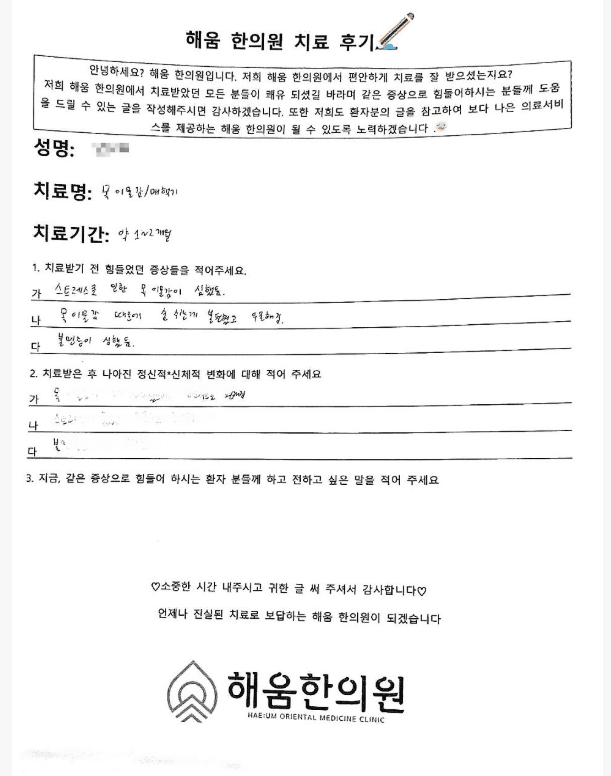
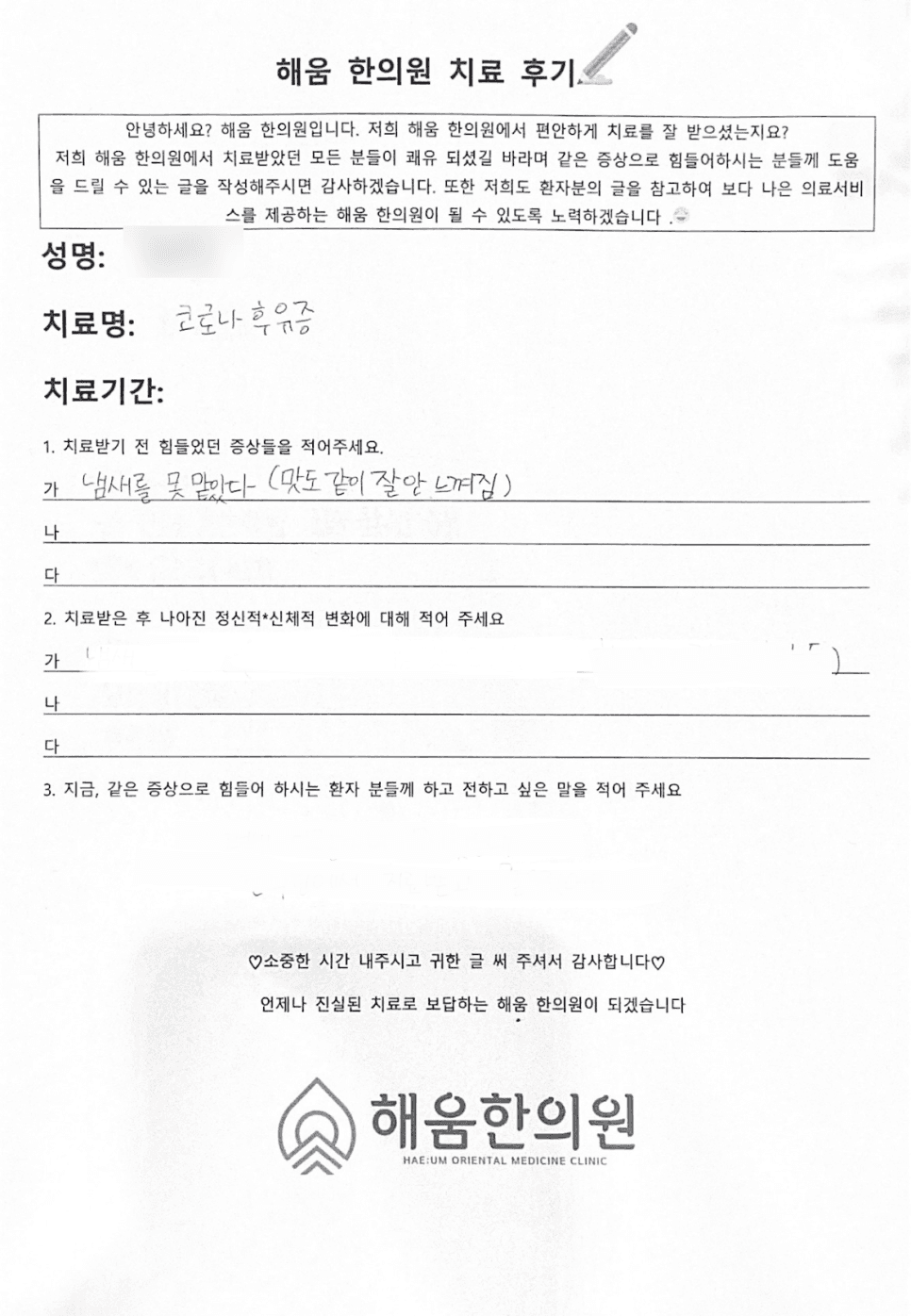
- 치료후기 6건
- 의료진 칼럼 1편
- 건강정보 2편
- 온라인 상담 1건
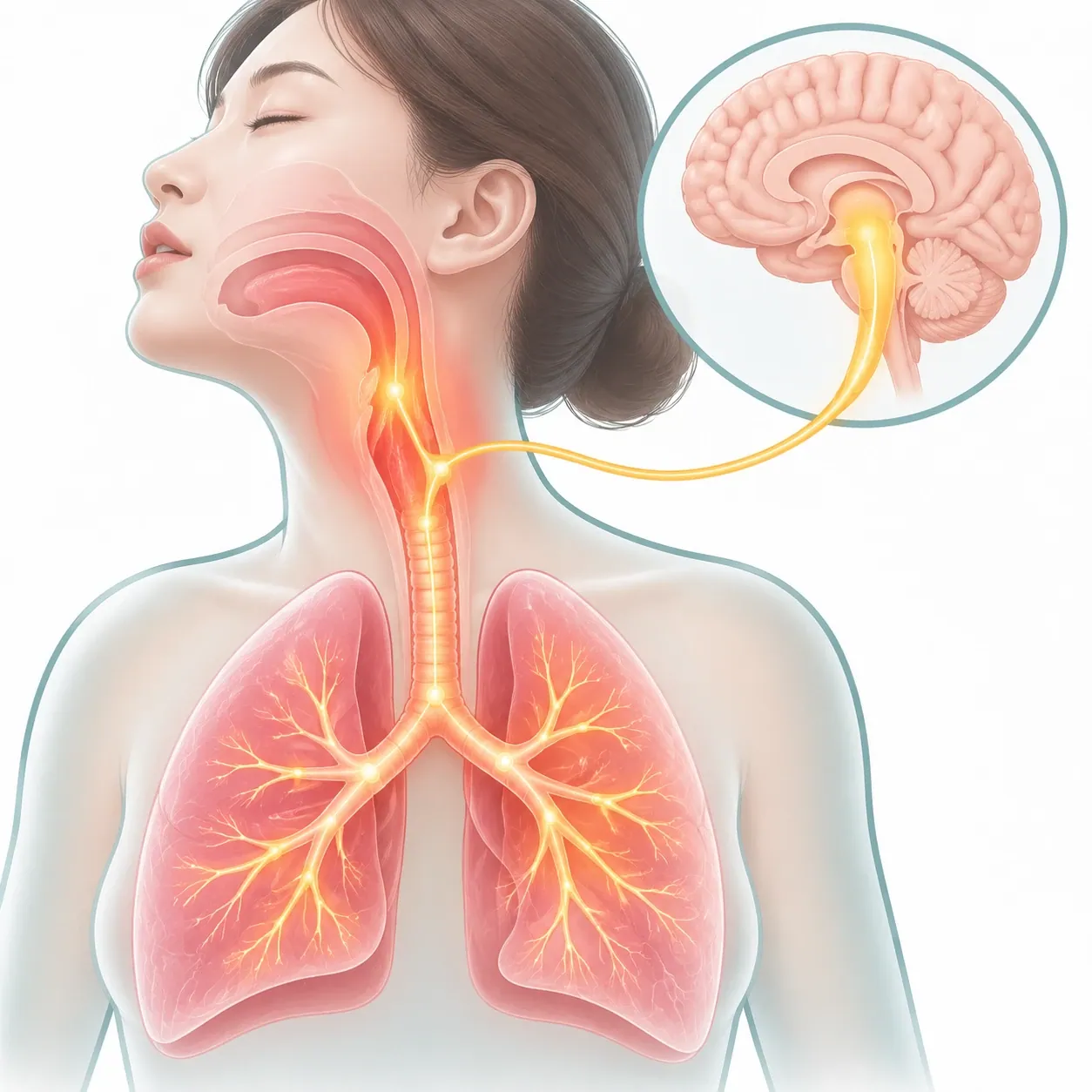
이런 증상이 있나요?
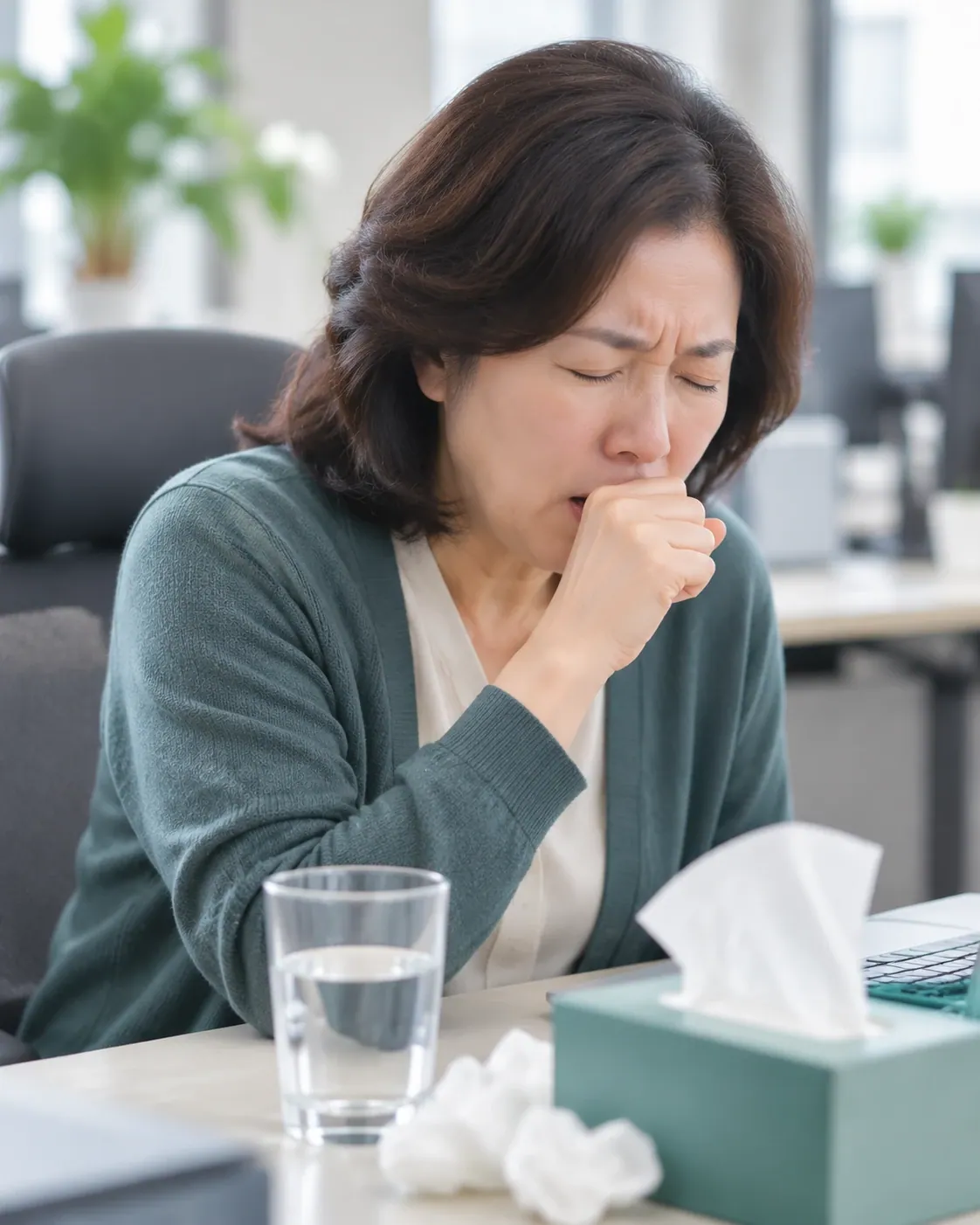
- 기침이 8주 넘게 이어진다
- 말을 하거나 웃을 때, 찬 바람이나 냄새에 기침이 터진다
- 목이 간질거리거나 무언가 걸린 느낌이 든다
- 콧물이 목 뒤로 넘어가 자주 헛기침을 한다
- 밤이나 새벽, 식사 뒤에 기침이 심하다
- 검사는 정상인데 약을 먹어도 그때뿐이다
진단은 흉부 엑스레이와 폐 기능 검사로 폐 질환과 결핵을 먼저 확인하는 데서 시작합니다. 그다음 흔한 원인인 후비루, 기침형 천식, 위식도 역류를 차례로 살핍니다. 필요하면 호기 산화질소 검사, 코 내시경, 위 내시경을 더합니다[3].
만성기침은 왜 생기나요?
- 콧물이 목 뒤로 넘어가는 후비루(비염, 축농증)
- 기침형 천식, 호산구 기관지염
- 위식도 역류, 인후두 역류
- 흡연과 만성 기관지염
- 혈압약(ACE 억제제) 같은 약물
- 감기·코로나 뒤 예민해진 기관지
원인이 무엇이든 만성 기침의 바탕에는 '기침 과민'이 있습니다. 기침을 일으키는 미주신경이 예민해져, 찬 공기나 향수, 말하기 같은 작은 자극에도 기침이 터집니다[3]. 그래서 원인을 치료한 뒤에도 기침이 남는 경우가 많습니다.
이 예민함은 몸 상태에 따라 오르내립니다. 잠을 못 자고 지친 날, 긴장한 날에 기침이 심해지는 경우를 진료에서 자주 봅니다. 신경이 쉬지 못하면 기침 신경도 함께 예민해지기 때문입니다.
만성기침의 표준 치료
원인을 찾아 치료하는 것이 먼저입니다. 후비루는 비염 약, 기침형 천식은 흡입 스테로이드, 역류는 위산 억제제를 쓰고, 원인 약물은 바꿉니다. 그래도 남는 '난치성 기침'에는 신경을 가라앉히는 약을 씁니다. 가바펜틴은 기침 관련 삶의 질을 높였지만 31%에서 부작용이 있었습니다[4]. 기침이 올라올 때 참는 호흡법을 익히는 말하기 치료도 기침 점수를 8.9점에서 4.6점으로 줄였습니다[5].
기침 신경을 막는 새 약(게파픽산트)도 나왔지만, 위약보다 기침 횟수를 15~19% 더 줄이는 정도였고 맛이 변하는 부작용이 흔했습니다[6]. 신경만 누르는 치료로는 부족한 분이 많습니다. 신경이 예민해진 바탕, 곧 건조하고 지친 목과 기관지, 쉬지 못하는 몸을 함께 다스려야 합니다. 한의학 치료는 이 바탕을 다스립니다.
관련 연구를 살펴보면, 한약 연구 80편을 모은 분석에서 일반 치료에 한약을 더하면 기침 정도와 기침 관련 삶의 질이 더 좋아지고 재발이 줄었습니다[7]. 침 관련 치료 연구 30편에서도 일반 치료에 더했을 때 기침 정도가 더 줄었습니다[8]. 위약과 비교한 연구는 적어 추가적인 연구가 필요합니다.
해움한의원은 이렇게 치료합니다

해움한의원은 기침만 누르지 않습니다. 기침을 일으키는 원인과 함께, 예민해진 목과 기관지, 쉬지 못하는 몸의 긴장을 함께 치료합니다.
1단계. 기침의 원인과 위험 신호를 가립니다
기침이 시작된 때와 심해지는 상황, 코와 위장 증상, 드시는 약과 받은 검사를 자세히 살펴봅니다. 엑스레이나 폐 기능 검사가 필요하면 먼저 안내해 드립니다.
2단계. 예민해진 목과 가슴을 가라앉힙니다
침과 약침으로 목과 가슴, 등의 긴장을 풀고 자율신경의 균형을 돕습니다. 기침이 올라올 때 참는 호흡법도 함께 알려 드립니다.
3단계. 유형에 맞춰 바탕을 다스립니다
코, 위장, 수면처럼 기침을 키우는 요인을 함께 관리합니다. 체질과 상태에 맞춰 한약을 짓습니다.
4만 건의 처방 사례가 말해주는, 한방 맞춤 치료의 힘



해움한의원 원장이 쓴 만성기침 칼럼

면역질환과 자율신경치료
오늘은 검사도 이상이 없고 치료가 안 되는, 이비인후과와 내과에서 다루는 면역 질환에 대한 내용입니다.
읽어보기

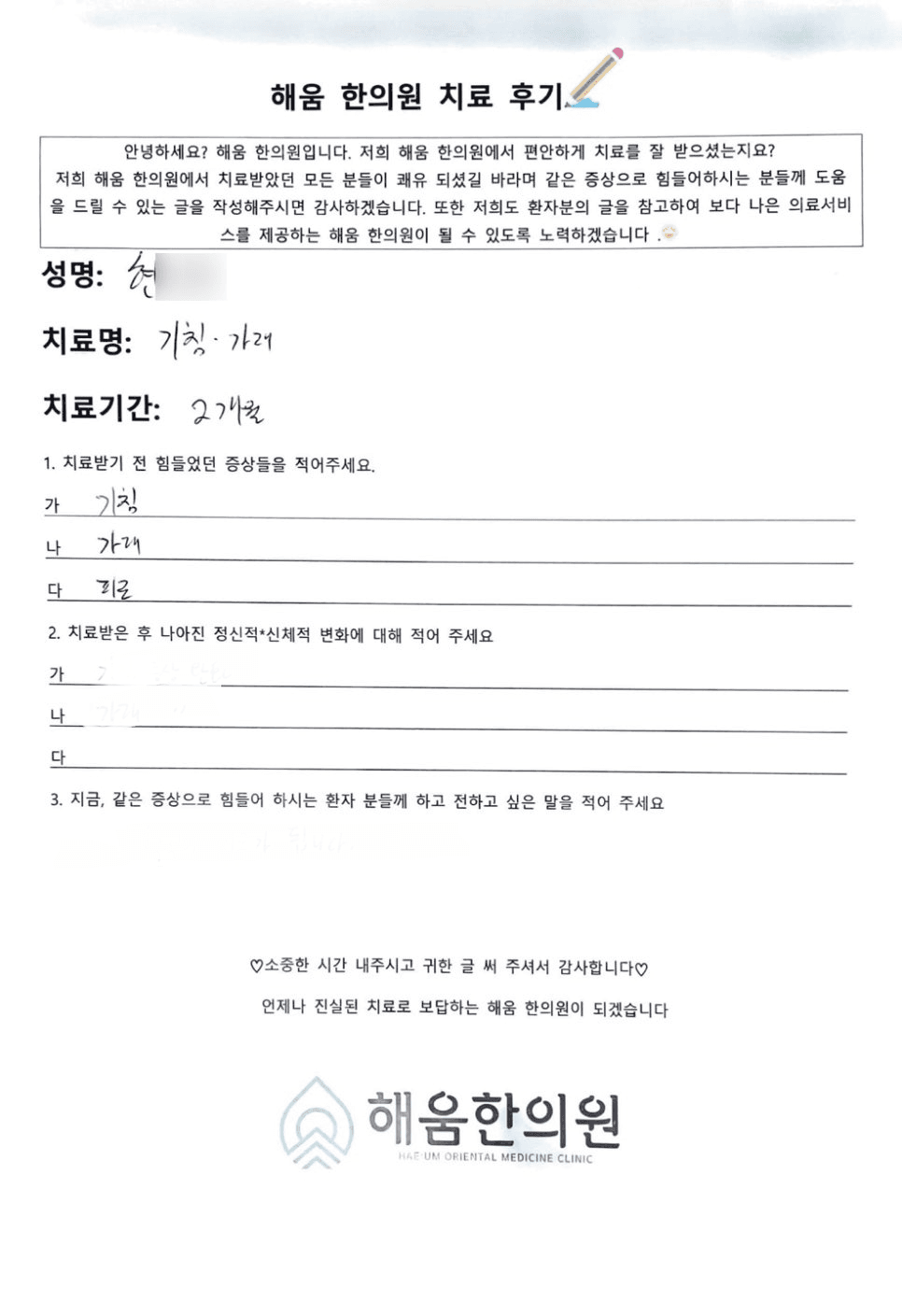
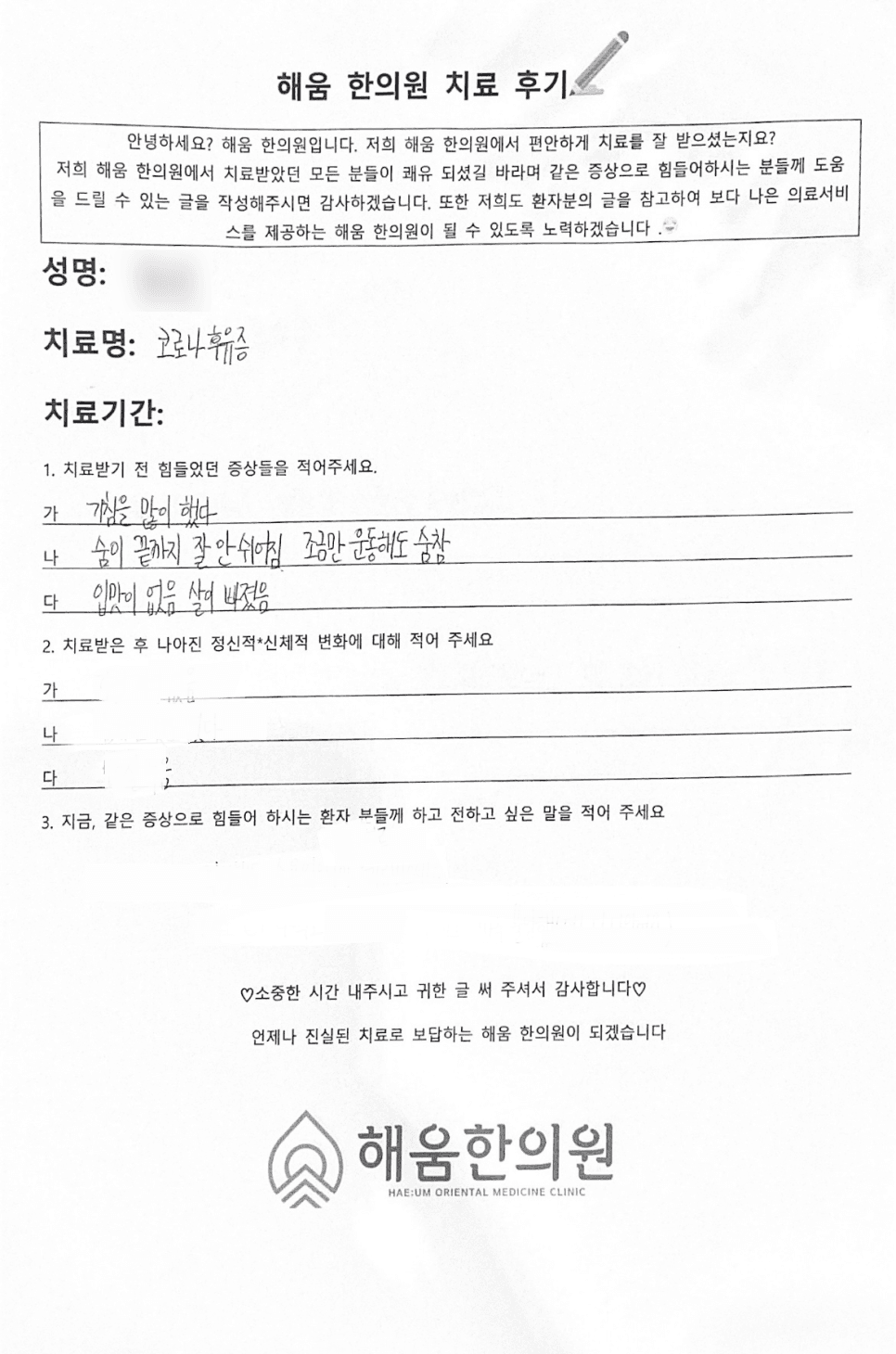
만성기침, 누가 진료하나요?
담당 의료진
대표원장 박재은

“병이 아니라 그 뒤의 사람을 봅니다”
경희대학교 한의과대학에서 석사·박사 과정을 마쳤습니다. 심리상담사 1급 자격과 4만 건 이상의 한약 처방 경험을 바탕으로 진료합니다.
의료진 소개 더보기만성기침, 자주 묻는 질문
만성기침은 왜 검사에서 이상이 없나요?
기침이 오래되면 폐가 나빠지나요?
호흡기내과 약과 한약을 같이 먹어도 되나요?
치료는 얼마나 걸리나요?
생활에서 무엇을 주의해야 하나요?
해움한의원에서 만성기침을 진료하나요?
만성기침으로 내원하려면 어떻게 하나요?
만성기침에 관해 알아두면 좋은 정보
2건만성기침과 관련해 정리한 건강정보입니다.
목이물감통증, 가래가 낀 느낌인데 검사상 이상이 없다면?
목에 가래가 낀 듯 답답한데, 왜 검사에서는 괜찮다고 할까요?목 안에 무언가 걸린 것처럼 답답합니다.가래가 있는 것 같아 자꾸 “켁켁” 기침을 하게 되고, 침을 삼켜도 시원하게 내려가지 않습니다.처음에는 감기나 기관

삼켜도 안 넘어가는 목이물감 , 매핵기 증상일 수 있습니다
“목에 뭐가 걸린 것 같은데… 안 내려가요”물을 마셔도기침을 해도계속 목에 뭔가 걸린 느낌이 드는 경우가 있습니다.“가래가 낀 것 같아요”“삼켜지지도 않고 뱉어지지도 않아요”이런 증상이 반복된다면단순한 목감기나 가래

이런 경우에는 미루지 말고 진료를 받으세요
아래 증상은 결핵, 폐암, 심부전 같은 다른 질환일 수 있습니다. 내과나 호흡기내과를 먼저 확인하세요. 숨이 심하게 차거나 피를 많이 토하면 바로 응급실(119)로 가세요.
- 가래에 피가 섞여 나온다
- 밤에 식은땀이 나고 몸무게가 빠진다
- 숨이 차거나 쌕쌕거리는 소리가 난다
- 담배를 피우는데 기침 양상이 달라졌다
- 음식을 삼킬 때마다 사레가 들린다
참고문헌 8편
[1]Kang MG, Song WJ, Kim HJ, Won HK, Sohn KH, Kang SY, et al. Point prevalence and epidemiological characteristics of chronic cough in the general adult population: The Korean National Health and Nutrition Examination Survey 2010-2012. Medicine (Baltimore). 2017;96(13):e6486. doi:10.1097/md.0000000000006486. PMID: 28353590.
요약 국민건강영양조사에 참여한 성인 1만 8,071명 분석입니다. 조사 시점에 8주 넘게 기침하던 만성 기침은 2.6%였고 65세 이상에서 더 흔했습니다. 기침하는 사람 중 1년 넘게 이어진 경우가 27.7%였습니다.원문은 출판사 저작권 자료로, 위 링크에서 확인하실 수 있습니다.
[2]Won HK, Lee JH, An J, Sohn KH, Kang MG, Kang SY, et al. Impact of Chronic Cough on Health-Related Quality of Life in the Korean Adult General Population: The Korean National Health and Nutrition Examination Survey 2010-2016. Allergy Asthma Immunol Res. 2020;12(6):964-979. doi:10.4168/aair.2020.12.6.964. PMID: 32935489.
요약 2010~2016년 국민건강영양조사에서 40세 이상 성인을 분석한 연구입니다. 만성 기침은 3.48%였고, 만성 기침이 있는 사람의 삶의 질 점수(EQ-5D)는 0.79로 없는 사람(0.86)보다 낮았습니다. 다른 질환을 고려해도 이 차이는 남았고, 65세 이상 여성에서 영향이 가장 컸습니다.원문은 출판사 저작권 자료로, 위 링크에서 확인하실 수 있습니다.
[3]Morice AH, Millqvist E, Bieksiene K, Birring SS, Dicpinigaitis P, Domingo Ribas C, et al. ERS guidelines on the diagnosis and treatment of chronic cough in adults and children. Eur Respir J. 2020;55(1):1901136. doi:10.1183/13993003.01136-2019. PMID: 31515408.
요약 유럽호흡기학회의 만성 기침 진료지침입니다. 만성 기침을 미주신경 감각이 예민해진 '기침 과민'으로 설명하고, 기침형 천식·호산구 기관지염은 소염 치료, 산이 아닌 역류는 위장 운동을 돕는 약으로 치료하도록 했습니다. 다른 치료에 듣지 않는 기침에는 저용량 모르핀, 가바펜틴·프레가발린 같은 신경 조절 약과 기침 억제 훈련(말하기 치료)을 제시했고, 가바펜틴 계열은 부작용으로 쓰기가 제한된다고 적었습니다.원문은 출판사 저작권 자료로, 위 링크에서 확인하실 수 있습니다.
[4]Ryan NM, Birring SS, Gibson PG. Gabapentin for refractory chronic cough: a randomised, double-blind, placebo-controlled trial. Lancet. 2012;380(9853):1583-1589. doi:10.1016/s0140-6736(12)60776-4. PMID: 22951084.
요약 8주 넘게 낫지 않는 난치성 기침 환자 62명에게 가바펜틴과 위약을 10주간 비교한 호주 연구입니다. 가바펜틴은 기침 관련 삶의 질 점수를 위약보다 더 올렸습니다. 부작용(메스꺼움, 피로 등)은 가바펜틴 군 31%, 위약 군 10%였습니다.원문은 출판사 저작권 자료로, 위 링크에서 확인하실 수 있습니다.
[5]Vertigan AE, Theodoros DG, Gibson PG, Winkworth AL. Efficacy of speech pathology management for chronic cough: a randomised placebo controlled trial of treatment efficacy. Thorax. 2006;61(12):1065-1069. doi:10.1136/thx.2006.064337. PMID: 16844725.
요약 약물 치료에도 낫지 않는 만성 기침 환자 87명을 언어치료사의 기침 조절 훈련 4회와 가짜 훈련으로 나눈 연구입니다. 훈련 군의 기침 점수는 8.9점에서 4.6점으로 줄었고, 연구진은 약에 듣지 않는 기침의 대안이 될 수 있다고 결론 내렸습니다.원문은 출판사 저작권 자료로, 위 링크에서 확인하실 수 있습니다.
[6]McGarvey LP, Birring SS, Morice AH, Dicpinigaitis PV, Pavord ID, Schelfhout J, et al. Efficacy and safety of gefapixant, a P2X3 receptor antagonist, in refractory chronic cough and unexplained chronic cough (COUGH-1 and COUGH-2): results from two double-blind, randomised, parallel-group, placebo-controlled, phase 3 trials. Lancet. 2022;399(10328):909-923. doi:10.1016/s0140-6736(21)02348-5. PMID: 35248186.
요약 1년 넘게 낫지 않거나 원인을 모르는 만성 기침 환자 2,044명을 대상으로 한 두 건의 3상 연구입니다. 신경 차단 약 게파픽산트 45mg 하루 두 번은 위약보다 하루 기침 횟수를 18.5%(12주), 14.6%(24주) 더 줄였고, 15mg 은 차이가 없었습니다. 가장 흔한 부작용은 맛 이상으로, 미각 변화가 16~21%에서 나타났습니다. 제약사(MSD)가 지원했습니다.원문은 출판사 저작권 자료로, 위 링크에서 확인하실 수 있습니다.
[7]Lee B, Kwon CY, Suh HW, Kim YJ, Kim KI, Lee BJ, et al. Herbal medicine for the treatment of chronic cough: a systematic review and meta-analysis. Front Pharmacol. 2023;14:1230604. doi:10.3389/fphar.2023.1230604. PMID: 37920213.
초록 (Abstract)
Objectives: Chronic cough is a frequent condition worldwide that significantly impairs quality of life. Herbal medicine (HM) has been used to treat chronic cough due to the limited effectiveness of conventional medications. This study aimed to summarize and determine the effects of HM on patients with chronic cough.
Methods: A comprehensive search of 11 databases was conducted to find randomized controlled clinical trials (RCTs) that reported the effects of HM for patients with chronic cough on 16 March 2023. The primary outcome was cough severity, and the secondary outcomes included cough-related quality of life, cough frequency, total effective rate (TER), and cough recurrence rate. The methodological quality of the included studies was assessed using the Cochrane risk of bias tool, and the certainty of the evidence for effect estimates was assessed using the Grading of Recommendations, Assessment, Development, and Evaluations tool.
Results: A total of 80 RCTs comprising 7,573 patients were included. When HM was used as an alternative therapy to conventional medication, there were inconsistent results in improving cough severity. However, HM significantly improved cough-related quality of life and TER and significantly lowered the cough recurrence rate compared with conventional medication. When used as an add-on therapy to conventional medication, HM significantly improved cough severity, cough-related quality of life, and TER and significantly lowered the recurrence rate. In addition, HM had a significantly lower incidence of adverse events when used as an add-on or alternative therapy to conventional medication. The subgroup analysis according to age and cause of cough also showed a statistically consistent correlation with the overall results. The certainty of the evidence for the effect of HM was generally moderate to low due to the risk of bias in the included studies.
Conclusion: HM may improve cough severity and cough-related quality of life, and lower the cough recurrence rate and incidence of adverse events in patients with chronic cough. However, due to the high risk of bias and clinical heterogeneity of the included studies, further high-quality placebo-controlled clinical trials should be conducted using a validated and objective assessment tool.
Systematic Review Registration: https://www.crd.york.ac.uk/prospero/display_record.php?ID=CRD42023418736, CRD42023418736.
결과 (Results)
3.1 Study selection and characteristics: A total of 2,958 articles were identified through the database search. After removing 546 duplicate articles, 1813 articles were excluded through the title and abstract review. As a result, 597 studies underwent full-text review, except for one study where the full text was not retrieved. After the full-text review, 517 studies were excluded for the following reasons: not an RCT (n = 444), not about chronic cough (n = 30), not reporting cough period (n = 33), not about HM (n = 1), using EATM as the control group intervention (n = 6), not reporting the outcome of interest (n = 2), and duplicate data (n = 1) (Supplementary Material S2). Finally, a total of 80 studies involving 7,573 participants were included in this review (;;;;;;;;;;;;;;;;;;;;;;;;;;;;;;;;;;;;;;;;;;;;;;;;;;;;;;;;;;;;;;;;;;;;;;;;;;;;;;; ) (Figure 1).
One study was conducted in Korea and published in English; the others were conducted in China and published in Chinese. The study setting of one study was a family planning service station, and the remaining settings were clinics. A total of 21 studies reported funding sources (;;;;;;;;;;;;;;;;;;;; ). A total of 27 studies were conducted on children (;;;;;;;;;;;;;;;;;;;;;;;;;; ), 3 studies included both children and adults (;; ), and the remaining 50 studies were conducted on adults. Only 30 studies (37.5%) described a cause for the cough, including post-respiratory infection in 5 studies (;;;; ); GERD (;; ), UACS (;; ), and unexplained chronic cough (;; ) in 3 studies each; and chronic bronchitis, CVA, and nonspecific chronic chough in 1 study each. There were also 13 studies targeting a mixed population, including patients with various causes of the cough (;;;;;;;;;;;; ). One study was a 3-arm RCT comparing HM plus conventional medication, HM, and conventional medication. The remaining studies were 2-arm RCTs, 33 comparing HM and conventional medication (;;;;;;;;;;;;;;;;;;;;;;;;;;;;;;;; ), 1 comparing HM and placebo HM, and the rest comparing HM plus conventional medication and conventional medication alone (Supplementary Material S3).
In the included studies, various HMs were used, and among them, Zhisou-san or its modified form was used the most frequently (13 studies) (;;;;;;;;;;;; ). A total of 154 botanical drugs were used, and as a result of analyzing the constituent botanical drugs of basic HM, four studies were excluded that used different prescriptions according to the pattern identification (;;; ). Among them, Glycyrrhiza glabra L. [Fabaceae; Glycyrrhizae Radix et Rhizoma] was used the most (61 studies), followed by Platycodon grandiflorus (Jacq.) A.DC. [Campanulaceae; Platycodonis Radix] (41 studies), Aster tataricus L.f. [Asteraceae; Asteris Radix et Rhizoma] (36 studies), Pinellia ternata (Thunb.) Makino [Araceae; Pinelliae Tuber] (29 studies), Citrus × aurantium f. deliciosa (Ten.) M. Hiroe [Rutaceae; Citri Unshius Pericarpium] (28 studies), Prunus armeniaca L. [Rosaceae; Armeniacae Semen] (27 studies), Poria cocos Wolf [Polyporaceae; Poria Sclerotium] (24 studies), Stemona tuberosa Lour. [Stemonaceae; Stemonae Radix] (22 studies), and Schisandra chinensis (Turcz.) Baill. [Schisandraceae; Schisandrae Fructus] (20 studies). As for the dosage of HMs, decoction was the most common (68 studies), followed by granule (5 studies) and oral liquid (3 studies). The HM administration duration varied from 1 week to 3 months, with 2 weeks being the most (34 studies), followed by 4 weeks (13 studies), 1 month (9 studies), and 1 week (7 studies). Twelve studies performed follow-ups after the end of the HM administration, and the follow-up period varied from 1 week to 1 year (Supplementary Material S4).
3.2 Risk of bias assessment: All the studies appropriately generated random sequences using random number tables or dice-throwing methods, and none of the studies mentioned allocation concealment. Except for one study comparing HM and placebo HM, no study conducted blinding of the participants and personnel. In addition, only two studies blinded the outcome assessors (; ). Four studies were evaluated as having a high risk of attrition bias by a per-protocol analysis (;;; ). All the studies were rated as having a low risk of reporting bias and other biases (Supplementary Material S5).
3.3 HM versus conventional medication: Although there was no significant difference in the SCS total score between the two groups (MD -0.07, 95% CI −0.31 to 0.18, I2 = 0%), each daytime (MD −0.34, 95% CI −0.59 to −0.08, I2 = 91%) or nighttime SCS score (MD −0.38, 95% CI -0.58 to −0.19, I2 = 86%) significantly decreased in the HM group compared with the conventional medication group (Table 1).
Cough-related quality of life, assessed by the LCQ total score, and physical, psychological, and social sub-items, were significantly increased after the treatment in the HM group compared with the conventional medication group (total: MD 2.32, 95% CI 0.04 to 4.61, I2 = 96%; physical items: MD 0.63, 95% CI 0.30 to 0.95, I2 = 75%; psychological items: MD 0.58, 95% CI 0.30 to 0.87, I2 = 71%; social items: MD 0.66, 95% CI 0.14 to 1.18, I2 = 88%). In addition, the TER, calculated according to the cough symptom improvement, was significantly higher in the HM group compared with the conventional medication group (RR 1.23, 95% CI 1.18 to 1.29, I2 = 35%), regardless of subgroup according to age. The funnel plot for the TER was asymmetric, and the result of the Egger’s test also suggested the risk of publication bias with a p-value of less than 0.05 (Supplementary Material S6). Cough recurrence rate was significantly lower in the HM group (RR 0.29, 95% CI 0.16 to 0.51, I2 = 0%) (Table 1).
Eighteen studies comparing HM and conventional medication reported the incidence of adverse events (;;;;;;;;;;;;;;;;; ). The incidence of adverse events was significantly lower in the HM group compared with the conventional medication group (RR 0.26, 95% CI 0.17 to 0.40, I2 = 0%). The funnel plot was symmetric, and the p-value of the Egger’s test was 0.917, suggesting that the risk of publication was low (Supplementary Material S6). When analyzing subgroups according to age, insignificant results were shown between the two groups in children, but adverse events were significantly lower in the HM group in adults and mixed populations (Table 1).
3.4 HM plus conventional medication versus conventional medication alone: Cough severity, evaluated by SCS daytime and nighttime scores, was significantly lower in the HM plus conventional medication group (SCS daytime: MD −0.53, 95% CI −0.67 to −0.39, I2 = 97%; SCS nighttime: MD −0.55, 95% CI −0.69 to −0.41, I2 = 95%), which was consistent with subgroup analyses according to age and cause of cough. In addition, cough severity, assessed by the 0–100 mm cough VAS, also significantly improved in the HM plus conventional medication group (MD −11.69, 95% CI −21.71 to −1.67, I2 = 98%) (Table 1).
Cough-related quality of life, assessed by the LCQ, was significantly improved in the HM plus conventional medication group compared with conventional medication alone (physical items: MD 0.88, 95% CI 0.71 to 1.05, I2 = 0%; psychological items: MD 0.62, 95% CI 0.46 to 0.77, I2 = 0%; social items: MD 0.81, 95% CI 0.44 to 1.17, I2 = 71%), and these results were consistent in the subgroup analysis according to age. One study targeted adults with chronic cough due to GERD. When HM was additionally administered with conventional medication (rabeprazole and mosapride citrate) for 8 weeks, cough severity and quality of life, assessed by the chronic cough impact scale, were significantly improved compared to conventional medication alone (p < 0.01). One study targeted pediatric patients with chronic cough due to UACS. When HM was additionally administered with conventional medication (budesonide nasal spray) for 12 weeks, cough frequency per day was significantly improved compared to conventional medication alone (p < 0.05).
The TER, according to the cough symptom improvement, was significantly higher in the HM plus conventional medication group (RR 1.18, 95% CI 1.16 to 1.21, I2 = 0%). The funnel plot for the TER was asymmetric, and the result of Egger’s test also suggested the risk of publication bias with a p-value of less than 0.05 (Supplementary Material S6). The cough symptom recurrent rate was significantly lower in the HM plus conventional medication group (RR 0.30, 95% CI 0.19 to 0.46, I2 = 0%), and the statistical significance was consistent when conducting a subgroup analysis according to age (Table 1).
Seventeen studies comparing HM plus conventional medication and conventional medication alone reported the incidence of adverse events (;;;;;;;;;;;;;;;; ), and it was found that adverse events were significantly lower in the HM plus conventional medication group (RR 0.46, 95% CI 0.25 to 0.87, I2 = 50%) (Table 1). The funnel plot was symmetric, and the p-value of Egger’s test was 0.433, suggesting the risk of publication was low (Supplementary Material S6).
3.5 HM versus placebo HM: Only one study compared HM versus placebo HM, and therefore, a meta-analysis was not possible. In the study, HM significantly improved cough severity, measured by the cough diary score and cough VAS, and cough-related quality of life, measured by LCQ, compared with the baseline. HM significantly improved daytime and total cough diary score compared to the placebo HM.
3.6 Certainty assessment: The certainty of the evidence for all meta-analysis outcomes comparing HM to conventional medication was moderate to low. The main reason for downgrading was the risk of bias of the included studies, inconsistency, imprecision, and publication bias. The certainty of the evidence for cough severity and cough-related quality of life when comparing HM plus conventional medication and conventional medication alone was moderate, downgraded by the risk of bias of the included studies. In this comparison group, the certainty of the evidence for TER and cough recurrence rate was low, and the certainty of the evidence for adverse event rates was very low (Table 1).
원문 발췌 · Lee B, Kwon CY, Suh HW, Kim YJ, Kim KI, Lee BJ, Lee JH, Front Pharmacol 2023 · CC BY 4.0 라이선스에 따라 수정 없이 인용했습니다(본문 속 인용 번호는 생략).
[8]Lee B, Kwon CY, Jeong YK, Ha NY, Kim KI, Lee BJ, et al. Acupuncture-related therapy for chronic cough: A systematic review and meta-analysis. Integr Med Res. 2025;14(1):101121. doi:10.1016/j.imr.2025.101121. PMID: 39944112.
요약 만성 기침에 침, 혈자리 한약 붙이기, 뜸을 쓴 무작위 연구 30편, 2,835명을 모은 우리나라 연구진의 분석입니다. 일반 치료에 침 관련 치료를 더하면 기침 정도와 기침 관련 삶의 질이 더 좋아졌고 부작용은 차이가 없었습니다. 근거 수준은 대체로 중간이었습니다.원문은 출판사 저작권 자료로, 위 링크에서 확인하실 수 있습니다.